



Why This Matters to Distributors: IBC is turning its member sourcing program into a digital marketplace to help independent distributors recapture $8 million to $10 million in annual purchases now going to larger competitors, with plans to connect to other distribution marketplaces.
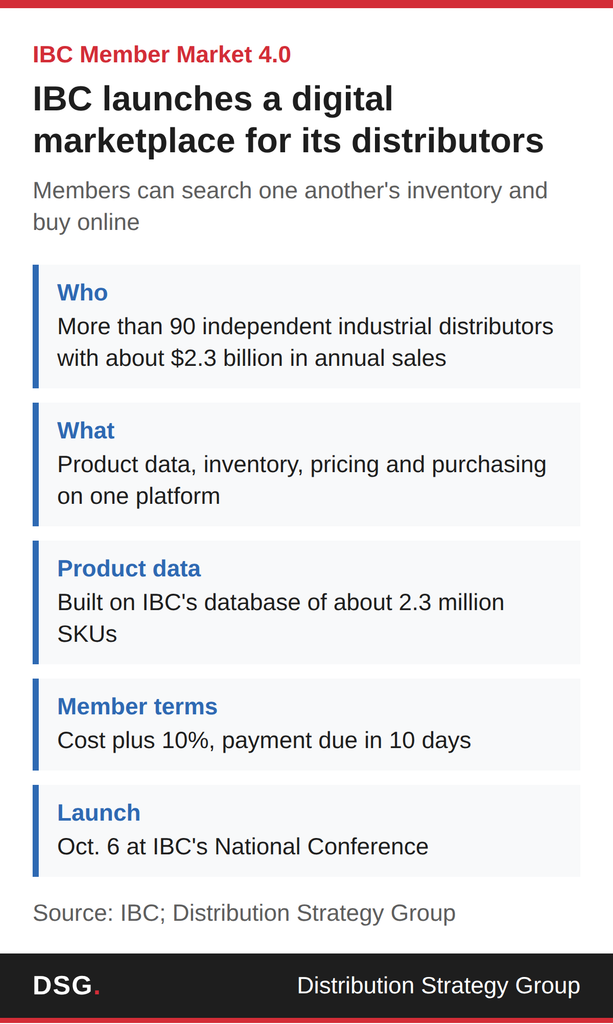
IBC has launched a new digital marketplace that will allow its industrial distributor members to search one another’s inventory, access detailed product information, and complete purchases through a common ecommerce platform. IBC is an industrial buying group and provider of maintenance, repair, operations, and production supply-chain services. Its network includes more than 90 mid-sized independent distributors representing about $2.3 billion in annual sales.
The organization provides members with group purchasing programs, technology, national accounts, and other services designed to help independent distributors compete in the industrial market. The new marketplace, called Member Market 4.0, represents a significant expansion of a member-to-member sourcing program IBC has operated in various forms since 2001.
IBC estimates its members spend $8 million to $10 million annually with large industrial supply distributors to fill customer orders for products they do not stock themselves. Member Market 4.0 is designed to redirect more of that purchasing to other member distributors while making it easier to locate products and complete transactions digitally.
“If we’re able to keep those dollars inside the group and help a member with new business as a result, that’s a plus,” IBC president and CEO Ron Nuñez told Distribution Strategy Group.
IBC’s existing Member Market allows distributors to identify other members carrying a particular brand or product. Member Market 4.0 will go further by combining product data, inventory availability, pricing and purchasing on a single platform. Member-to-member transactions will continue to operate under IBC’s longstanding cost-plus-10% model, with payment due in 10 days.
The marketplace will formally launch Oct. 6 during IBC’s National Conference. IBC signed an agreement for the underlying marketplace technology in June and has spent the past several months connecting participating distributors and their inventory systems. Nuñez asked that the marketplace technology provider not be publicly identified.
Member Market dates to 2001, when IBC maintained member inventory information on a spreadsheet. The organization later moved the program online, allowing distributors to search for other members carrying brands, but the system remained heavily dependent on members manually updating inventory information.
A distributor might indicate, for example, that it carried a high, medium, or low level of inventory from a manufacturer. Another member searching for that brand could identify potential suppliers but would still have to contact the distributor and arrange the transaction separately. Nuñez said the existing Member Market receives about 30 to 40 searches a day, but its usefulness has been constrained by inventory information that can become outdated.
IBC began exploring a broader overhaul about 2½ years ago after a member asked the organization to provide better inventory visibility. The new marketplace is designed to replace that manual process with direct system connections that provide more current inventory and pricing information and allow distributors to complete purchases online.
Participating distributors will be able to search by manufacturer part number and product attributes, identify members carrying an item and place orders through the marketplace. Buyers also will be able to purchase products from multiple IBC distributors through the system. The objective is to make it easier for an independent distributor to fill an order outside its normal product offering without automatically turning to a large industrial supply distributor.
Nuñez cited a recent example involving a high-end air filter. He said IBC compared the cost of sourcing the product through a large industrial supply distributor with a transaction under IBC’s cost-plus-10% model. The outside distributor price was about $6,000, compared with about $4,000 through the IBC model, he said. For the purchasing distributor, the difference could provide additional room to resell the product profitably while maintaining control of the customer relationship.
A major piece of the new marketplace is infrastructure IBC has already spent years developing: its product information management (PIM) database. IBC began developing the PIM in 2020 to give member distributors access to standardized digital product content they could use for ecommerce.
Nuñez said the database now contains about 2.3 million stock-keeping units (SKUs) with product descriptions, specifications, attributes, and other information. That database will become the product-content foundation for Member Market 4.0.
Instead of requiring every participating distributor to build and maintain a separate digital catalog, IBC can match the distributor’s inventory to product information already contained in the PIM. Participating distributors primarily need to provide manufacturer part numbers, inventory and pricing, Nuñez said.
That capability is particularly important for industrial products with numerous technical specifications. A distributor searching for cutting tools, for example, could narrow the search using characteristics such as diameter and tool configuration instead of searching only by manufacturer or broad product category.
The system also addresses one of the weaknesses of previous versions of Member Market: maintaining consistent and sufficiently detailed product information across independent distributors with different enterprise resource planning (ERP) systems and varying levels of ecommerce capabilities. IBC is also using artificial intelligence (AI) to help prepare supplier and distributor product data for the PIM.
Nuñez said the organization has spent two years developing an internal system it calls the “data equalizer,” which helps categorize, normalize, and standardize incoming product information. The system was developed by Dr. Juan Pablo Mallarino, an IBC artificial intelligence engineer, one of IBC’s newer team members, Nuñez said.
Mallarino’s work focuses toward using AI to improve the underlying data, and IBC now uses the technology to help ingest and standardize product information before it enters the PIM, Nuñez said.
The marketplace could also accelerate expansion of the database. If a distributor wants to sell a product that is not represented in the PIM, IBC can seek the necessary product content and add the supplier or product line.
The next challenge is connecting distributors’ business systems to the marketplace. Chris Abato, IBC’s director of member technical services, is leading the implementation after joining IBC earlier this year. Abato has spent more than two decades during his career working with Epicor and its Prophet 21 enterprise resource planning system.
IBC initially is concentrating on Prophet 21 distributors because it has developed the application programming interfaces (APIs) and other integration capabilities needed to connect those systems to the marketplace. Nuñez said IBC has an initial potential pool of about 50 to 60 Prophet 21 distributors and, with the integration work already completed, can connect some distributors to the marketplace in about a day.
IBC expects the distributors participating on its implementation committee to be connected before the Oct. 6 launch and is targeting 70 to 75 connected distributors within 24 months. The larger opportunity could come from outside IBC as the organization connects Member Market 4.0 with marketplaces operated by other distribution groups, giving buyers on those platforms access to products supplied by participating IBC distributors.
IBC plans to establish sufficient inventory and seller participation on Member Market 4.0 before activating that connection. “We need the foundation established before we can then connect to BLUE HAWK,” Nuñez said. “That’s the first phase. And then we’ll open it up to the other marketplaces.”[RN1]
IBC says eight additional marketplaces have expressed interest in connecting with Member Market 4.0. An executive summary provided by IBC to Distribution Strategy Group estimates those marketplaces represent $80 million to $100 million in annual purchasing volume in product categories relevant to IBC members. Those figures represent potential purchasing volume, not committed sales or revenue for IBC distributors.
IBC expects those additional connections to begin in the third year of the program and reach their planned full run rate in the fifth year. IBC would earn referral fees on qualifying transactions coming through the outside marketplaces. The strategy would give smaller independent distributors access to additional digital sales channels without requiring each company to separately build integrations with multiple marketplaces.
IBC had a national accounts operation and its PIM database but lacked the marketplace technology needed to connect outside purchasing demand directly with member inventory, Nuñez said. IBC participated in the bidding process but did not win the business. Nuñez said the experience underscored the need for a transactional digital platform that could combine IBC’s product data, member inventory and national accounts.
Do not miss any content from Distribution Strategy Group. Join our list.
Share this article:
