



Maximizing profitability before a sale is not enough. The goal is transferable profitability: durable earnings a buyer believes will continue after the owner leaves.
The numbers say the business runs fine. Walk the floor and it says something else. There is the written process, and there is the one people run: the spreadsheet that never became official, the exception one person is trusted to call, the customer everyone knows to handle a certain way. From the inside that is not a problem. It is Tuesday.
Profitability is what the business earns with you in it. Transferable profitability is what it earns in somebody else’s hands. In an owner-led company those two numbers can sit far apart.
Most of what gets written for owners covers decision concentration, customer concentration, bench strength, undocumented steps, backward-looking reporting, one-time revenue, and clean books. It all matters and it all gets examined.
A financial quality-of-earnings review helps test whether reported earnings are supportable, and it is worth doing. What it does not settle is whether the operating system can produce those earnings again without undocumented judgment, tools nobody owns, or a key person stepping in.
The frontline transferability test
I have spent more than two decades running, improving, and rebuilding operations. The way I learned to find that gap is to walk the work from the org chart down to the person doing it. Do that long before a sale, a succession, or an outside review does it for you. Five parts, and an owner can begin with the team already doing the work.
1. The exception test
- Look for: Where the real work leaves the written process. Every operation has exceptions: the rush job, the customer who gets different terms, the order that skips a step because it always has.
- Ask: The people doing the work, when does this job not follow the steps, and who decides that is okay?
- Failure looks like: The rule that governs is unwritten, and one person is the rule.
- Fix: Write the exception into the process and set who can approve it and how far it goes. An exception with a name and a limit transfers; one that lives in somebody’s judgment does not.
2. The shadow-system test
- Look for: What people built because the official system did not do the job: side spreadsheets, private trackers, inbox rules, a running message thread, a notebook, an app someone bought on a personal card.
- Ask: What people open every day that is not in the system, and who fixes it when it stops working.
- Failure looks like: A tool the work cannot proceed without, where nobody has written down who owns it, how it calculates, who can get into it, or what happens when it breaks. Not every spreadsheet is a problem, and plenty of good operations run on them.
- Fix: Give the tool an owner, document the logic, and put access somewhere that survives a resignation. Only then decide whether the real system should absorb it.
3. The decision-rights test
- Look for: Who is allowed to decide on pricing, credit, scheduling, staffing, a service recovery, a concession that keeps a customer. Somebody makes those calls every day; the question is whether the limits are written down or carried around.
- Ask: A frontline employee how far they can go on their own before they must check with a manager.
- Failure looks like: The honest answer is that it depends, or that everybody just knows, which puts the thresholds in a few heads instead of in the business.
- Fix: Put the real limits in writing at the level where the work happens and then let people use them.
4. The translator test
- Look for: A workflow the company cannot afford to get wrong, and whether a capable replacement could run it from what is written and the systems everybody has. Not somebody who has done the job before, but somebody good who has not.
- Ask: The person who owns the work what a colleague covering for a month would call about. That answer is the list.
- Failure looks like: Quiet, because the work still gets done. It just gets done by somebody translating.
- Fix: Fix the document until it stands on its own, then have the new person run the workflow while the current one is still there to catch what it missed.
5. The visibility test
- Look for: What management can see.
- Ask: Where the monthly numbers come from and how long they take to assemble.
- Failure looks like: One person pulls from three systems, cleans it up in a spreadsheet, and rebuilds the story by hand, so the reporting is a person, not a process. Problems surface late and get solved by instinct, which works only while the instinct is still employed there.
- Fix: Settle on the few numbers that matter, name an owner for each, and produce them the same way every period.
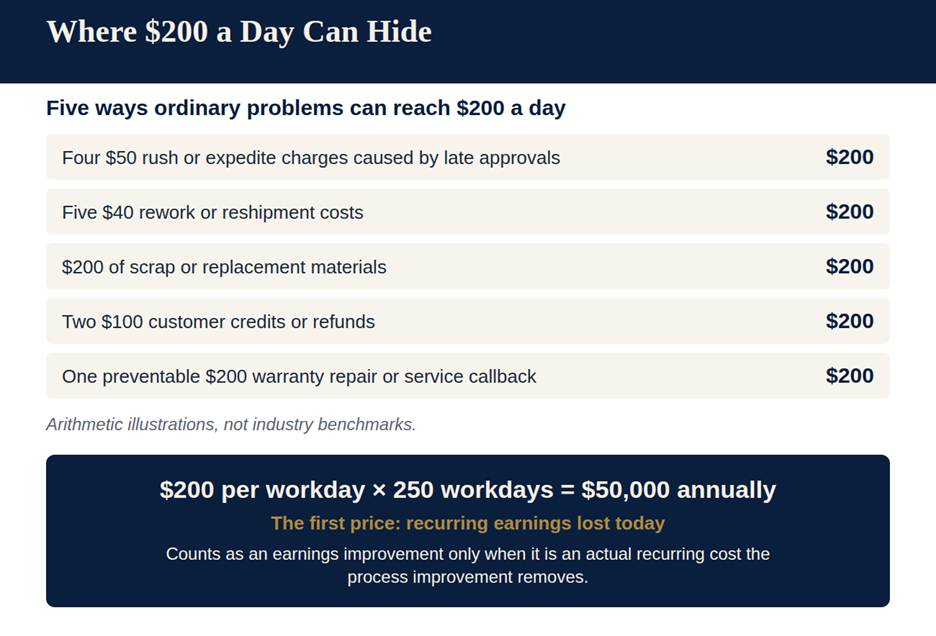
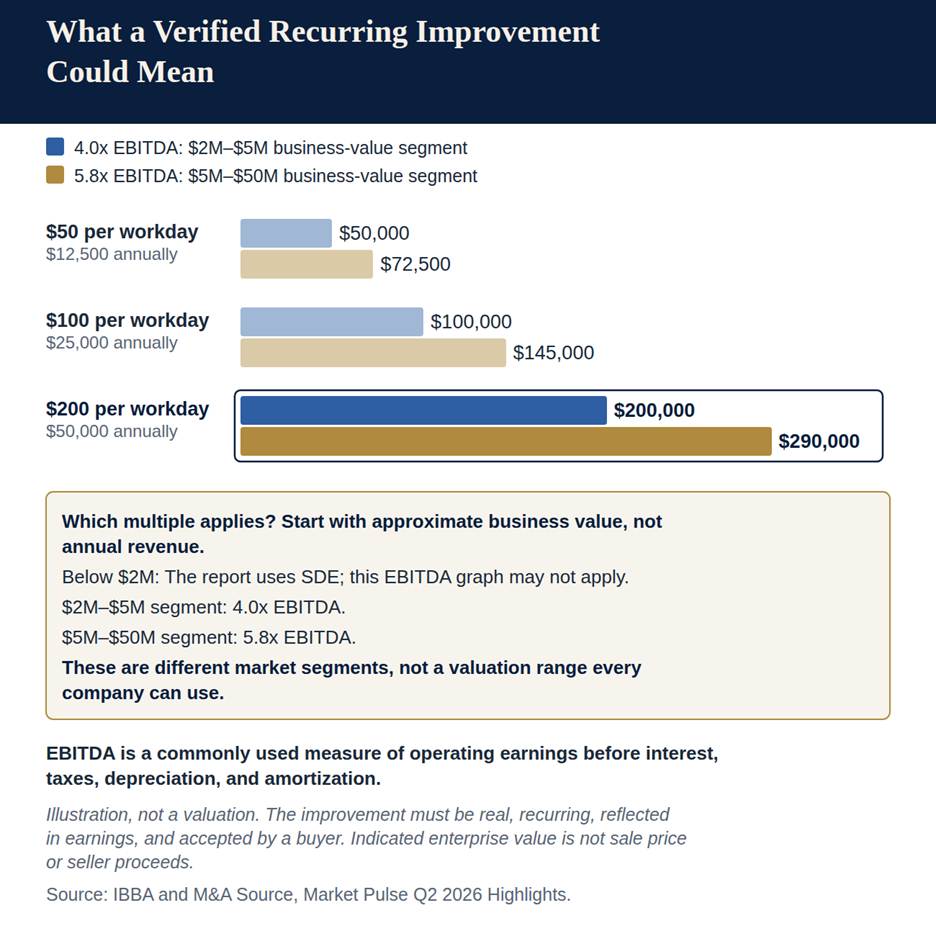
No owner writes a $50,000 check lightly. Yet a company can spend that much in $200 daily pieces. Say four hourly employees each work one overtime hour fixing the same broken handoff. At $50 an hour, that is $200 a day and $50,000 across 250 workdays. At sale, recurring earnings are priced again. IBBA and M&A Source reported 4.0x EBITDA for the report’s $2 million-to-$5 million business-value segment and 5.8x for its $5 million-to-$50 million segment. If a buyer verifies and accepts the improvement, that could indicate $200,000 to $290,000 in enterprise value, depending on the applicable segment. Roughly a quarter-million dollars. Condo-sized value inside one workaround. You do not have to sell to collect the first $50,000.
The fix does not always require a major transformation. Small changes in everyday processes and workflows can have a substantial financial impact because the improvement repeats across every order, shift, customer, or week. A preventable credit, an unnecessary handoff, or a few minutes of avoidable work may look insignificant once. Repeated hundreds or thousands of times, it becomes material.
Run the test on one critical workflow
Start with one critical workflow.
- Pick one workflow that materially moves revenue, margin, cash, capacity, or customer retention.
- Hand the written process to a capable employee who does not normally do that job.
- Ask them to walk through or simulate it while the current process owner observes.
- Do not coach unless customer, financial, compliance, or safety risk requires intervention.
- Note every point where they must leave the procedure, call somebody, hunt for a file or a tool that is named nowhere, ask for permission no document grants, or rebuild information by hand. Each break is fixable. Write them down, put a name next to each, and decide what closes it: a step to document, a limit to set, an owner to assign, a person to train, or a number to make visible.
- Then do it again next quarter with a different workflow.
There is a version of getting ready that makes this worse. A critical position stays open. Maintenance slips. Training pauses. Short-term earnings improve while the operating system weakens, and the absorbed work lands on the frontline as one more thing nobody wrote down.
People. Process. Technology. In that order. Put the right people in position with real authority. Build the process around how the work moves, exceptions included. Then add technology to support it, not to cover for a process nobody fixed. A business built that way runs better every day you own it.
A fresh set of eyes finds this kind of thing years early. That was the argument of the first article in this series, and it holds here. A buyer or successor will want to understand exactly what the frontline is holding before deciding what can transfer.
Before an owner focuses on valuation, the more important question is whether the business can consistently produce the earnings being valued. That means finding the work the frontline is quietly holding together, quantifying the recurring leakage, and fixing the operating conditions behind it. The objective is not cosmetic cleanup before a sale. It is a stronger business whose performance is easier to explain, defend, and transfer to the next owner.
Share this article: