



Why This Matters to Distributors: Fastener distributors continued to report expanding business conditions in August, but sales growth and expectations for the next six months cooled from July. At the same time, pricing accelerated sharply and supplier delivery times lengthened, adding cost and supply-chain pressure.
Fastener distribution activity remained in expansion territory in August, although growth slowed from July as distributors reported softer sales, sharply higher pricing, and longer supplier delivery times.
The seasonally adjusted Fastener Distributor Index fell to 58.3 in August from 59.9 in July, according to the latest report from Baird and FCH Sourcing Network. It was the 16th consecutive month above 50 and the sixth consecutive reading above 55.
The FDI is a monthly survey of North American fastener distributors conducted by Baird and FCH Sourcing Network. As a diffusion index, a reading above 50 indicates expansion and a reading below 50 indicates contraction. The National Fastener Distributors Association also lists the August report as the latest FDI release.
Sales remained in expansion territory but slowed from July. The seasonally adjusted sales index fell to 63.8 from 82.7. Still, 59% of respondents reported sales above seasonal expectations, compared with an average of about 54% over the previous year. Twenty-eight percent reported below-seasonal sales and 14% said sales were in line with seasonal expectations.
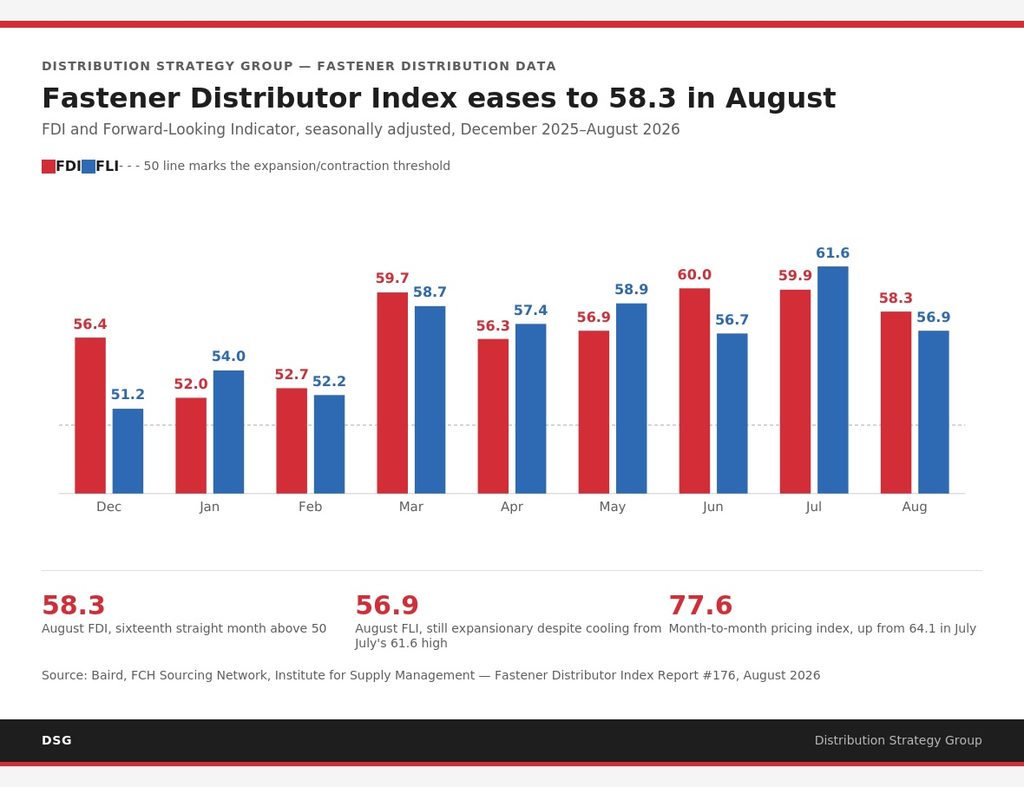
The month-to-month pricing index increased to 77.6 from 64.1. Fifty-five percent of respondents reported higher prices from July, up from 31% a month earlier, while 45% reported no change and none reported lower prices.
The year-over-year pricing index increased to 91.4 from 89.1. Eighty-three percent of respondents reported higher prices than a year earlier, while 17% reported no change. No respondents reported lower year-over-year prices.
Supplier delivery times also lengthened. The supplier deliveries index jumped to 69.0 from 57.8. Forty-one percent of respondents reported slower lead times or deliveries, up from 22% in July. Fifty-five percent reported minor change. Survey comments cited ocean freight costs and availability as factors behind the slowdown.
One respondent said risks related to the Strait of Hormuz were affecting ocean freight costs and availability. Another said, “Ocean Freight issues are causing frustration and pain.” A third respondent said customers continued to demand better pricing even as container shipping costs had tripled.
Customer inventories remained lean. The customer inventories index registered 41.4, compared with 40.6 in July, marking its eighth consecutive month below 50. Just 3% of respondents said customer inventories were too high, while 76% described them as in line with expectations.
Distributor inventories moved higher, with the respondent inventories index increasing to 60.3 from 57.8. Employment remained in expansion territory but softened to 56.9 from 59.4. Twenty-four percent of respondents reported employment above seasonal norms, 66% reported staffing in line with seasonal levels and 10% reported employment below normal.
Expectations for the next six months also moderated.
The Forward-Looking Indicator fell to 56.9 from 61.6 in July, which Baird described as a multi-year high. The August reading remained above 50 and in line with the 2026 average.
46% of respondents said they expect business activity to be higher for six months from now, down from 66% in July. Forty-three percent expect activity to remain about the same, while 11% expect lower activity.
Distributor comments pointed to continued demand from data center and construction customers, although conditions were uneven.
“Solid month, we are seeing growth continue in data center and construction related business,” one respondent said, while adding that the company’s traditional customer base and product mix remained flat. Another respondent said increased sales continued to come from new business.
Other distributors reported signs of softer demand. One respondent attributed some of August’s slowdown to end-of-summer vacations. Another said September sales would help determine whether the August decline was an anomaly. A separate respondent reported a slowdown in data center construction that had negatively affected sales.
The FDI results were consistent with continued expansion in U.S. manufacturing. The Institute for Supply Management’s Manufacturing Purchasing Managers’ Index registered 54.6 in August, down from 55.6 in July, marking the eighth consecutive month of manufacturing expansion.
Fastenal’s August results also showed continued industrial demand. Baird reported that Fastenal’s average daily sales increased 16.6% year over year, compared with 15.5% growth in July. Direct materials sales increased 19.1%, while indirect materials, which include maintenance, repair, and operations products, increased 15.6%. Fastenal’s investor relations site confirms the company issued its August sales report on Sept. 4.
Taken together, the August data show fastener distribution continuing to expand, but with a different operating mix than in July: slower sales growth and a more cautious six-month outlook alongside rising prices and longer supplier delivery times.
Do not miss any content from Distribution Strategy Group. Join our list.
Share this article:
