


Why This Matters to Distributors: State governments are becoming the primary source of new business regulation. Distributors operating across multiple states face growing compliance costs such as AI, packaging, wage, and workforce rules that increasingly vary by jurisdiction.
As state legislatures wrapped up their 2026 sessions, lawmakers approved a broad range of measures that will affect how wholesale distributors hire employees, manage packaging obligations, and administer workplace policies.
The most significant developments centered on four areas: artificial intelligence in employment decisions, extended producer responsibility (EPR) programs for packaging, rising wage requirements, and restrictions on traditional workforce management practices.
The most far-reaching AI legislation emerged in Connecticut, where lawmakers approved Senate Bill 5, a sweeping measure that includes new requirements governing the use of automated employment decision tools. Gov. Ned Lamont signed the legislation in May.
The law requires employers to provide disclosures when using AI-driven tools in employment decisions and establishes new reporting requirements tied to workforce reductions involving AI systems. Key provisions take effect beginning Oct. 1, 2026, with additional notice and disclosure requirements phased in through 2027.
The legislation also makes clear that employers cannot avoid liability for discriminatory outcomes by attributing decisions to an automated system.
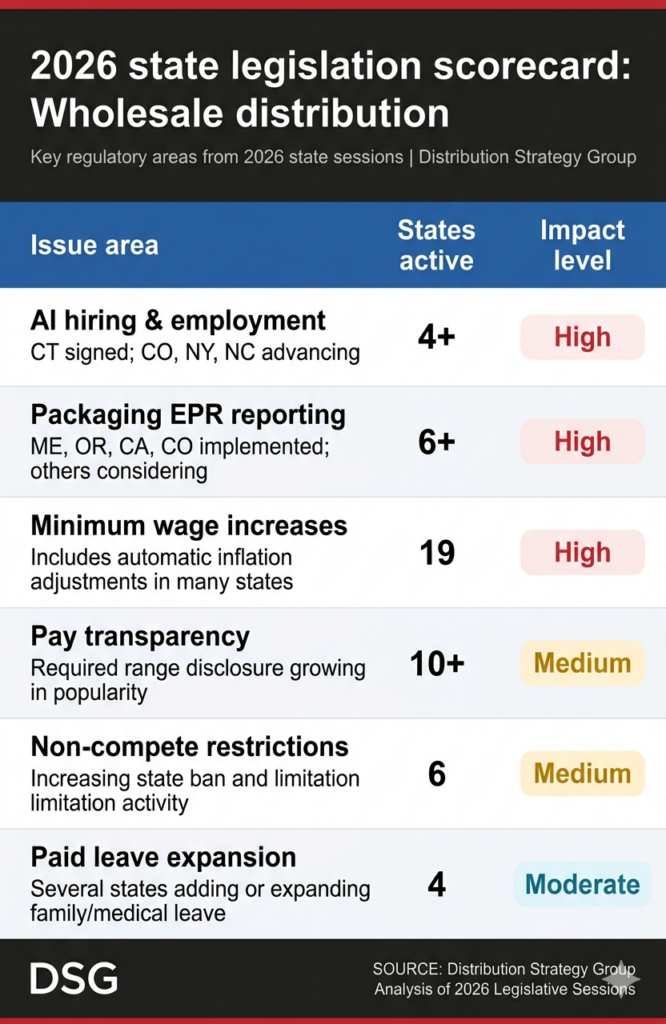
Connecticut is part of a broader state-level push to regulate AI. Legislators in North Carolina introduced the Omnibus AI Protections Act, New York advanced bills regulating automated employment decision tools, and Colorado lawmakers proposed revisions to the state’s existing AI framework. Florida lawmakers also debated AI-related consumer protections during a special legislative session.
While the White House released a national AI policy framework in March, it does not create new legal obligations, leaving employers to navigate a growing patchwork of state requirements.
For distributors increasingly using AI to screen applicants, schedule workers, manage performance or support human resources functions, the result is a compliance landscape that varies significantly by state.
Packaging regulation also gained momentum as several EPR programs moved from policy development to implementation.
Six states require producer reporting submissions by May 31, including California, Colorado, Oregon, Minnesota, Maryland, and Washington. The reporting requirements vary widely. California, Colorado, and Oregon require detailed packaging data, while Minnesota, Maryland and Washington rely on more aggregated reporting approaches.
Colorado’s EPR program entered its first year of producer fee collection in January, requiring qualifying companies to register with the Circular Action Alliance and submit data reports packaging.
Meanwhile, the National Association of Wholesaler-Distributors continues to challenge Oregon’s EPR law in federal court. A judge granted a preliminary injunction in February that temporarily blocks enforcement of the program against NAW members pending trial.
Additional EPR legislation was introduced this year in New Hampshire and Wisconsin, while lawmakers in Massachusetts, New Jersey, New York, Rhode Island, and Virginia continue to consider similar proposals.
For distributors, a central question remains whether they qualify as “producers” under state EPR definitions. If so, they may face registration requirements, reporting obligations and annual fees that differ from state to state.
Labor-related mandates also continued to expand.
Nineteen states increased minimum wages on Jan. 1, including several major distribution markets such as California, Colorado, Illinois, Michigan, Minnesota, New Jersey, New York, and Washington. Washington’s minimum wage rose to $17.13 per hour, while inflation-based adjustments in several states also increased salary thresholds used to determine overtime exemptions.
Pay transparency requirements gained additional traction. Beginning Oct. 1, Connecticut employers must disclose wage ranges and benefits information in job postings. Maine enacted a similar requirement covering employers with 10 or more employees.
At the same time, states continued to limit the use of non-compete agreements. California, Minnesota, North Dakota, and Oklahoma prohibit most employee non-competes, while Washington, Wyoming and other states have enacted significant restrictions on their use.
Taken together, the measures illustrate a broader shift in business regulation from Washington to state capitals. For distributors with operations spanning multiple states, compliance increasingly requires managing a patchwork of AI disclosures, packaging mandates, wage laws, pay transparency rules and employment restrictions that often differ from one jurisdiction to the next.
The growing complexity is forcing distributors to devote more resources to legal, human resources and compliance functions at a time when many are simultaneously investing in AI, automation, and workforce modernization initiatives.
Do not miss any content from Distribution Strategy Group. Join our list.
Share this article:
