



Why This Matters to Distributors: Distributors are preparing to spend more on artificial intelligence and digital sales, but many still struggle to control discounts, recover cost increases, and expand sales to existing customers. A new survey points to those everyday practices as critical to improving profitability.
Wholesale distributors expect stronger growth over the next several years, but rising costs, price competition and gaps in sales execution are complicating their efforts to deliver it, according to a new Simon-Kucher survey.
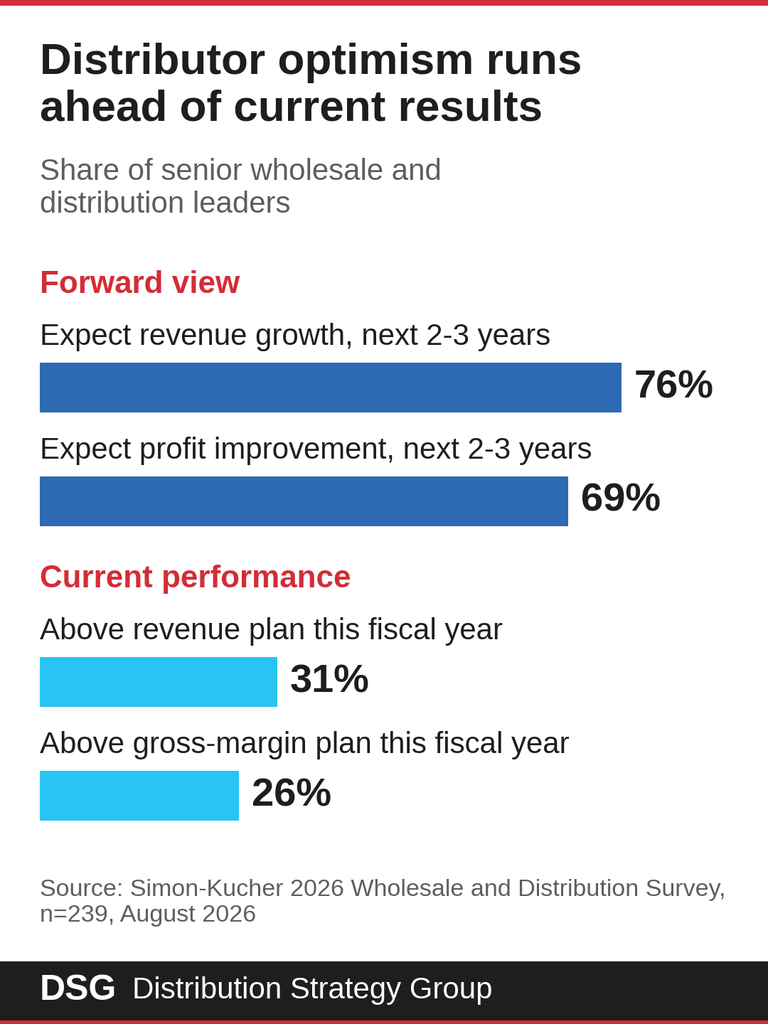
The pricing and growth consulting firm found that 76% of respondents expect their growth outlook to improve over the next two to three years, and 69% anticipate improved profitability. Current results were more restrained: 31% reported revenue above their fiscal-year plans, while 26% said gross margins exceeded plan.
Most respondents said their businesses were performing close to expectations. About one-fifth reported revenue and gross margins below plan, suggesting that executives’ optimism has yet to translate into widespread outperformance.
The findings come from Simon-Kucher’s 2026 Wholesale and Distribution Industry Report, which surveyed 239 senior industry leaders across North America and Europe in August. About 70% represented businesses with annual revenue of at least $500 million, giving larger companies substantial weight in the results.
Respondents came from industrial supplies, building products, technology, food service, electrical products, and other distribution markets. The survey measures executives’ assessments of their companies rather than industrywide sales growth.
Rising operating costs topped the list of external pressures, cited by 54% of respondents. More aggressive price competition followed at 45%, while 36% identified slower growth or weaker customer demand.
North American respondents reported greater cost pressure than their European counterparts. Sixty percent identified rising operating expenses as a leading concern, compared with 45% in Europe.
The most frequently cited internal shortfall was missed opportunities to sell additional products or capture more of existing customers’ purchases, identified by 41% of respondents. Prohibitive costs to serve customers and limitations in data, systems or processes followed, each cited by 33%.
Another 28% pointed out slow or incomplete efforts to pass cost increases along to customers. A quarter cited excessive discounting or exceptions to established prices.
Those findings put pricing practices at the center of distributors’ efforts to protect profitability. More than half of respondents, 52%, said their companies primarily set prices by adding a markup to cost. Another 29% reported using a structured pricing approach, while 17% used advanced or dynamic pricing.
Larger companies were more likely to have invested in pricing tools. Among distributors with annual revenue of at least $500 million, 55% reported such investments, compared with 27% of smaller companies. Discount discipline, however, was identical between the groups.
The report also found that companies performing above plan were more likely to use advanced pricing methods. That association does not establish that the pricing methods caused better results, but it highlights a difference in how stronger performers approach the market.
Growth priorities also varied by company size. Among businesses with less than $500 million in annual revenue, 58% identified winning new customers as a leading initiative for the next two to three years, compared with 27% of larger companies.
Larger distributors placed greater emphasis on strengthening pricing, expanding digital sales and developing commercial data and artificial intelligence capabilities. Respondents from companies performing above plan also placed more emphasis on capturing additional business from existing customers.
AI topped planned investments, with 47% of respondents expecting to spend on pricing or sales applications over the next 12 to 24 months. Digital sales and e-commerce followed at 44%, pricing strategy and execution at 39%, and salesforce effectiveness at 36%.
Broad AI deployment remained limited, however. Among larger companies, 31% were testing commercial applications, while 20% were expanding deployment or had broadly incorporated AI into their businesses. Among smaller companies, those figures were 14% and 13%, respectively.
Connecting AI to existing systems was the most frequently cited barrier, identified by 42% of respondents. Poor data quality and concerns about explaining or trusting AI results each drew responses from 31%. Another 29% cited an unclear business case or return on investment.
AI adoption was similar among companies performing above plan and other respondents. The survey therefore did not show a clear relationship between adoption alone and stronger business performance.
Simon-Kucher recommended that distributors concentrate sales resources on customers with the greatest potential for profitable growth, strengthen pricing and discount controls, and use customer profitability data to guide service levels and commercial terms. It also urged companies to prioritize digital and AI applications with a clear business payoff and build the data, processes and employee adoption needed to support them.
Do not miss any content from Distribution Strategy Group. Join our list.
Share this article:
