



Why This Matters to Distributors: Rexel’s results point to continued strength in electrical distribution, particularly in North America, where data center construction, industrial automation and infrastructure projects continue to drive demand. The company also continued expanding through acquisitions, highlighting an industrywide strategy of adding technical capabilities and strengthening regional coverage.
Electrical distributor Rexel raised its full-year 2026 outlook after reporting stronger second-quarter sales across all major regions, led by continued growth in North America and rising demand from data center, industrial automation, and electrification projects.
The Paris-based company reported second-quarter sales of €5.25 billion ($5.98 billion), up 6.1% from a year earlier. On a constant, same-day basis, sales increased 6.7%. First-half sales reached €9.99 billion ($11.37 billion), up 2.2% year over year, or 5.1% on a constant, same-day basis.
Rexel said sales accelerated in every geographic region during the quarter, with positive volume growth across all markets for the first time since the second quarter of 2023. The company attributed the gains to continued investment in data centers and electrification, along with favorable pricing and demand for value-added services.
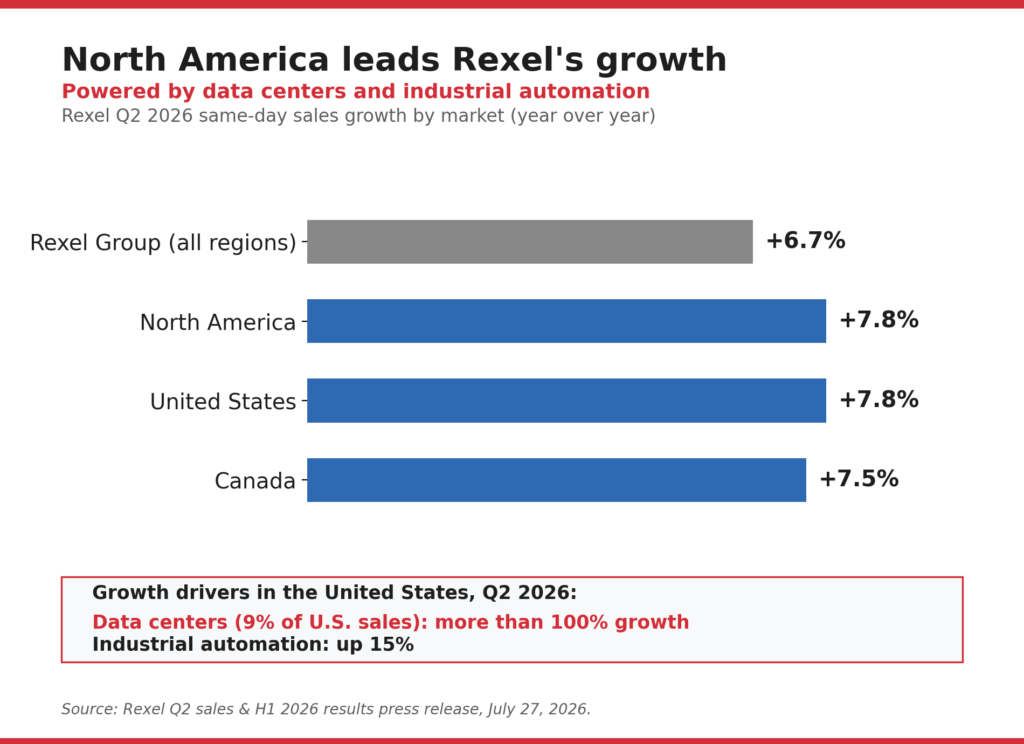
North America, which accounts for 47% of Rexel’s business, remained its strongest-performing region.
Sales in the region increased 7.8% on a constant, same-day basis during the second quarter and 6.9% during the first half. In the United States, data center sales more than doubled from a year earlier and now account for about 9% of the company’s sales. Industrial automation sales increased 15%, while aerospace, health care and water infrastructure also posted gains.
Rexel also reported record project backlogs in North America. Its U.S. backlog exceeded $2 billion, while its Canadian backlog topped CAD1 billion (US$739 million), reflecting continued demand for large commercial and industrial projects.
Europe returned to volume growth during the quarter, with sales increasing 4.4% on a constant, same-day basis. Growth was led by demand for heating, ventilation and air conditioning (HVAC), solar and electric vehicle charging products. Sales in Asia-Pacific climbed 17%, driven by industrial automation projects in China and India and strong solar activity in Australia.
Digital sales continued to expand, representing 35% of companywide revenue during the first half. In North America, digital sales reached 27% of revenue as customers increased their use of online quoting and order-entry tools.
Based on the stronger first half, Rexel increased its outlook for 2026. The company now expects about 5% same-day sales growth for the year, compared with its previous forecast of 3% to 5%, while maintaining its outlook for an adjusted EBITA margin of at least 6.2%.
CEO Guillaume Texier said the company’s performance reflects continued investment in electrification and disciplined execution despite geopolitical uncertainty. He said Rexel will continue investing in digital and artificial intelligence tools, advanced services, and acquisitions.
Rexel completed three North American acquisitions during the first half of 2026: TC 360 in Canada, Revere Electrical Supply in Illinois and DEE Electronics in Iowa. The deals expand the company’s industrial automation, advanced services and original equipment manufacturer capabilities while strengthening its presence in key industrial markets. Revere generated about $330 million in 2025 sales, while DEE Electronics generated about $50 million in annual sales before its acquisition.
The acquisitions reflect a broader trend across electrical and industrial distribution. Rather than pursuing acquisitions solely to increase market share, distributors are increasingly targeting companies with specialized engineering expertise, automation capabilities, and exposure to fast-growing markets such as data centers, electrification, and critical infrastructure. Those deals allow distributors to expand technical services, deepen customer relationships, and strengthen their position in regional markets.
Do not miss any content from Distribution Strategy Group. Join our list.
Share this article:
