


Why This Matters to Distributors: Whether they are called distributors, wholesalers, merchants, factors or stockists, companies across the UK and Europe face the same challenge: AI is moving from experimentation into core commercial and operating functions. DSG’s AI Forum UK & Europe will focus on what is working now, where companies are producing measurable results and what distribution leaders should consider as they move from AI pilots to production.
Distribution has its own language on either side of the Atlantic.
In the U.S., companies that buy products from manufacturers, hold inventory and resell to business customers are generally called distributors. Across the UK and Europe, those same businesses are just as likely to be called wholesalers, merchants, factors or stockists, depending on the industry and country. Builders’ merchants, electrical wholesalers, industrial distributors, automotive factors and foodservice wholesalers are all part of the same broader distribution economy.
Whatever the terminology, they increasingly face the same question: How do they turn artificial intelligence into a working part of the business?
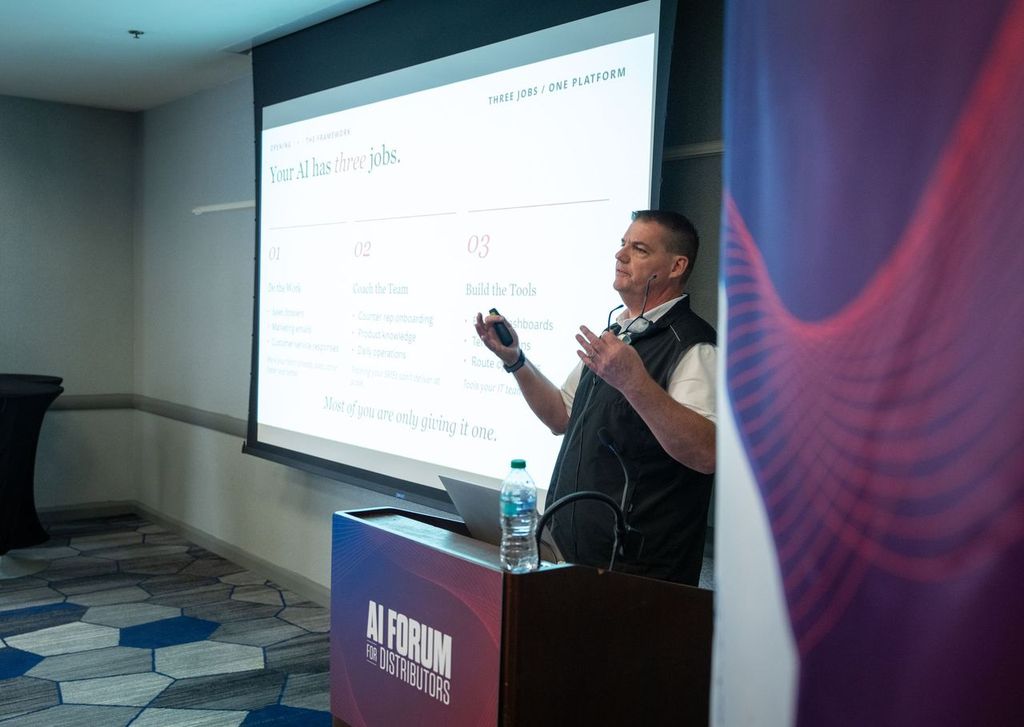
Distribution Strategy Group’s AI Forum UK & Europe, set for Oct. 15 at the National Conference Centre in Birmingham, is designed to help answer that question.
The one-day program will focus on how distributors, wholesalers and merchants are moving AI from pilots into production, what results companies are seeing and where the technology is beginning to change sales, customer service, operations and workforce planning.
The program combines distribution case studies, technology demonstrations and peer networking for executives from the UK, Ireland and continental Europe.
Here are 10 reasons to attend.
1. The focus is AI in production, not AI theory.
Jonathan Bein’s opening keynote, “What’s Really Working in AI,” will examine five areas where distributors are already putting AI to work: accounts receivable automation, warehouse robotics, AI-powered customer relationship management, quote and order automation, and inventory management.
Rather than focusing on what AI might eventually do, the session will examine live deployments, the results companies are reporting and the lessons other distributors, wholesalers and merchants can apply to their businesses.
2. The cost of moving slowly is becoming clearer.
Bein will examine research showing a widening performance gap between companies that adopt AI early and those that move more slowly.
For distribution executives, the issue is increasingly less about company size and more about speed and execution. Companies that successfully automate processes, improve decision-making and increase employee productivity could build operating advantages that become increasingly difficult for competitors to close.
3. Attendees will see where departmental AI can fall short.
Ben Firman’s session will examine a problem emerging as companies move beyond their first AI projects: systems deployed within individual departments that lack the context needed to work effectively across the broader business.
Drawing on his work with North American distributors, Firman will examine why isolated AI deployments can produce promising demonstrations but inconsistent operating results.
Those shortcomings can become particularly visible in processes that cross multiple functions, including returns, warranties and repairs.
4. The agenda includes hands-on guidance for today’s AI tools.
Brian Hopkins’ featured session, “The AI-Powered Distributor: Beyond the Chatbot,” will put widely used AI platforms through practical distribution exercises.
Hopkins will compare ChatGPT, Claude, Gemini and Perplexity for specific business tasks. He will also demonstrate how AI can be used to build a prospecting dashboard in minutes and develop an interactive sales commission model.
The emphasis will be on what executives and their teams can do with available technology now rather than waiting for another generation of AI tools.
5. Parts Town will provide a distributor’s view from inside an AI deployment.
Audreyanne Snow, vice president of AI Program Delivery at Parts Town Unlimited, will deliver the closing keynote.
Snow leads enterprise AI initiatives from strategy through implementation after previously overseeing supply chain and logistics operations at Parts Town. Her session will examine how the company identifies AI opportunities, prepares its people and processes, moves projects into production and measures results.
For UK and European wholesalers, merchants and distributors, the session provides an opportunity to hear directly from an executive responsible for turning AI strategy into operating programs inside a large distribution business.
6. Networking is built into the agenda.
The forum includes four dedicated networking periods: breakfast, lunch, an afternoon break and a closing reception.
Those sessions will give attendees time to compare approaches with executives facing many of the same questions: Where should we start? Should we build or buy? How do we prepare our data? Which processes should be automated first? And where can AI produce a measurable return?
The conversations between sessions are intended to be an important part of the program.
7. There are no competing tracks.
Every attendee follows the same agenda throughout the day.
The single-track format eliminates the need to choose between simultaneous sessions and keeps the room focused on the same issues, case studies and demonstrations.
It also gives attendees a common starting point for discussions during networking sessions.
8. AI solution providers get focused, structured sessions.
Five 25-minute sponsor sessions are scheduled throughout the program, giving attendees a direct look at technology being developed for distribution.
The format provides concentrated access to solution providers without requiring attendees to spend the day navigating a traditional trade-show floor or choose between vendor presentations and educational sessions.
9. The audience is being built specifically around UK and European distribution.
DSG is developing the attendee base with trade associations and buying groups serving the UK, Ireland and continental Europe.
Those organizations include the Electrical Distributors’ Association, Euromat, NMBS and Nexus Automotive International, along with UK trade media.
That means bringing together the different businesses that make up European distribution: builders’ merchants, electrical wholesalers, industrial distributors, automotive factors, foodservice wholesalers and other business-to-business distribution companies.
The objective is not to transplant a U.S. conference agenda to Birmingham. It is to create a room of European distribution leaders discussing AI in the context of their own customers, supply chains, labor markets, business structures and regulatory environment.
10. The discussion extends beyond technology to workforce planning.
AI adoption will affect more than technology investments. It will also change how work is organized across distribution businesses.
Bein’s opening keynote will examine how companies could capture AI-driven labor savings through attrition rather than large-scale workforce reductions. He will also look at customer service functions that agentic AI is expected to increasingly handle through 2028.
That gives executives a planning horizon for determining which jobs could change, which skills will become more important and where companies should begin preparing employees now.
From AI Interest to AI Execution
The terminology may differ across markets, but the business challenge does not.
Whether the company calls itself a distributor, wholesaler, merchant, factor or stockist, executives increasingly need to determine where AI can produce results, how to put it into production and how to measure whether the investment is working.
The question is no longer simply what AI can do. It is where to deploy it, how quickly to move and how to avoid spending money on projects that never make it beyond the pilot stage.
AI Forum UK & Europe is designed around those questions.
The forum runs from 9 a.m. to 5:30 p.m. Oct. 15 at the National Conference Centre in Birmingham.
Registration is open at https://distributionstrategy.com/ai-forum-uk-eu/
Share this article:
