


Why This Matters to Distributors: Supply chain risk is shifting from transportation bottlenecks to shortages of critical materials and components. S&P Global says petrochemical constraints, AI-driven memory demand and tariff uncertainty are increasing pressure on product availability, inventory planning, and pricing heading into 2027.
Artificial intelligence demand, shortages of key industrial materials and tariff uncertainty are creating a new set of supply chain bottlenecks that could keep product availability and costs under pressure into 2027, according to S&P Global Market Intelligence.
The firm’s third-quarter 2026 corporate strategy outlook says supply chain problems are increasingly moving beyond ports, shipping lanes, and other traditional transportation chokepoints. The greater risks now include scarce raw materials, constrained components, and shorter windows for companies to make sourcing and inventory decisions.
For distributors, the shift is significant. Electrical and technology distributors face rising semiconductors and computer costs as AI infrastructure consumes more memory chips. Chemical, plastics, and industrial distributors are dealing with tighter petrochemical supplies. Across distribution, tariff uncertainty is also encouraging companies to bring in inventory earlier and rebuild safety stocks.
“Supply chain bottlenecks are no longer just about where goods move,” S&P Global researchers wrote. “They increasingly depend on what materials are scarce, which components are constrained and how much time firms can afford to buy.”
Petrochemical Disruptions Expose Supply Risks
Recent Middle East disruptions showed how difficult it can be to replace certain industrial materials even when companies can find alternative transportation routes.
S&P Global identified plastics feedstocks, aluminum, fertilizers, and specialty materials among the manufacturing inputs most affected.
Naphtha and petrochemicals have been particularly difficult to replace. Imports into mainland China, Japan, Singapore, and Taiwan fell to 73% of pre-conflict levels in April. Propylene polymer shipments were at 80.9% of previous levels.
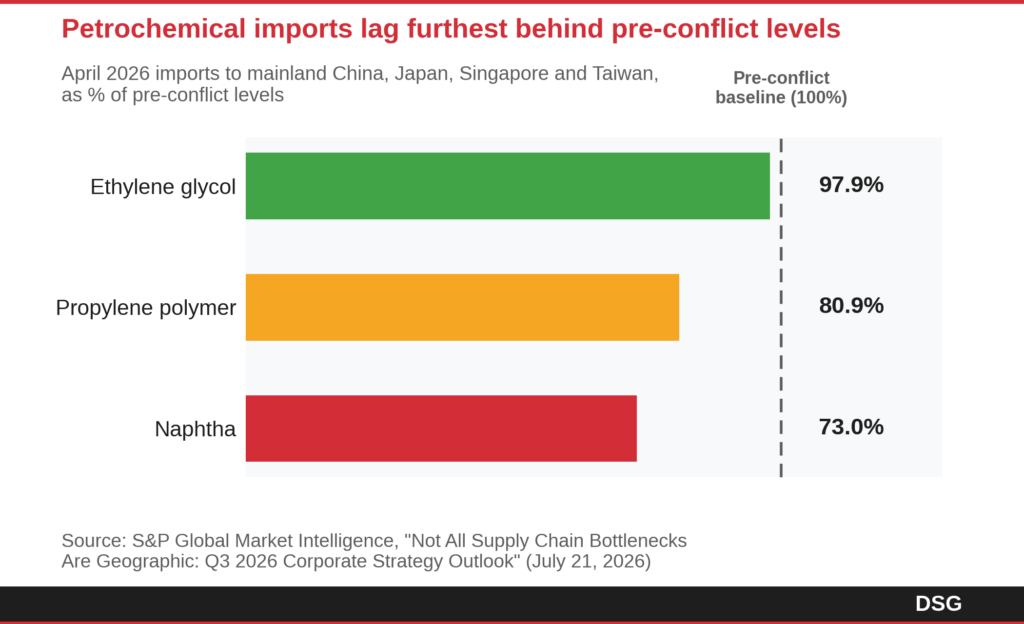
Other products proved easier to source elsewhere. Ethylene glycol shipments reached 97.9% of pre-conflict levels, while unwrought aluminum shipments increased as buyers sourced more material outside the Middle East.
For industrial and chemical distributors, the distinction is important. Changing transportation routes does little to solve a shortage when alternative sources of the underlying product are limited.
The disruptions are also increasing pressure on manufacturers to decide how much of their higher costs can be passed on to customers.
S&P Global said the gap between manufacturers’ input and output prices in June was the widest since the post-pandemic inflation period. That suggests companies have not fully passed higher costs downstream, increasing the risk of margin pressure if demand weakens.
AI Demand Tightens Electronics Supply
Technology distributors face a different problem.
Rapid investment in AI infrastructure is tightening memory-chip availability and increasing semiconductor prices, with S&P Global expecting the effects to work their way into computers and other electronics through 2027.
South Korea’s semiconductor producer price index reached 275% of its 2023 average in May, while export prices climbed to 715% of the 2023 average, according to the report.
S&P Global forecasts producer prices for computers will rise 16% in the U.S. and 10.9% in mainland China by the second quarter of 2027 compared with the fourth quarter of 2025.
That has direct implications for distributors selling computers, servers, networking equipment, and other data center technologies. AI-related demand is competing for components also used in traditional commercial and consumer electronics.
Chipmakers are spending heavily to add production capacity, but additional supply will take time.
S&P Global estimates capital spending by the three largest memory producers will reach $181.1 billion in 2027, up 141% from 2024. New plants and equipment, however, will not immediately eliminate shortages because new capacity must be built and components qualified before supply reaches the market.
Supplier Shifts Won’t Be Immediate
Companies are also looking for alternative sources of memory chips, but S&P Global cautioned that changing suppliers can take years because of technical qualification requirements and regulatory risks.
Mainland China and Hong Kong exports of memory circuits increased 151.5% year over year during the three months ended April 30, accounting for 28.1% of global trade.
South Korea remained the largest supplier, with a 44.5% share.
For distributors, that concentration creates a familiar problem: More potential suppliers do not necessarily translate into immediate availability if customers must qualify new components or technologies before they can be used.
Tariffs Push Companies to Ship Early
Tariff uncertainty is also changing when companies buy and ship products.
S&P Global found evidence that U.S. companies moved shipments forward in 2026 to get ahead of potential Section 301 tariff increases and prepare for peak-season demand.
U.S. seaborne imports of consumer electronics and leisure goods increased 23.4% from April to May, compared with an average May increase of 6.6% over the previous decade.
The increase moderated in June, when shipments rose 12.6%, in line with the 10-year average of 12.7%.
The figures suggest some companies accelerated orders rather than responding solely to stronger end-market demand.
That matters for distributors because pulling orders forward can temporarily inflate volumes while reducing demand later in the year.
Companies Rebuild Safety Stocks
Businesses are also responding to supply uncertainty by carrying more inventory.
The global manufacturing Purchasing Managers’ Index measure of purchased-material inventories increased to 51.4 in May from 49.7 in January, reaching its highest level since August 2022. A reading above 50 indicates expansion.
Safety-stock building has also increased, although S&P Global said it remains at about one-fifth of its December 2021 peak.
For distributors, carrying additional inventory can protect customers from shortages and delayed shipments. It can also tie up cash and increase the risk of excess inventory if demand slows, prices fall or technology changes.
The calculation is particularly difficult in electronics, where distributors must balance the risk of shortages against rapidly changing products and potentially higher tariffs.
Supply Chain Risk Moves Beyond Transportation
Transportation risks have not disappeared.
S&P Global warned that Panama Canal shipping could face renewed pressure over the next 12 months if El Niño reduces water levels. During previous El Niño periods, shippers routed more freight through U.S. West Coast ports and moved goods inland by rail.
But the broader message from the report is that supply chain planning is becoming less about solving a single transportation bottleneck.
A distributor may be able to change ports, carriers, or shipping routes. Finding another source for a specialized petrochemical, semiconductor or qualified electronic component can be far more difficult.
That puts sourcing, inventory management, and supplier diversification closer to the center of distribution strategy heading into 2027.
For technology distributors, the most immediate pressure may come from the collision between AI infrastructure spending and constrained semiconductor capacity. For chemical, industrial, and agricultural distributors, the challenge is tighter availability of petrochemicals, aluminum, fertilizers, and other materials with limited alternative sources.
Across distribution, tariffs are adding another layer of uncertainty by encouraging companies to order earlier and hold more inventory.
The result is a different kind of supply chain risk: The warehouse may have enough space, and the carrier may have enough capacity, but the product a customer needs may still be difficult — and increasingly expensive — to obtain.
Do not miss any content from Distribution Strategy Group. Join our list.
Share this article:
