

Why This Matters to Distributors: Applied Industrial Technologies is using engineering expertise, robotics, and equipment connectivity to expand sales to existing customers. Its strategy highlights opportunities for distributors to win additional business by helping customers design, connect and maintain industrial systems.
Applied Industrial Technologies is adding automation capacity and evaluating acquisitions as manufacturers expand projects involving robotics, equipment monitoring, and plant improvements.
The Cleveland-based distributor is targeting businesses that would add technical expertise and services to its Service Center and Engineered Solutions operations. Executives outlined the approach during the company’s Oct. 27 earnings call, citing stronger orders and growing customer demand for automation.
“Our pipeline is active with varying size targets across both segments,” said Neil Schrimsher, president and CEO. “This includes several mid-size targets at various stages of due diligence that could enhance our technical differentiation and value-added service capabilities.”
Schrimsher said acquisitions remain a priority for fiscal 2027. Executives did not identify potential targets or announce a transaction during the call.
The strategy accompanies growth in Applied’s existing operations. Sales increased 7.6% to $1.29 billion from $1.20 billion for the fiscal first quarter ended Sept. 30. Net income rose 9.5% to $110.4 million from $100.8 million. The quarter also represents Applied’s fiscal year-to-date results.
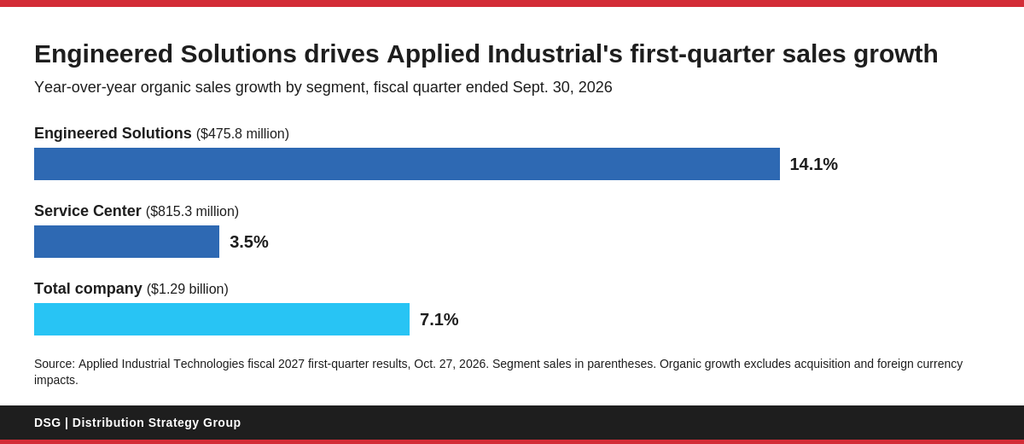
Engineered Solutions, which includes automation, fluid power, and flow control, accounted for approximately 64% of the company’s dollar increase in sales. Sales in that business increased 14.1% to $475.8 million from $417 million.
Orders in Engineered Solutions increased more than 30% from a year earlier, executives said. Automation sales excluding acquisitions and currency changes grew more than 20% for the second consecutive quarter, while unfilled automation orders increased more than 30% from both the previous quarter and a year earlier.
“It is increasingly evident customers are investing in automation to meet lasting operational requirements and strengthen their competitive position long term,” Schrimsher said.
Customers are investing in robotics, machine vision and digital technologies to address labor shortages, improve safety and quality, and strengthen supply chain reliability. Applied is using its existing customer relationships, engineering expertise, and supplier partnerships to expand that business.
“Our scaling footprint across the U.S. and Mexico, combined with the leading engineering and application expertise and strategic relationships with premier automation suppliers, is providing a clear competitive advantage as we connect these solutions across our legacy customer base,” Schrimsher said.
Applied is also investing in additional capacity to manage automation demand. Schrimsher said those investments would take place during the current quarter, but he did not disclose their cost or identify locations.
“We see high interest and activity in collaborative robots and mobile robots,” he said.
The company is helping customers incorporate automation into their operating plans, including businesses in food and beverage and technology markets. Its offerings include collaborative robots that collaborate with employees, mobile robots that move through facilities, and machine vision systems used for inspection and quality control.
Equipment connectivity provides another opportunity to expand customer relationships. Applied is helping companies collect machinery data and identify the operating measures they need to track.
“We’re helping customers extract data off their operating equipment and knowing or establishing with them the key performance indicators to continue to watch, monitor, and track,” Schrimsher said.
He said connecting that information to operating decisions creates additional opportunities for Applied.
“You want to be connecting to the data on that equipment to drive informed actions and behavior, and that’s a growth area for us as well in automation,” he said.
Applied’s work with linear motion technology, which provides precise movement in machinery, can also lead to broader involvement in customer systems. Schrimsher said the company helps customers consider how individual components fit into the overall application.
“We would be helping those providers how to think about the rest of that solution,” he said. “Not simply just reselling a component or a product offering.”
Customer projects are expanding to include more areas within plants and facilities. Schrimsher said Engineered Solutions projects often cost hundreds of thousands of dollars rather than requiring multimillion-dollar investments.
He said the increase in activity reflects more than customers restarting delayed work.
“I do not think it is just pent-up and deferral,” Schrimsher said.
Fluid power sales excluding acquisitions and currency changes grew at a rate in the high teens. Demand came from semiconductor and data center customers, as well as manufacturers of industrial and mobile equipment. Unfilled orders ended the quarter at their highest level in four years.
Schrimsher cited opportunities in fluid conveyance, industrial power, pneumatic automation, and next-generation hydraulic systems. Applied is using its system engineering and assembly capabilities to support those applications.
Flow control sales excluding acquisitions and currency changes increased more than 6%. Demand strengthened among metals, utility, energy, and technology customers, while activity in chemicals and refining was beginning to improve.
“Increased service work plus projects that we’re seeing on flow control will be good as well,” Schrimsher said.
The larger Service Center business, which supplies maintenance, repair and operations products and technical support, reported sales of $815.3 million, up 4.2% from $782.5 million. Excluding acquisitions and currency changes, sales increased 3.5%.
Demand was strongest in the U.S., where Service Center sales excluding acquisitions and currency changes increased approximately 6%. U.S. orders rose 7% from the previous quarter, exceeding the company’s normal seasonal pattern. Demand in Canada and Mexico remained softer, although executives said conditions were beginning to improve.
Applied maintained its forecast for full-year sales growth of 4% to 6.5%. Companywide October sales through the announcement date were approximately 10% above a year earlier, excluding acquisitions and currency changes, but the company said its outlook continued to account for inflation, trade policy changes, and geopolitical uncertainty.
Do not miss any content from Distribution Strategy Group. Join our list.
Share this article:
