



Why This Matters to Distributors: Ecommerce is taking on a larger share of routine ordering as wholesalers grow, but sales representatives continue to handle the largest transactions. Among wholesalers with at least $15 million in annual revenue, 63.5% of digitally captured orders are placed directly through ecommerce, while three-quarters of wholesalers still generate website orders worth less than half their rep-written orders. The findings point to a more defined split between digital self-service and human selling, with ecommerce handling routine purchases and reorders while sales teams focus on larger and more complex accounts.
Ecommerce is playing a larger role in wholesale distribution as companies grow, but sales representatives still generate the biggest orders, according to a new analysis of purchasing activity across more than 250 wholesalers. The 2026 B2B E-Commerce Benchmark Report from WizCommerce analyzed anonymized order and customer data from more than 250 wholesalers using its platform between January 2025 and July 2026.
The company also surveyed more than 100 wholesale brands in August about ecommerce adoption, sales technology, artificial intelligence, and sales-rep workflows. The report tracks eight benchmarks, including digital order capture, online customer acquisition, ecommerce-only buyers, order values, new-buyer activation, dormant-account reactivation, sales-rep technology adoption, and product merchandising.
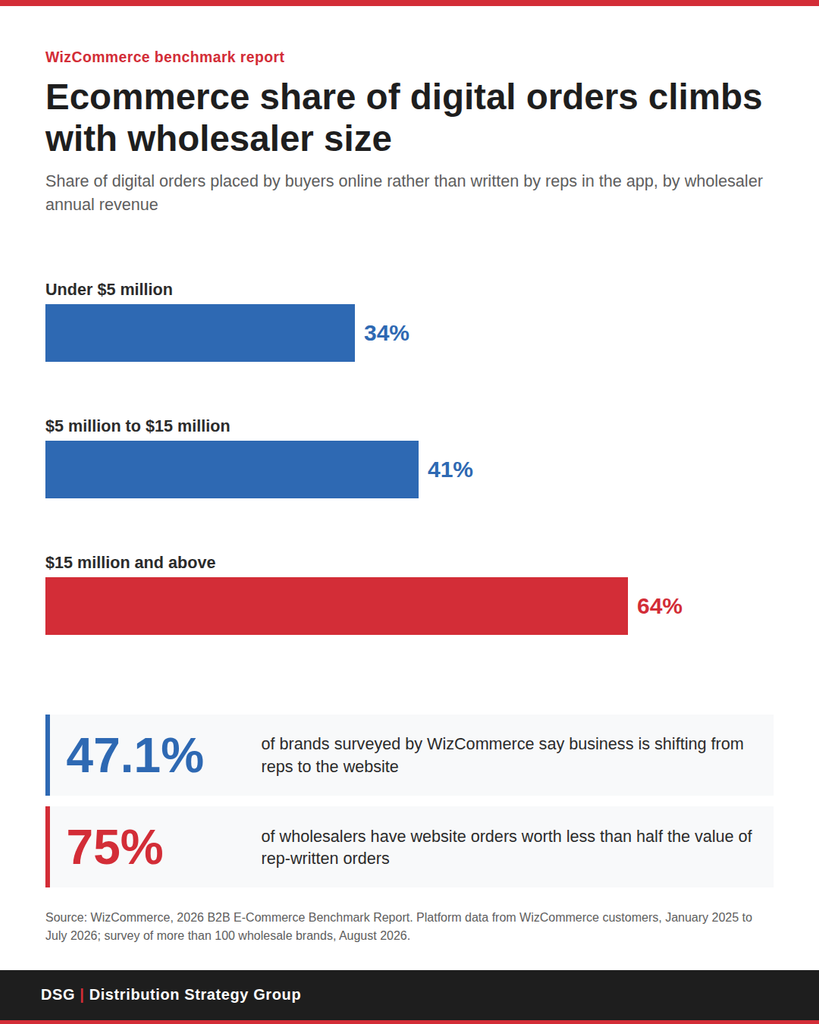
One of the clearest differences appears as wholesalers get larger. For companies with less than $5 million in annual revenue, buyers place 34% of digitally captured orders through ecommerce, while sales representatives write 66%. Ecommerce’s share rises to 40.7% for wholesalers with $5 million to $15 million in revenue.
At companies generating at least $15 million annually, the mix reverses. Ecommerce accounts for 63.5% of digitally captured orders, compared with 36.5% written by sales representatives.
The market survey showed a similar shift. About 47% of respondents said business has been moving from sales representatives to their websites during the past two to three years, while 23.5% said both channels are growing and reps are maintaining their share. Overall, 70.6% said online sales are growing in some form.
The report also found that distributor websites are doing more than serving existing customers. At the median wholesaler, 23.7% of new buyer accounts are created through ecommerce self-registration rather than by a sales representative or customer service employee. Among the highest-performing wholesalers in the report, that figure rises to 62.45%.
The shift is also visible in how existing customers place orders. Among wholesalers with less than $5 million in revenue, 25.5% of buyers have ordered exclusively through ecommerce. That rises to 39.9% among companies with $5 million to $15 million in revenue and 40.2% among wholesalers with at least $15 million in sales.
The report defines an ecommerce-only customer as one whose full order history has been through the website, with no rep-written orders. Larger wholesalers also convert new digital customers into buyers more quickly.
About 44.3% of new online buyers at wholesalers with less than $5 million in revenue place their first ecommerce order within 30 days. The rate increases to 53.3% for companies with $5 million to $15 million in revenue and 65.9% for companies with at least $15 million.
The report also identifies a persistent limitation in distributor ecommerce. At 75% of wholesalers studied, the average website order is worth less than half the average rep-written order. Only 14.29% of wholesalers have narrowed the gap between website and rep-written order values to less than 20%.
That suggests customers are increasingly comfortable placing routine orders online but still rely on sales representatives for many larger purchases. The report points to customer-specific pricing, real-time inventory visibility and product recommendations as capabilities that can help customers complete larger orders online.
Digital channels also are helping wholesalers recover inactive customers. At the median wholesaler, 28.6% of accounts that returned after being dormant for at least 12 months placed their comeback order through the website rather than through a sales representative. Among the highest-performing companies, that figure reached 50.4%.
That gives ecommerce a role beyond shifting existing orders online. It can also serve customers that may not justify regular sales coverage or bring back accounts that are no longer being actively worked by a rep.
Sales technology adoption remains uneven
The report found a separate gap between distributors’ investment in sales technology and actual rep usage. The median monthly adoption rate for digital order-writing tools was 46% of licensed sales-rep seats. Adoption fell as sales teams grew, from 50% among companies with one to 10 representatives to 42% for teams with 11 to 25 reps and 39% for companies with more than 25.
Administrative work also continues to take up a significant share of sales time. In the survey, 44.1% of respondents estimated that representatives spend 20% to 40% of their workweek on administrative tasks. Quotes, catalogs, and presentations were the most frequently cited burden, followed by tracking orders and ship dates and looking up inventory, availability, and pricing.
Artificial intelligence adoption is further along at a general level than it is inside distributor sales workflows. Thirty-eight percent of surveyed brands said they are using AI to support sales representatives, while another 30% are actively exploring it.
General-purpose uses such as email and research remain more common than applications directly tied to deciding what to sell, serving customers, building quotes and catalogs, or handling orders and administrative work. The report also found that 79% of respondents would allow AI to handle routine sales-rep work with representatives stepping in for important or unusual situations. Only 6% said they wanted AI kept out of sales-rep work entirely.
The broader finding is that ecommerce and sales representatives are increasingly taking on different roles rather than simply competing for the same orders. WizCommerce found that reps continue to write the largest orders across every company size it measured, while distributor websites are increasingly handling routine transactions, opening new accounts, and bringing dormant customers back without direct sales-rep involvement.
For distributors, that makes the next stage of ecommerce less about replacing the sales force and more about deciding which customers and transactions truly require one.
Do not miss any content from Distribution Strategy Group. Join our list.
Share this article:
