


Why This Matters to Distributors: Motion’s growth across more customer markets points to improving demand for industrial parts and services. Larger projects are growing faster than routine maintenance sales, suggesting some customers are moving ahead with investments they previously postponed.
Industrial customers are resuming deferred maintenance and larger projects, broadening Motion’s sales growth as the distributor prepares to separate from Genuine Parts Co. in early 2027.
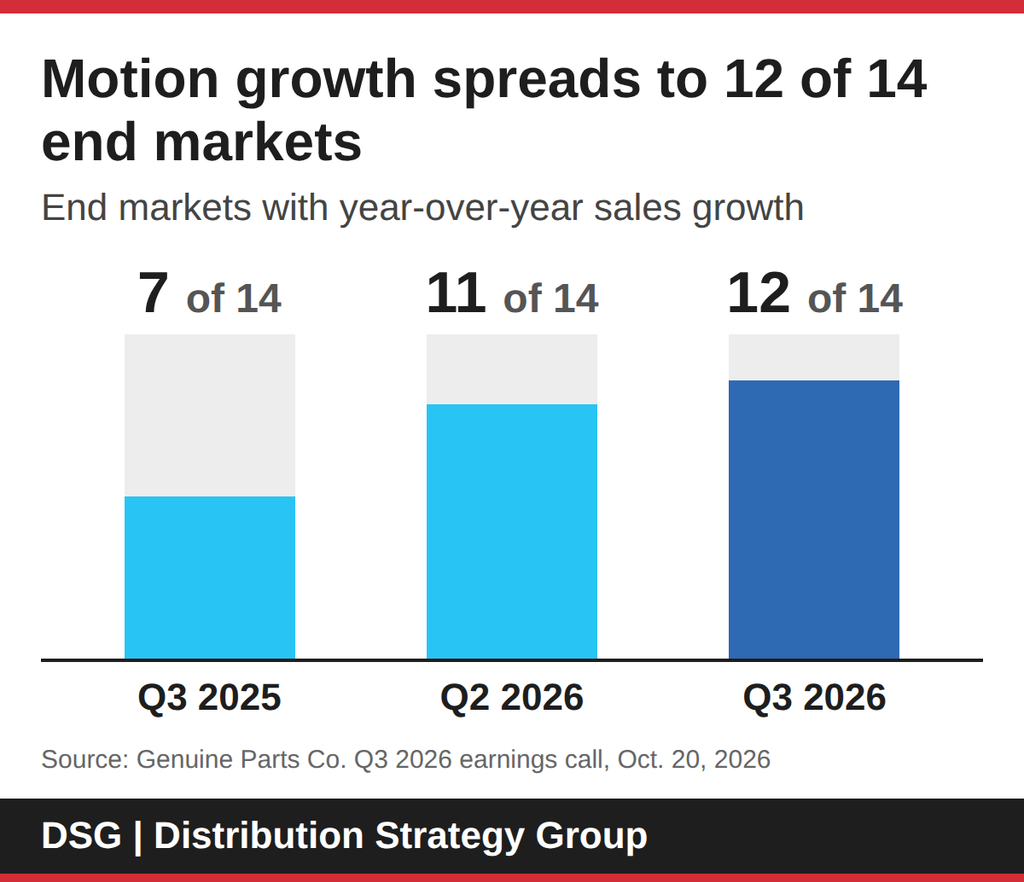
Motion reported growth in 12 of its 14 tracked customer markets during the third quarter, up from 11 in the second quarter and seven a year earlier. Demand strengthened among large corporate accounts and smaller local customers, while sales tied to capital projects grew twice as fast as its core maintenance business, executives said during Genuine Parts’ Oct. 20 earnings call.
“Following a prolonged period of industrial market contraction, deferred maintenance and delayed investments are beginning to be addressed by customers,” said Will Stengel, Genuine Parts’ chairman and CEO.
Motion’s quarterly sales increased 6.1% to $2.41 billion from $2.27 billion a year earlier. For the first nine months, sales rose 6.1% to $7.14 billion from $6.72 billion, according to Genuine Parts’ earnings release.
The results provide a more encouraging picture of customer spending as Motion approaches its planned launch as an independent public company. September was its strongest month of the quarter, and executives said the business maintained that pace entering October.
Motion’s core maintenance, repair, and operations business, which accounts for approximately 80% of sales, grew 5% during the quarter. The remaining 20%, associated with more capital-intensive projects, increased 10%, Stengel said. Larger orders and project activity were solid, giving Motion growth from both everyday equipment needs and longer-term investments.
Equipment and machinery sales increased by a high single-digit percentage. Motion also reported gains ranging from mid-single digits to double digits in food products, iron and steel, automotive, fabricated metals, distribution centers and logistics, oil and gas extraction, and equipment rental and leasing.
Demand remained softer in lumber and wood, and rubber and plastics. Those weaker markets tempered an otherwise broader improvement across Motion’s customer base.
Stengel said spending on data centers and artificial intelligence infrastructure also supports industrial activity.
“We believe data center and AI infrastructure investment is also having a positive impact on the broader manufacturing economy,” he said.
Motion did not disclose revenue directly attributable to those investments. The comments described management’s assessment of their effect on manufacturing demand rather than a separately measured source of sales.
Higher prices contributed to Motion’s growth as well. Comparable sales, which exclude acquisition and currency effects, increased 5.5%, while Stengel said price inflation contributed approximately 2% to industrial sales during the quarter.
Beyond improving market conditions, Stengel credited Motion’s technical expertise, and work to become more involved in customers’ operations. He emphasized its ability to combine products and services through a single invoice, helping customers address operating problems and simplify purchasing.
He also pointed to several years of improvements in sales execution, pricing and purchasing. Those efforts, combined with cost controls, supported the business as Motion continued investing for growth.
Management remained cautious about the final months of 2026, despite the stronger start to October. Industrial customers sometimes reduce production around the holidays, affecting demand for replacement parts and related services.
“We have seen in the past two years some of our customers slow down production in the fourth quarter, particularly as we get into the Christmas and New Year period,” said Bert Nappier, Genuine Parts’ chief financial and operating officer.
Responding to an analyst’s question about the industrial outlook, Nappier said management’s caution reflected uncertainty about November and December. He described current business conditions as steady and said Motion’s October performance had picked up where September ended.
Genuine Parts maintained its forecast for full-year industrial sales growth of 3% to 6%. Motion’s sales increased slightly more than 6% through September.
The broader demand comes as Genuine Parts works toward separating its industrial and automotive businesses into two publicly traded companies in the first quarter of 2027. Stengel said work on personnel, systems and contracts remained on schedule and within previously disclosed cost estimates.
The company also is developing financing arrangements, investment priorities and the registration documents needed for the separation. Executives plan to provide more detail on Motion’s strategy and financial outlook on its Dec. 9 investor day in New York.
Stengel will become Motion’s chairman and CEO upon completion of the separation. James Howe will serve as president and chief operating officer, overseeing day-to-day operations, and Howard Yu will serve as executive vice president and chief financial officer. Those leadership arrangements were announced in September.
Stengel said all of Motion’s future executives would remain in their existing roles. The automotive business will retain the Genuine Parts name and will be led by Court Carruthers.
The separation remains subject to conditions, including final approval from Genuine Parts’ board and an effective registration statement with the Securities and Exchange Commission.
Motion outpaced both of its parent company’s automotive divisions during the quarter. North American automotive sales increased 2.2%, while international automotive sales rose 4.5%.
Genuine Parts’ total quarterly sales increased 4.2% to $6.52 billion, while net income declined 0.8% to $224.4 million from $226.2 million. For the first nine months, sales rose 5.6% to $19.32 billion, and net income fell 5.2% to $640.5 million from $675.4 million. The company did not report separate net income for Motion.
For Motion, the next test is whether the improvement in maintenance spending and larger projects continues through year-end. Nappier said management expects the business to enter its first year as an independent company with demand holding up.
“Customers are enthusiastic,” he said, “and I think we will turn into 2027 with good momentum.”
Do not miss any content from Distribution Strategy Group. Join our list.
Share this article:
