

Why This Matters to Distributors: Watsco is combining acquisitions, contractor technology and shared logistics to expand its product offerings and deepen customer relationships, with plumbing distribution becoming a larger growth priority.
Watsco is expanding its plumbing distribution business, testing a purchasing platform for large institutional customers and preparing to extend shared logistics to more locations and suppliers in 2027.
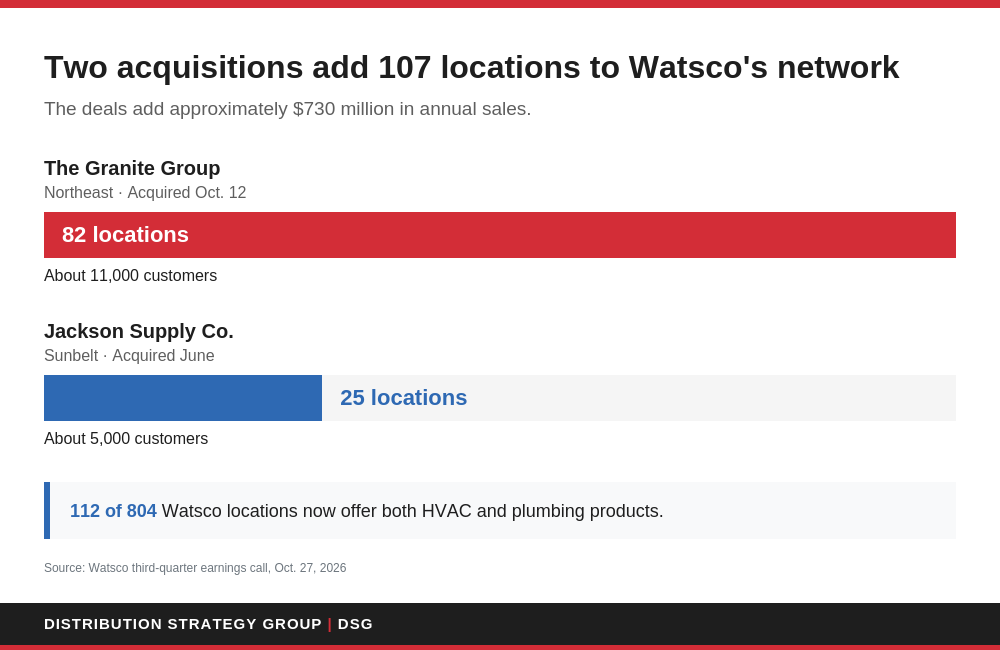
Executives outlined the strategy during the Miami-based distributor’s Oct. 27 earnings call, following two acquisitions that added 107 locations and approximately $730 million in annual sales. The purchases broaden Watsco’s geographic reach while creating opportunities to introduce its technology and services to more contractors.
The latest acquisition, The Granite Group, adds 82 Northeast locations serving approximately 11,000 customers. Jackson Supply Co., acquired in June, brought in 25 Sunbelt locations and approximately 5,000 customers.
Watsco CEO Albert Nahmad said plumbing now represents an explicit growth priority alongside heating, ventilation and air conditioning distribution.
“We are now committed to growing in the plumbing market, which means that we have enormous opportunities in that distribution business of plumbing as well as the HVAC market,” Nahmad said. “We have two industries that we can play and play hard and get size.”
Granite is Watsco’s fourth acquisition of a distributor serving both HVAC and plumbing contractors. Watsco now has 112 locations offering both categories within a network of 804 locations.
Barry Logan, Watsco’s executive vice president of planning and strategy and corporate secretary, said the company’s approach centers on established distributors with experience in both trades.
“We get a lot of questions about entering plumbing, and what we’ve actually entered is acquiring businesses that have done both HVAC and plumbing well for decades,” Logan said.
Founded in 1971 and based in Concord, New Hampshire, Granite offers approximately 29,000 products from more than 450 suppliers. It has expanded through acquisitions and more than 30 new store openings since 2010. Watsco completed the acquisition Oct. 12, and Granite will continue operating independently under CEO Bill Condron and its existing management team.
Executives also see an opportunity to extend digital services to plumbing contractors. Rick Gomez, Watsco’s vice president of corporate development, said those customers generally have experienced less consolidation and adopted less technology than their HVAC counterparts.
“We think that there’s the same kind of maturity and sophistication curve that we’ve seen with our HVAC contractor base over the last five or 10 years and how they’ve adopted technology in their business,” Gomez said. “We think that it’s in the very early innings as it relates to the plumbing contractor.”
Watsco President A.J. Nahmad added: “Which is all opportunity in the long term.”
Watsco’s acquisition strategy emphasizes management continuity, local operations and investment in growth. Logan said the company intends to build on the businesses it acquires rather than focus on combining operations or cutting expenses.
“When we acquire a company like Granite or Jackson, we’re keeping the people, we’re keeping the culture, we’re keeping the infrastructure, we’re keeping what’s made them successful for 50 years,” Logan said. “The question is, how do we help them build on that success and build on their networks?”
Albert Nahmad said Watsco also provides equity within acquired organizations, giving leaders an ownership stake in the larger company. Executives described access to technology, products and financial resources as the principal ways Watsco supports those businesses.
The company has invested approximately $280 million in digital platforms over five years. Ecommerce sales increased 10% in the third quarter and 12% through September, reaching $2.75 billion over the preceding 12 months, or 37% of revenue.
Its internal artificial intelligence platform, Ask.Watsco, supports more than 2,700 employees. A separate customer-facing model, AL.watsco, provides product information and recommendations. Both draw on customer, product and supplier data developed over 15 years.
A.J. Nahmad said ecommerce accounts for 60% to 70% of sales in some markets, while the company’s mobile app has more than 73,000 active monthly users. He said the objective is to make Watsco’s operating companies easier to do business with while helping contractors grow.
“Simply put, the contractors we serve digitally are growing faster, have greater loyalty, and we believe we can lower our cost to serve at scale over time,” he said.
Watsco’s digital services also extend into contractors’ sales activities. Its OnCallAir proposal platform was used to present approximately 351,000 proposals to homeowners over the preceding 12 months, generating $2 billion in gross merchandise value, up 14%. That figure measures contractor business conducted through the platform and is separate from Watsco’s distribution revenue.
The company is testing another platform, SupplySync, to serve large institutional customers. A.J. Nahmad said the pilot is processing transactions, with plans to add customers in the coming months.
“This is a growing channel with unique customer needs that provides incremental growth opportunity for Watsco while leveraging our existing scale and infrastructure,” he said.
Executives linked that opportunity to contractor consolidation, including the expansion of midsize businesses backed by private equity. Gomez said customer acquisitions can create openings for Watsco to win business previously supplied by other distributors.
A.J. Nahmad said Watsco intends to serve those larger organizations while continuing to support smaller contractors.
“The small guys with one truck or three trucks, we have wonderful pricing and programs and technology and systems and processes for those guys as well, including helping them go from small to big, because when they do, they drag us along in their growth, and they are very loyal,” he said.
Watsco is also changing how it purchases and distributes parts and supplies. Its Vendor Consolidation and Rationalization initiative is expanding across non-equipment categories, with executives describing the effort as a way to improve purchasing and strengthen relationships with selected suppliers.
Hydros, the company’s shared logistics and distribution initiative, is expected to reach more locations and vendors in 2027. A.J. Nahmad said the program helps operating companies broaden their offerings.
“We love Hydros, which is helping our business units carry more products on the parts and supply side and expand their offering,” he said.
Watsco purchased approximately $1.7 billion in non-equipment products from more than 1,500 vendors over the preceding 12 months. Those products accounted for 30% of total purchases, compared with the company’s estimate that non-equipment products represent 40% of the HVAC and refrigeration market’s product mix.
The initiatives come as sales improve but earnings remain below year-earlier levels. Third-quarter sales increased 7.4% to $2.22 billion, while net income attributable to Watsco declined 3.8% to $155.4 million. Through September, sales rose 3.5% to $5.86 billion, while attributable net income fell 6.5% to $397.8 million.
Executives said replacement demand has improved but has not fully returned to normal. Consumer uncertainty and equipment purchases pulled forward during the pandemic continue to influence buying.
Watsco is also expanding its offering of side-discharge HVAC systems as contractor acceptance increases. Executives said a broader selection of brands and price points gives contractors additional efficiency options to offer homeowners, many of whom have been choosing entry-level equipment.
Across the acquisitions and operating initiatives, executives described the same objective: giving distributors more resources to expand while preserving the businesses and customer relationships they have built.
“How do we provide them the technology, the financial resources so they can grow faster?” said Paul Johnston, Watsco’s executive vice president. “That’s the opportunity, and that’s the only synergy we have.”
Do not miss any content from Distribution Strategy Group. Join our list.
Share this article:
