

Why This Matters to Distributors: QXO is bringing together purchasing, sales and technology across Beacon Roofing Supply, Kodiak Building Partners, and TopBuild. Its strategy combines broader product offerings with installation services, coordinated deliveries and higher-margin private-label products to capture more of contractors’ spending.
QXO is consolidating purchasing across approximately $12 billion in spending and changing sales incentives to sell more products to existing customers as it integrates Beacon Roofing Supply, Kodiak Building Partners, and TopBuild.
Chairman and CEO Brad Jacobs detailed the changes during a Nov. 9 conference call, outlining efforts to recover dormant accounts, improve underperforming branches and connect sales, inventory, and delivery systems. The strategy centers on winning more business from customers already served by the three acquired companies.
“We have about 194,000 unique customers, and almost none of them currently buy our full product offering,” Jacobs said. “We already have ongoing relationships with these customers, and in many cases, we’re already on their job sites.”
QXO subsequently reported third-quarter sales of $4.895 billion, up 79.4% from $2.728 billion a year earlier, reflecting acquisitions. Its net loss narrowed 11.5% to $123 million from $139 million, according to results released Nov. 12.
TopBuild contributed $1.64 billion in quarterly sales following its July 1 acquisition, while Kodiak contributed $589 million following its April 1 acquisition. Their combined contribution slightly exceeded QXO’s $2.167 billion year-over-year sales increase.
The reported growth therefore reflects a larger company rather than a comparable increase in sales across existing operations. Jacobs said underlying daily sales trends improved for a second consecutive quarter, but the earnings release did not quantify companywide organic sales growth.
QXO’s 28,000 employees serve customers through 1,150 branches across all 50 states and seven Canadian provinces, Jacobs said. Its customers include general contractors, specialty subcontractors, production homebuilders, and custom builders.
The acquisitions give QXO opportunities to supply more categories on the same construction project. Jacobs cited data centers, where an insulation customer could also purchase roofing, waterproofing and doors, and homebuilders whose relationships with Kodiak began with lumber, trusses, or engineered products.
QXO has revised compensation to reward salespeople for selling across product categories and increasing private-label sales. It also has reactivated 3,300 dormant accounts, Jacobs said, although he did not disclose the revenue generated by those accounts.
Tens of thousands of inactive accounts remain, including approximately 2,000 larger former customers that once generated $500 million in combined business with the acquired companies.
A pilot in Tampa is testing how QXO can coordinate distribution, installation, and field management across 18 trades. Jacobs said combining services could reduce duplicate trips, material handling, and scheduling problems. One example is coordinating interior trim and garage door installation during a single visit.
The company also wants to track its participation in individual projects more closely. Jacobs said a connected system could show whether QXO supplies a hospital’s roofing, mechanical insulation, building insulation, and doors, helping salespeople identify additional business.
Purchasing consolidation is another major part of the integration.
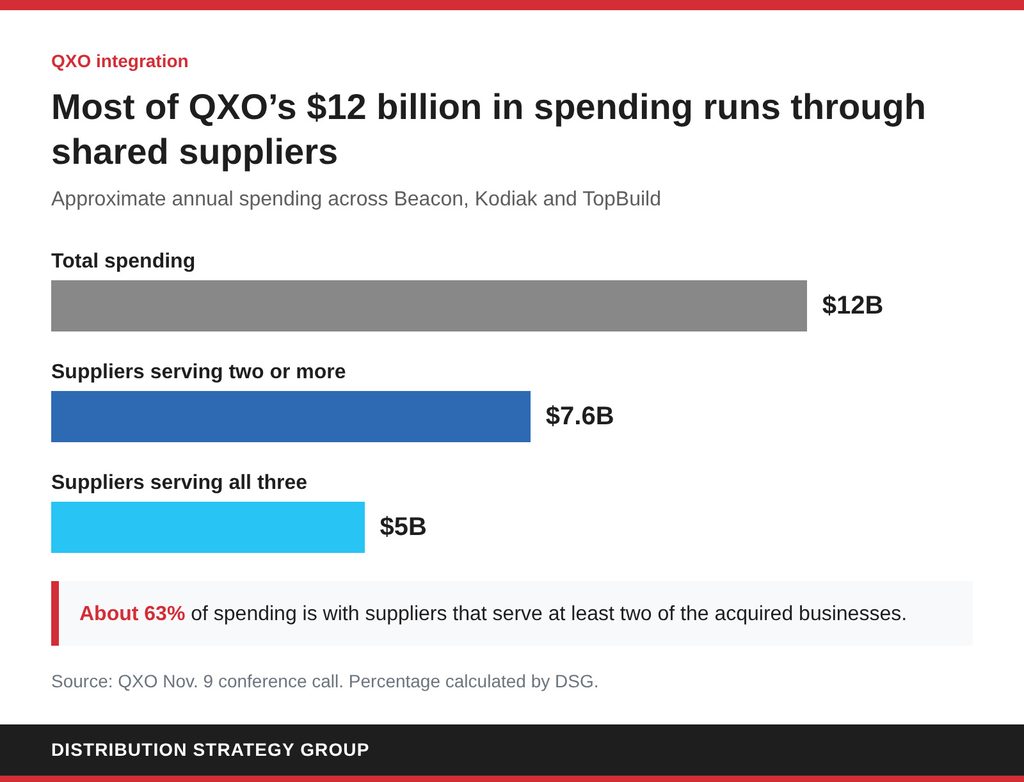
Jacobs said the three acquired businesses account for approximately $12 billion in spending, including about $11 billion in products and materials and more than $1.1 billion in indirect goods and services. Approximately $7.6 billion is with suppliers serving at least two of the businesses, including $5 billion with suppliers serving all three.
QXO is coordinating negotiations, consolidating suppliers, and pursuing common purchasing agreements and improved rebate collection. The company now purchases more than $1 billion annually from some suppliers and hundreds of millions of dollars from others, Jacobs said.
“We want deep relationships with a smaller number of strategic supplier partners,” he said. “We want to be important partners with them and preferably their most important partner.”
Jacobs said QXO intends to pass some purchasing savings on to customers and retain some itself. The company already has achieved savings in fleet, technology, and waste disposal, he said, without providing amounts.
Private-label products are a separate priority. Jacobs said their margins are approximately 20 percentage points higher than the rest of QXO’s product mix.
TRI-BUILT reached a record 10.6% of roofing and waterproofing sales in the third quarter. The brand generated $943 million in sales over the preceding 12 months, entirely within the former Beacon business.
QXO aims to increase TRI-BUILT sales to more than $2 billion over three years by adding products and encouraging salespeople to sell the brand. It also plans to expand private-label offerings at the former Kodiak and TopBuild operations.
Third-quarter sales of complementary products in roofing and waterproofing increased 4.2% to $607 million. That included increases of 16% in gutters and accessories, 15% in fiber cement and 7% in windows. Mechanical insulation distribution revenue increased 16%, supported in part by data center demand.
Jacobs tied QXO’s pricing strategy to improvements in product availability, delivery, and customer service. Companywide pricing increased 2.2% year over year during the quarter, with increases in nine of its 11 business areas.
Monthly companywide pricing moved from a 1.7% year-over-year decline in April to a 2.3% increase in September. In roofing and waterproofing, it moved from a 1.1% decline to a 4.1% increase over the same period.
QXO has tightened oversight of excessive price overrides and is developing tools that consider demand, inventory availability, customer profitability, and sensitivity to price changes.
In roofing and waterproofing, third quarter on-time delivery performance improved by 6.5 percentage points, and instances of key products being out of stock declined more than 25%, Jacobs said. Invoice accuracy improved from the low 90% range at the beginning of the year to the high 90% range in the third quarter.
Face-to-face customer meetings increased 57% from July to early November. About one-third of regions exceeded QXO’s 95% on-time delivery target, he said.
QXO also is assigning experienced operators to underperforming branches and extending practices used at TopBuild to other operations. Those efforts focus on customer contact, pricing, staffing, and inventory management.
Jacobs said the company has reduced unnecessary management layers, adjusted reporting responsibilities, and tied compensation more closely to operating goals. It also is expanding its Precision Leadership Training program to the sales organization.
Technology is intended to connect the operating changes across the acquired businesses.
QXO is implementing an enterprise resource planning system, a proprietary point-of-sale system, warehouse, and transportation management systems, purchasing automation, pricing tools, and customer relationship management software with artificial intelligence capabilities.
The company is testing the technology at operating locations and training employees before accelerating deployment. Jacobs said he expects operations representing most of the revenue across the three businesses to use the new platform within the following year.
The systems are intended to reduce repeated data entry, provide real-time inventory, and order information, and speed quotations. Jacobs said QXO wants employees to produce quotes in seconds or minutes rather than hours or days.
Warehouse initiatives include automating inventory scanning, storage assignments and picking. Transportation tools are intended to improve truck loading and routing, while expanded online capabilities would let customers check inventory, obtain quotes, place orders, and track deliveries.
Jacobs said one AI project could potentially double sales force productivity in a business unit. He did not identify the unit, define the productivity measure, or provide results demonstrating that improvement.
Sales strengthened in October, according to Jacobs. Companywide daily sales increased 5.4% year over year, while roofing and waterproofing daily sales increased 9.1%.
The third quarter financial results showed higher gross profit alongside increased operating and financing expenses.
Gross profit rose to $1.38 billion from $636 million, and gross margin increased to 28.2% from 23.3%. Operating income fell to $2 million from $25 million as operating expenses increased to $1.378 billion from $611 million. Net interest expense rose to $163 million from $37 million.
For the first nine months, sales increased 112.4% to $9.871 billion from $4.648 billion, while the net loss widened 114.3% to $405 million from $189 million.
Those comparisons also reflect acquisition timing. This year’s results include Kodiak beginning April 1 and TopBuild beginning July 1, while the prior-year period includes Beacon only from April 29.
Adjusted net income increased 38.0% to $229 million in the quarter from $166 million. For the first nine months, it declined 2.9% to $302 million from $311 million. That company-defined measure excludes amortization, stock-based compensation and certain acquisition, restructuring and business transformation costs, among other items.
QXO also announced Nov. 12 that Dev Ahuja will become chief financial officer in January 2027. He will succeed Ihsan Essaid, who will become vice chairman, an executive role overseeing acquisitions and capital-raising activities.
Ahuja joins from aluminum producer Novelis, where he has served as chief financial officer since 2016. QXO said he helped complete and integrate Novelis’ $2.8 billion acquisition of Aleris. Essaid, QXO’s chief financial officer since July 2024, will report to Jacobs.
The board separately authorized up to $500 million in common stock repurchases, with no expiration date. The authorization does not require QXO to purchase shares.
Jacobs reiterated a goal of $50 billion in annual revenue within the decade through acquisitions and internal growth. He also outlined a target of $4 billion in adjusted earnings before interest, taxes, depreciation, and amortization by 2030 from businesses QXO already owns.
Using internally generated cash for smaller acquisitions could increase that figure to approximately $5.5 billion, he said. Both figures are management targets.
The Nov. 9 call also addressed Jacobs’ proposed separate venture through CKX Lands. His family office and minority co-investors have agreed to invest $1 billion, including an expected $900 million from Jacobs.
The transaction remains subject to closing conditions, including CKX shareholder approval. Jacobs said he would become CKX’s chairman and CEO while retaining both roles at QXO. The industry for the new venture had not been selected.
Asked how he would balance the responsibilities, Jacobs cited his experience managing multiple businesses and his departure from the boards of XPO, GXO and RXO the previous year.
“But I want to emphasize I am 100% fully committed to QXO,” he said.Do not miss any content from Distribution Strategy Group. Join our list.
Share this article:
