

Why This Matters to Distributors: Motion’s latest results point to strengthening demand across both maintenance, repair and operations (MRO) and larger capital projects as Genuine Parts prepares to spin off the business in early 2027. The company’s performance offers distributors an early indication that industrial spending is broadening across more end markets after two years of uneven growth.
Motion, the industrial distribution business of Genuine Parts Co., reported stronger second-quarter results as industrial demand continued to broaden across manufacturing markets, with growth accelerating in both routine maintenance spending and larger capital projects.
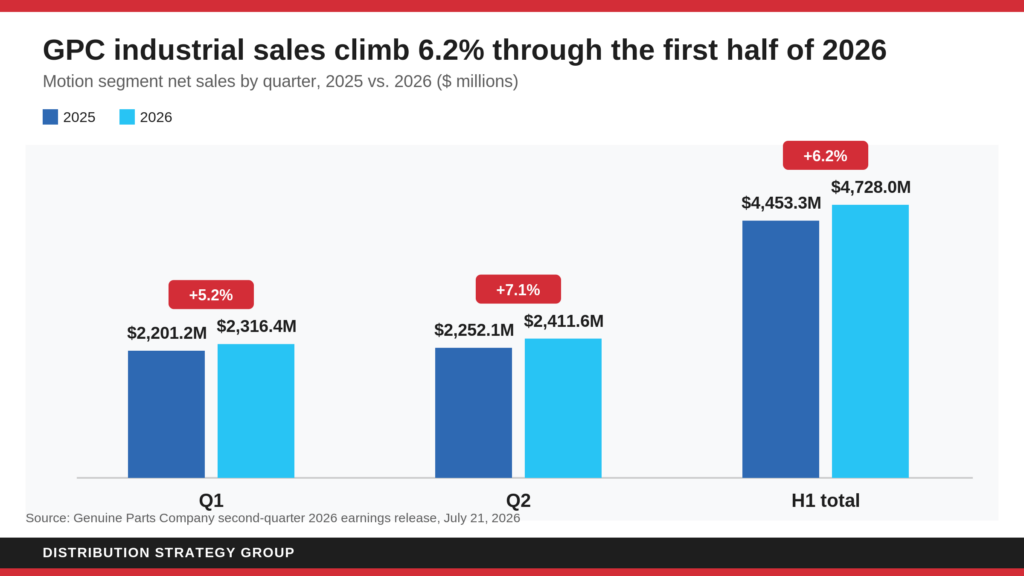
The Atlanta-based distributor generated $2.4 billion in second-quarter sales, up 7% from a year earlier, while operating earnings before interest, taxes, depreciation, and amortization (EBITDA) rose 10% to $316 million, executives said during Genuine Parts’ July 21 earnings call.
Comparable sales in the Industrial segment, which include Motion, increased 6%, with price increases accounting for about 2.5 percentage points of growth. The segment’s EBITDA margin improved to 13.1% from 12.8% a year ago as pricing and sourcing initiatives lifted gross margins.
Chairman and CEO Will Stengel called it “an excellent quarter,” citing balanced growth across the company’s customer base.
“Motion posted balanced growth across large corporate accounts, small- to medium-sized local customers, as well as its value-added solution offerings,” Stengel said.
He also pointed to six consecutive months of Purchasing Managers’ Index readings above 50 as evidence that U.S. industrial activity continues to strengthen.
The improvement reached 11 of the 14 end markets Motion tracks, up from 10 in the first quarter and only five in the same period last year.
Equipment and machinery and food products posted the strongest gains. Other markets showing growth included iron and steel, automotive, mining, fabricated metals, distribution centers and logistics, oil and gas, and equipment rental and leasing. Pulp and paper, lumber and wood products, and rubber and plastics remained weaker.
Motion’s core maintenance, repair, and operations (MRO) business, which represents about 80% of sales, grew approximately 7% and improved sequentially from the first quarter. The remaining 20% of revenue, tied to larger capital projects, increased approximately 9% — its strongest performance since the first quarter of 2023, according to Executive Vice President and Chief Financial Officer Bert Nappier.
The results suggest manufacturers are beginning to move beyond routine maintenance spending and resume larger equipment and infrastructure investments that have been delayed over the past two years.
Geopolitical tensions had little direct effect on Motion during the quarter.
Genuine Parts said the conflict involving Iran reduced companywide EBITDA by approximately $16 million, but only about $1 million affected the Industrial segment. Most of the impact was concentrated on the automotive business.
Stengel said the conflict created “a qualitative overhang with customer discussions” rather than materially slowing industrial demand. Softer conditions in Motion’s Asia-Pacific operations partially offset the segment’s profit growth.
The quarter also marked another milestone in Genuine Parts’ plan to separate its Global Automotive and Global Industrial businesses into two independent public companies.
The company said the transaction remains on schedule to close during the first quarter of 2027. Management completed a standalone audit for the industrial business and expects to confidentially file a Form 10 with the Securities and Exchange Commission later this summer. Investor days for both companies are scheduled for early December in New York.
Nappier said the standalone Motion company will incur additional costs as it builds its own corporate infrastructure. He estimated annual corporate expenses of $50 million to $75 million, plus another $25 million to $40 million in separation-related operating costs, bringing total additional annual costs to $100 million after the split.
Stengel also dismissed speculation that Genuine Parts could sell its automotive business instead of completing the separation.
“We are not currently in discussions with any competitor,” he told analysts.
For industrial distributors, Motion’s quarter provides one of the strongest signals this year that manufacturing activity is improving across a wider range of industries.
Capital-project spending, which had lagged as manufacturers delayed investments amid economic uncertainty, is now growing faster than Motion’s core MRO business. At the same time, the number of expanding end markets has more than doubled from a year ago, indicating that the industrial recovery is becoming broader rather than concentrated in a handful of sectors.
That trend could benefit distributors serving heavy industry, manufacturing, logistics, energy, and food processing as customers begin approving larger projects while maintaining steady demand for day-to-day maintenance products.
As Motion prepares to become an independent public company, investors and competitors will also gain a clearer view of its operating performance. The company will enter the market as one of North America’s largest industrial distributors, competing directly with Applied Industrial Technologies and MSC Industrial Supply while facing greater scrutiny of its growth, profitability, and execution.
Despite the additional costs associated with the separation, management remains optimistic about the second half of the year.
Nappier told analysts he expects Motion to “deliver a fantastic fiscal year,” assuming manufacturing activity and customer demand remain stable through the remainder of 2026.
Do not miss any content from Distribution Strategy Group. Join our list.
Share this article:
