


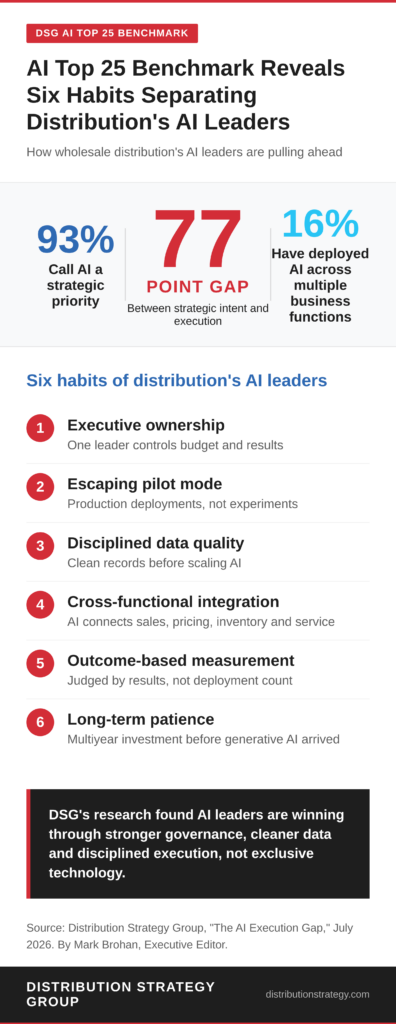
Why This Matters to Distributors: DSG’s research found the companies leading in AI aren’t using technology unavailable to competitors. They are outperforming through stronger governance, cleaner data, and disciplined execution. As AI deployments begin reinforcing one another across pricing, inventory, sales and customer service, distributors still confined to pilot projects risk falling further behind rivals already generating compounding operational gains.
Distribution Strategy Group’s AI Top 25 benchmark set out to identify 25 wholesale distributors that had moved artificial intelligence beyond pilot projects and into everyday operations. Researchers found 26 companies met the standard and expanded the list rather than exclude a qualifying distributor, according to DSG’s July 2026 report, The AI Execution Gap.
The result highlights a broader challenge facing the industry. While 93% of the 233 distribution executives surveyed for DSG’s State of AI in Distribution research said AI is a strategic priority, only 16% have deployed it across multiple business functions—a 77-point gap between ambition and execution.
DSG’s research suggests the obstacle isn’t technology. Over two years, researchers evaluated more than 300 North American distributors through earnings calls, executive interviews, customer case studies, and vendor documentation. Companies whose AI efforts remained limited to announcements or pilot projects were excluded. To qualify, distributors had to demonstrate sustained production deployments delivering measurable business value.
The companies that made the AI Top 25 distinguished themselves not by the software they bought, but by how they organized their businesses.
“What we mean by this gap is that companies are convinced AI matters, but they’re still in pilots or conceptual stages rather than execution,” said Jonathan Bein, DSG co-founder and managing partner. “We believe that gap will narrow over the next several years because many of today’s pilots will eventually become production deployments.”
Across the 26 qualifying distributors, DSG identified six management practices that consistently separated AI leaders from the rest of the field, regardless of company size, ownership structure or end market: executive ownership, moving beyond pilot projects, disciplined data management, cross-functional deployment, outcome-based measurement and long-term commitment.
The clearest pattern was executive ownership.
Rather than spreading responsibility across steering committees, leading distributors typically put one executive in charge of AI strategy, budget, and results.
“All these folks named a single owner,” said Brian Hopkins, DSG’s chief operating officer. “If you have budget authority, you’re the owner. You’re not a committee.”
Sonepar illustrates that approach. The company appointed Fabrice del Aguila, senior vice president of AI, data, and digital factory, to lead a five-year, €1 billion ($1.16 billion) transformation with Microsoft, Publicis Sapient and Hitachi Solutions. Del Aguila said the initiative will deliver agentic AI capabilities that act as an “exoskeleton” for Sonepar’s 24,000 sales associates through its global omnichannel platform.
Another defining characteristic was a willingness to move beyond pilot projects.
Wesco International’s finance organization now processes about 40% of its 3 million annual invoices without human intervention using Genpact’s AP Suite AI agents. Ingram Micro has also shifted from experimentation to enterprise-scale deployment. CEO Paul Bay said the company’s Xvantage platform now supports more than 400 AI models through its patented AI Factory, helping drive AI-led sales growth of more than 60% year over year in its largest markets.
“They stopped piloting a couple years ago and started making sure AI worked across the business,” Hopkins said.
Data quality emerged as one of the most overlooked competitive advantages.
More than half of the executives surveyed cited employee skills gaps or organizational resistance as their biggest AI challenge, with data quality close behind. Border States demonstrated what disciplined data management can achieve. According to a Nucleus Research case study, the company’s GAINS machine-learning lead-time prediction system generated a 976% return on investment, reduced inventory by $21 million and achieved payback in 1.3 months across a $600 million, 300,000-item inventory network.
Cardinal Health took a similarly long-term approach, establishing an enterprise AI center of excellence in 2021—well before generative AI entered the mainstream—and later building its Palantir-powered InteLogix supply chain platform on that foundation.
The research also found AI delivers greater value when deployed across multiple business functions rather than as isolated applications.
“The companies that started this process are now taking multiple AI use cases and putting them together simultaneously,” Hopkins said. “That’s going to be a differentiator over the next couple years.”
Grainger built product search and contact-center retrieval on a shared Databricks Mosaic AI platform, allowing both systems to draw from the same 400,000 daily product updates. Sysco’s SAGE, or Sysco Agentic Ecosystem, generates next-best-action recommendations across sales, supply chain, customer experience, and back-office operations. More than 95% of the company’s sales professionals now use its AI360 platform weekly.
The AI leaders also measured success by business outcomes rather than the number of deployments.
MSC Industrial Direct projects AI-driven inventory forecasting will generate $10 million to $15 million in annual savings by 2026. Fastenal evaluates AI investments against workforce productivity, targeting 5% to 10% efficiency gains across $1.6 billion in annual employee-related costs, former CEO Dan Florness said before Jeff Watts succeeded him as chief executive in July.
The final characteristic was patience.
Most Platinum-tier companies invested for years in analytics, automation and machine learning before generative AI captured widespread attention. When new AI capabilities emerged, they already had the data, governance and infrastructure needed to scale quickly.
Cencora paired that long-term investment with formal governance, using Infinitus AI voice agents to automate benefit-verification calls while maintaining human oversight for AI-assisted literature reviews.
Taken together, the six practices reinforce one another. Better forecasting improves inventory decisions. Cleaner inventory data strengthens customer service. Every customer interaction generates information that improves future AI recommendations. As those capabilities compound, so do the competitive advantages.
For distributors, the lesson is clear. AI leadership depends less on technology budgets than organizational discipline.
Employee-owned Graybar named a vice president of AI and digital transformation in 2025 to oversee its enterprise resource planning modernization, while privately held Hajoca acquired AI startup Onsemble to support its decentralized branch network. Neither company matches Ingram Micro’s scale, yet both earned a place in DSG’s AI Top 25.
The research suggests midsize distributors can follow the same path: establish clear executive ownership, improve product and customer data, measure AI against business outcomes and expand proven use cases across the organization. Companies widening the AI execution gap aren’t buying exclusive technology, they’re executing better.
Do not miss any content from Distribution Strategy Group. Join our list.
Share this article:
