


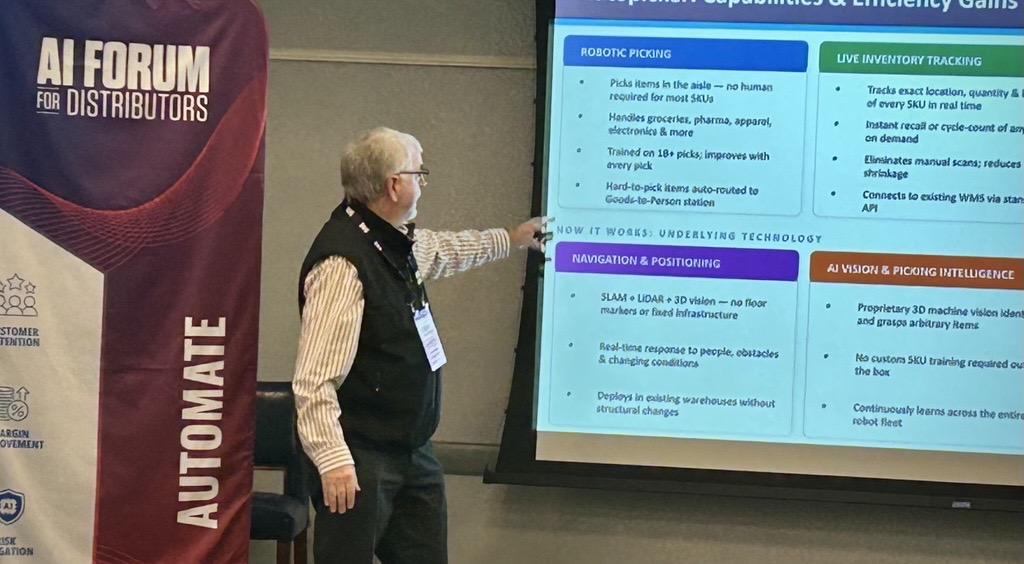
Why This Matters to Distributors: Distribution Strategy Group opened its Atlanta AI Forum on Aug. 12 at the Georgia Tech Hotel and Conference Center with new data showing AI moving into core distribution operations, including collections, order processing, inventory management, and warehouses. But adoption remains uneven, creating a widening gap between distributors deploying AI now and those still planning their first projects.
Distributors are moving artificial intelligence beyond experimentation and into day-to-day operations, but adoption remains limited across many business functions, according to research presented Wednesday at Distribution Strategy Group’s Applied AI for Distributors Atlanta Forum.
Jonathan Bein, Ph.D., co-founder and managing partner of DSG, opened the Aug. 12 event at the Georgia Tech Hotel and Conference Center with a presentation examining where distributors are putting AI to work and the results companies are reporting.
Bein focused on applications in accounts receivable, warehouse operations, sales and customer relationship management, quote and order processing, and inventory management.
A central theme was the difference between experimenting with AI and putting it into production. Bein distinguished generative AI, which creates content in response to prompts, from agentic AI, which can take actions across multiple systems with limited human intervention. He also differentiated conventional software with added AI features from applications built around AI as a core function.
In accounts receivable, Bein pointed to AI systems that automate invoicing, payment processing, and collections. He cited implementations that have reduced time spent on manual accounts receivable work by more than 75% and cut the number of days customers take to pay by 20% to 35%.
Warehouse operations represent another area where AI is being deployed. Bein discussed autonomous robotic picking systems that use lidar, 3D vision and mapping technology to navigate warehouses without fixed floor markers or other infrastructure. He cited deployments producing efficiency gains of more than 75%.
Order processing is also emerging as a significant use case because distributors continue to receive much of their business in formats that require employees to manually enter information.
More than 75% of business-to-business orders arrive through email, PDFs, spreadsheets, voicemail, or handwritten notes rather than standardized electronic formats, according to data presented at the forum. AI systems can read those documents, identify products, and convert the information into orders ready for enterprise resource planning systems.
Bein cited a 57% conversion rate on AI-processed transactions compared with about 20% for average transactions, along with productivity gains of 20% to 30%.
Inventory management is another developing application. Machine learning systems can combine a distributor’s historical sales information with outside data such as weather and regional demand patterns to improve inventory decisions. Bein cited implementations that reduced inventory by more than 10% while increasing inventory turns by as much as 40%.
Despite those examples, DSG research shows that AI adoption remains concentrated in a small number of business functions.
Marketing had the highest current AI use among distributors at 21%, followed by information technology and website and digital operations, both at 17%. Purchasing, physical security and warehousing had among the lowest current adoption rates, although those functions also had some of the largest percentages of distributors planning deployments within the next one to two years.
Bein also addressed AI’s potential effect on distributor employment. A DSG model using a hypothetical distributor with 500 employees in 2026 projected that automation could reduce staffing needs by 226 positions by 2030, primarily in warehouse and customer service operations.
Bein said those reductions could be absorbed through normal employee turnover rather than layoffs because projected attrition exceeds the estimated reduction in staffing needs across most functions. The result would be slower hiring as companies automate more work.
DSG’s modeling also projects that distributors using AI could reduce labor costs by 3 to 5 percentage points, increase revenue and inventory turnover by 6% to 10%, and improve Net Promoter Scores by 10 to 15 points.
The data presented at the Atlanta forum points to an industry where practical AI use is increasing but remains far from widespread. Many distributors remain one to three years away from deploying AI in core operational areas such as purchasing and warehousing.
“The swift will beat the slow, more than the large will beat the small,” Bein said, describing how he expects AI adoption to affect competition among distributors.
Do not miss any content from Distribution Strategy Group. Join our list.
Share this article:
