



Why This Matters to Distributors: Diesel has climbed to a record $6.285 a gallon nationally, forcing distributors to decide how much of the increase they can absorb, pass through to customers, or offset through more efficient operations. Public distributors are responding with fuel hedges, surcharges, price increases, and distribution network changes, but their disclosures show that none of those strategies completely protect margins when fuel prices rise rapidly.
Record diesel prices are pushing deeper into wholesale distribution, raising the cost of moving products from suppliers to distribution centers, branches and customers and forcing companies to rethink how they manage transportation expenses.
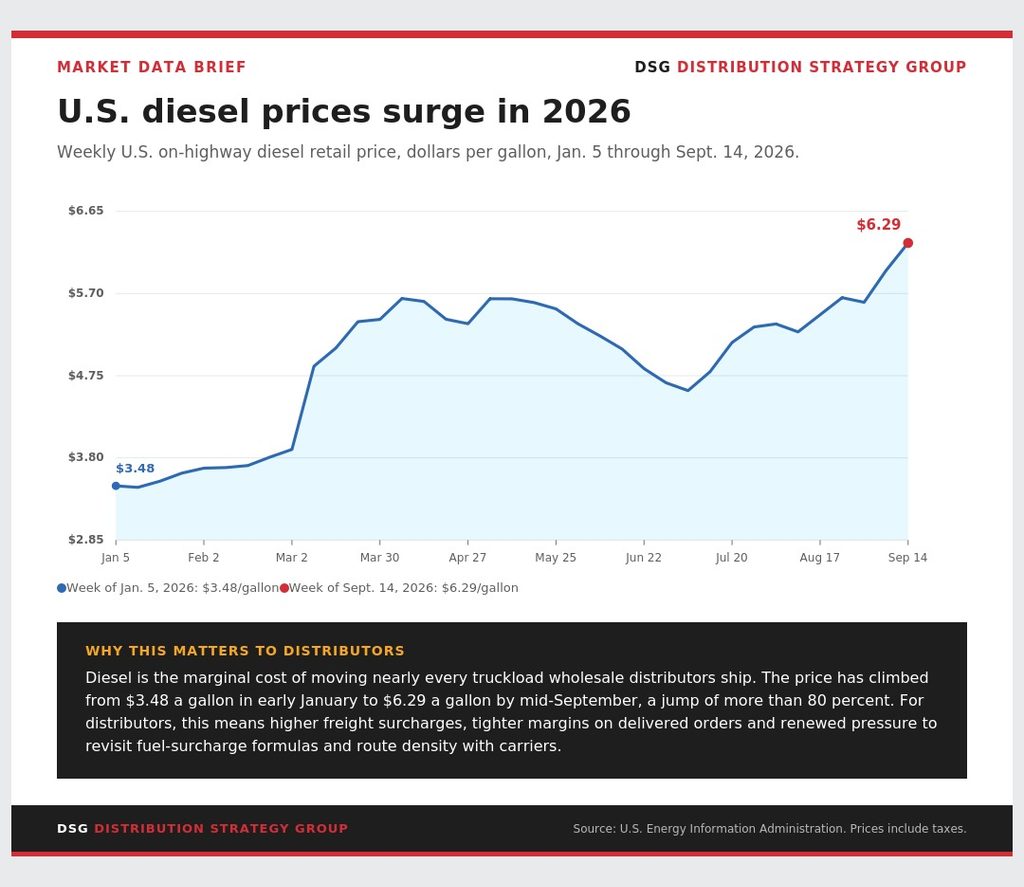
The U.S. average retail price for on-highway diesel reached $6.285 a gallon for the week of Sept. 14, according to the U.S. Energy Information Administration. That was up 31.8 cents from the previous week and $2.546, or 68.1%, from a year earlier. The Sept. 14 price is the highest in EIA’s national weekly series dating to 1994.
The speed of the increase is adding to the pressure. Diesel averaged $5.599 a gallon on Aug. 31 and $5.967 on Sept. 7 before reaching $6.285 on Sept. 14, an increase of 68.6 cents, or 12.3%, in two weeks.
For distributors, the impact extends well beyond the diesel pumped into company trucks. Higher fuel prices are showing up in inbound freight, outbound deliveries, carrier fuel surcharges, and supplier costs, while customer pricing and surcharge mechanisms can take weeks or months to catch up.
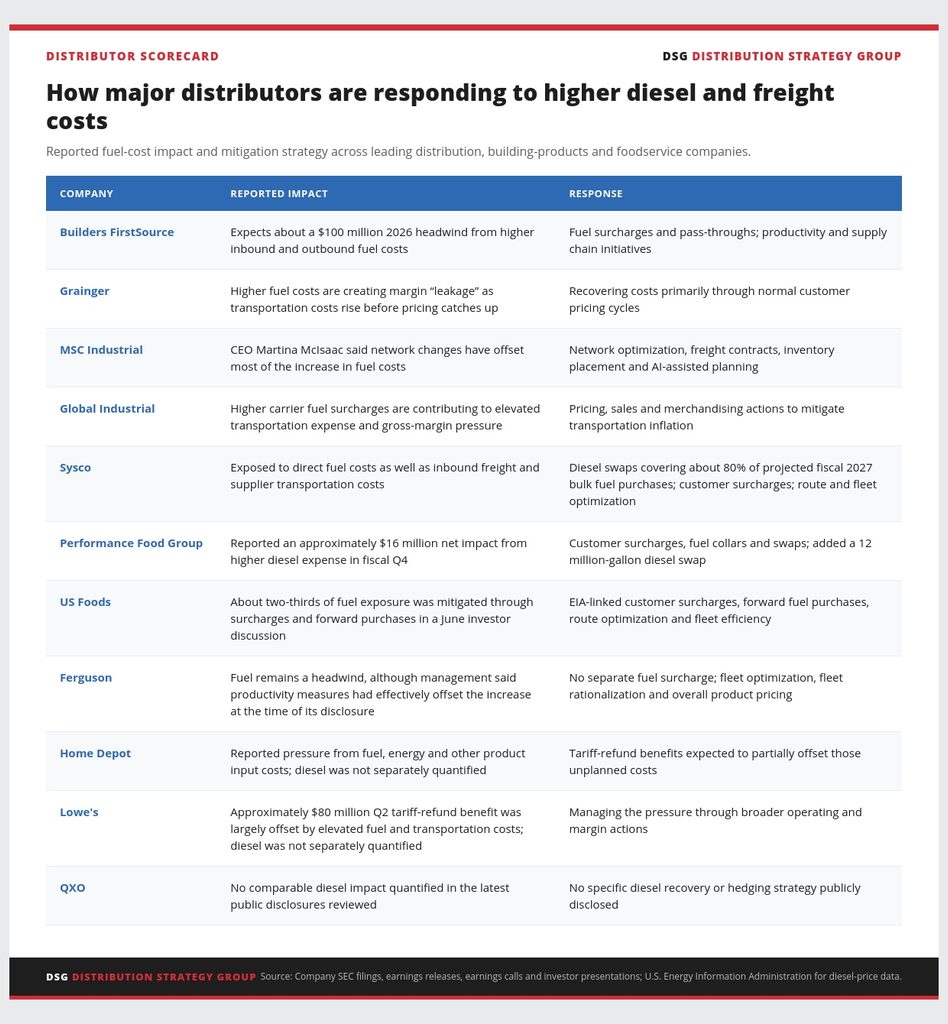
The responses vary widely. Builders FirstSource expects a $100 million fuel headwind this year. Grainger is absorbing some higher freight costs until pricing catches up. MSC Industrial says network optimization is offsetting most of its fuel pressure. Ferguson is refusing to impose fuel surcharges, while Sysco, Performance Food Group and US Foods are using financial contracts and customer surcharges to limit their exposure.
The widespread problem is timing. Diesel prices can change dramatically in a matter of days, while distributor pricing and customer contracts often cannot.
Builders FirstSource: A $100 Million Fuel Headwind
Builders FirstSource has put one of the biggest numbers on the problem. Chief financial officer Pete Beckmann said during the building materials distributor’s July 30 second-quarter earnings call that management continued to expect a $100 million full-year headwind from higher fuel costs. “We’re still expecting about $100 million headwind from the higher fuel cost, the combination of the inbound and the outbound,” Beckmann said during the call.
Builders FirstSource is recovering some of the increase from customers, but not all of it. Beckmann said fuel surcharge and pass-through recovery increased about 20% during the quarter. “We are effective at passing some of it through,” Beckmann told analysts. “We have more work to do.”
Beckmann also explained during the call how fuel and transportation expenses move through the company’s financial statements. “The inbound is really going to show up in the cost of inventory, the cost of the materials, and that flows through cost of goods sold,” Beckmann said. “The outbound will be more in the SG&A line.”
That mismatch matters because a distributor can recover some of its fuel increase and still suffer near-term margin pressure. The expense and recovery do not necessarily appear at the same time or in the same part of the income statement.
Grainger: Fuel Costs Hit Before Pricing Catches Up
Grainger is confronting a similar problem without relying primarily on an explicit fuel surcharge. The industrial and MRO distributor has said higher fuel costs are creating margin pressure as transportation expenses rise before pricing catches up.
Chief Financial Officer Deidra Merriwether addressed the issue during Grainger’s second-quarter earnings call while discussing the company’s sequential gross margin performance. “As we’ve kind of talked about, we’ve had some leakage related to fuel costs,” Merriwether told analysts. “So that also was a factor from Q1 gross margin to Q2.”
Grainger also has said it has absorbed unfavorable freight costs as transportation expenses rise before the company’s next opportunity to adjust customer prices. That creates a different model from distributors that automatically tie a surcharge to an external diesel index. Grainger can seek to recover transportation inflation through normal customer pricing, but the company can remain exposed while waiting for those pricing actions to take effect.
The experience illustrates one of the central problems created by the current diesel spike. A distributor can know what it needs to recover from customers and still take a margin hit before its pricing system catches up.
MSC Industrial: Reduce the Freight Requirement
MSC Industrial Direct is attacking the problem from another direction. Instead of focusing primarily on recovering higher diesel costs, MSC has been working to reduce transportation expenses through network optimization, freight contracts, and better inventory placement.
CEO Martina McIsaac discussed the strategy during a Sept. 9 investor conference, saying those investments are helping MSC offset higher fuel costs. “If you look at what’s happening with fuel cost, we’ve been able to offset most of that because of what we’ve done already in our network,” McIsaac said during the conference.
McIsaac said MSC had invested heavily in improving how products move through its distribution system. “We have invested a lot in network optimization, so managing our balance of freight versus footprint, optimizing within the four walls of our distribution centers,” she said.
The strategy changes the fuel equation. Instead of asking only how much of a higher freight bill can be passed to customers, MSC is trying to reduce the freight requirement itself.
Better inventory placement can mean fewer miles, fewer expedited shipments, and more efficient use of distribution centers. That does not eliminate diesel exposure, but it can reduce the amount of transportation subject to higher fuel prices.
Global Industrial: Fuel Surcharges Hit Gross Margin
Global Industrial demonstrates that distributors do not need a large private truck fleet to feel the effects of record diesel prices. The industrial products distributor said higher carrier fuel surcharges pressured second-quarter gross margin.
Chief financial officer Thomas Clark discussed the impact during Global Industrial’s second-quarter earnings call. “Margin performance in the quarter reflected inflation within our transportation network associated with increasing fuel surcharges as well as product and channel mix,” Clark told investors.
Clark said the transportation pressure was continuing. “Fuel costs remain volatile and transportation expense continues to be elevated,” he said.
For distributors relying heavily on parcel, less-than-truckload and other third-party transportation providers, diesel inflation can arrive through a freight invoice rather than directly at the pump. Global Industrial said its pricing, sales and merchandising teams were working to mitigate the effects of those pressures on customers. But its results show how quickly carrier fuel surcharges can reach a distributor’s gross margin before pricing and other measures fully offset the increase.
Sysco: Hedging Does Not Cover Everything
Sysco has one of the more extensive fuel-management programs among major distributors, combining financial hedges, customer surcharges, and fleet productivity.
As of June 27, the foodservice distributor had diesel swaps covering approximately 87 million gallons through June 2028. The company expects those contracts to lock in the price of about 80% of its bulk fuel purchases for fiscal 2027, representing approximately 70% of total projected fuel requirements.
Even if that level of protection leaves Sysco exposed to transportation costs it does not control directly. Higher diesel prices can increase inbound freight and supplier costs even when the fuel used in Sysco’s own fleet is hedged. Sysco’s annual report also says the company works to reduce fuel consumption through route optimization, improved fleet utilization and controls on idling and maximum vehicle speeds.
The company’s strategy therefore operates on several levels: hedges much of the diesel it buys, consumes less of it, and recovers some remaining costs through customers. But the strategy also illustrates the limits of hedging. A financial contract covering diesel for a Sysco truck does not protect the company from a supplier increasing prices because its transportation costs have risen.
Performance Food Group: A $16 Million Quarterly Hit
Performance Food Group provides one of the clearest examples of how quickly diesel inflation can become a material operating expense. The foodservice distributor said higher diesel expense produced an approximately $16 million net impact during its fiscal fourth quarter despite its existing fuel-management strategy.
Chief financial officer Patrick Hatcher quantified the impact during PFG’s fiscal fourth-quarter earnings call. “During fiscal 2026, our team worked to manage the increase in diesel prices through our surcharge program,” Hatcher told investors. “In the fourth quarter, the net impact from higher diesel expense was approximately $16 million.”
Hatcher said the volatility had prompted PFG to consider additional protection. “Due to the volatility in fuel prices, we have examined our approach to fuel expense,” Hatcher said during the call. “While our strategy has done a nice job of mitigating fuel volatility, we are looking at additional ways to help manage our exposure in the future.”
PFG subsequently added another layer of protection. In July, the company entered a diesel swap covering 12 million gallons of forecast purchases through June 30, 2027, at a fixed price of $4.46 a gallon, according to its annual report. PFG also had 4.1 million gallons remaining under existing fuel collar contracts as of June 27.
PFG’s experience shows why surcharges alone may not be enough during a rapid fuel increase. A distributor can eventually recover some of the expenses from customers and still take a substantial short-term hit while the recovery mechanism catches up.
US Foods: About Two-Thirds of Exposure Mitigated
US Foods also combining customer surcharges with forward fuel purchases and operating efficiencies. As of March 28, the company had $27 million in diesel forward purchase commitments that locked in approximately 32% of its projected diesel requirements through December.
US Foods estimated that a hypothetical 10% unfavorable change in diesel prices could add approximately $12 million to fuel costs on uncommitted volumes through December.
Chief financial officer Dirk Locascio provided a breakdown of the company’s fuel protection during a June 3 investor discussion. Locascio told US Foods mitigated about 30% to 40% of its fuel exposure through customer surcharges and had about one-third of its fuel locked through forward contracts. “So, about 2/3 of it mitigated with the balance flowing through and impacting the P&L,” Locascio said during the discussion.
US Foods also works to reduce fuel exposure through route optimization, improved fleet utilization, and an expanding electric vehicle fleet. Fuel costs related to outbound deliveries totaled approximately $174 million in fiscal 2025, according to the company’s SEC filing.
The company’s disclosures demonstrate why extensive protection cannot eliminate diesel risk. About one-third of its exposure remained after surcharges and forward contracts.
Ferguson: No Fuel Surcharge
Ferguson is taking a distinctly different approach. The plumbing, HVAC and infrastructure distributor has rejected separate fuel surcharges, choosing instead to rely on productivity and overall product pricing.
During Ferguson’s first-quarter earnings call, UBS analyst John Lovallo asked management whether the company had hedging mechanisms in place and whether it had implemented fuel surcharges. Chief financial officer Bill Brundage responded.
“We have not implemented fuel surcharges. We do not intend to,” Brundage said. “We do not pass along surcharges as a matter of principle from a pricing perspective.” Brundage said diesel remained a headwind, but one Ferguson was working to offset through productivity initiatives, including fleet optimization and fleet rationalization. “Today, we’ve effectively offset that increase in fuel,” Brundage said. “It will remain a bit of a headwind that we will continue to work hard to offset.”
CEO Kevin Murphy followed Brundage’s response and explained why Ferguson prefers not to separate fuel from the overall customer transaction. Murphy said Ferguson operates a final-mile fleet of more than 5,900 trucks that delivers half of the company’s revenue.
“We need to make sure that that value-added service, that service that we offer, is in the price of product,” Murphy said.
Ferguson’s model contrasts sharply with distributors that tie fuel surcharges directly to diesel indexes. Both approaches attempt to recover transportation costs, but Ferguson embeds the value of delivery in overall product pricing rather than placing a separate fuel charge on the invoice.
Home Depot: Fuel Pressure Reaches Full-Year Guidance
Home Depot has not quantified its diesel exposure separately, but fuel and energy costs have become significant enough to affect its fiscal 2026 planning. The company said its full-year guidance includes tariff refunds expected to partially offset “unplanned fuel, energy, and other product input costs throughout the fiscal year.”
Chief financial officer Richard McPhail provided additional context during Home Depot’s second-quarter earnings call. “We’ve also experienced unplanned pressure from fuel, energy, and other product input costs,” McPhail said.
Home Depot’s second-quarter filing also said the benefit from tariff refunds was offset by incremental pressure from fuel, energy, and other product input costs, along with the inclusion of GMS in its consolidated results. Home Depot has not broken out diesel separately. Assigning a specific dollar figure to diesel alone would therefore go beyond the company’s disclosures.
What is clear is that fuel and energy inflation have become significant enough to factor in Home Depot’s full-year planning.
Lowe’s: Fuel and Transportation Eat Into an $80 Million Benefit
Lowe’s has provided an even clearer measure of pressure. The company received an approximately $80 million, or 30-basis-point, second-quarter gross margin benefit from tariff refunds. Chief financial officer Brandon Sink said during Lowe’s second-quarter earnings call that much of that benefit was consumed elsewhere in the cost structure. The tariff refund benefit was “largely offset by elevated fuel and transportation costs during the quarter,” Sink said.
That does not mean fuel alone cost Lowe’s $80 million. The company grouped fuel and transportation together, and other factors also affected second-quarter gross margin. But the comparison provides a useful indication of scale. Fuel and transportation inflation were significant enough to offset an approximately $80 million quarterly benefit that otherwise would have supported gross margin.
QXO Has Not Quantified the Impact
QXO is notable for what it has not said. Despite operating a large building products distribution network following its acquisitions of Beacon Roofing Supply and Kodiak Building Partners, QXO has not provided a comparable public breakdown of its current diesel exposure or detailed how it is recovering higher fuel costs.
That absence should not be interpreted as evidence that QXO is unaffected. Without a specific company disclosure, however, estimating its diesel exposure or assigning it a fuel strategy would be speculative. The contrast with Builders FirstSource is particularly notable. One major building products distributor has quantified a $100 million annual fuel headwind and discussed its pass-through strategy in detail, while the other has not publicly provided comparable numbers.
The Real Problem Is How Fast Diesel Is Rising
Taken together, the disclosures point to several distinct responses. Sysco, PFG and US Foods are hedging part of their fuel exposure. Builders FirstSource and the foodservice distributors use customer surcharges or other pass-through mechanisms. Grainger and Ferguson rely more heavily on broader pricing, while MSC and Ferguson are attacking the expense through network and fleet productivity.
Global Industrial demonstrates another form of exposure: fuel inflation passed through by third-party transportation providers.
Most large distributors are using more than one strategy, but none offers complete protection. Hedges expire and cover only part of consumption. Customer surcharges can lag. Pricing cycles take time. Carrier fuel surcharges can increase costs before a distributor changes customer pricing, and operational improvements cannot completely offset a sudden commodity-price shock.
That makes the speed of the current increase particularly important. Diesel rose 12.3% in the two weeks through Sept. 14, a rate of change that can overwhelm pricing systems designed for more gradual inflation.
Grainger calls the result fuel “leakage.” Builders FirstSource expects a $100 million headwind despite increasing its passthrough. PFG took a $16 million quarterly hit despite its surcharge program, while US Foods said about one-third of its exposure remained after mitigation.
Those examples point to the same problem. For distributors, the issue is not simply the price of diesel. It is the gap between when the higher cost arrives and when the company can recover or eliminate it.
Diesel Is No Longer Just a Fleet Problem
Record diesel prices are exposing how transportation costs enter a distribution business from several directions at once. There is fuel purchased for company trucks, but there is also inbound freight from suppliers, third-party carrier surcharges, supplier price increases, and the cost of maintaining sales and service fleets.
A distributor that hedges its own diesel can therefore remain exposed elsewhere in its supply chain. Sysco demonstrates that problem through inbound freight. Global Industrial is seeing it through carrier fuel surcharges. Grainger is seeing it at the timing of customer pricing. Builders FirstSource is dealing with both inbound and outbound costs, while MSC is trying to reduce the underlying transportation requirement through network design and inventory placement.
At $6.285 a gallon, diesel has become more than a transportation department expense. It is now a pricing, procurement, inventory, contract, network design, and margin management issue.
For distributors, the critical questions are increasingly straightforward: Where does fuel expense enter the supply chain, how quickly can it be recovered, and how much transportation can be eliminated through better inventory placement, routing and fleet productivity before the higher cost ever reaches the customer?
Do not miss any content from Distribution Strategy Group. Join our list.
Share this article:
