


Why This Matters to Distributors: Anthropic’s expansion into AI agents and services for midsize companies could change how wholesale distributors serve customers and run their businesses. The opportunity extends beyond automating office tasks to connecting purchasing, sales, and operations. The risks include dependence on outside technology providers, changing usage limits and the cost of maintaining those connections.
Anthropic’s initial public offering filing outlines an expansion of artificial intelligence agents into business operations, with implications for how wholesale distributors process orders, support customers and connect their systems with buyers’ purchasing tools.
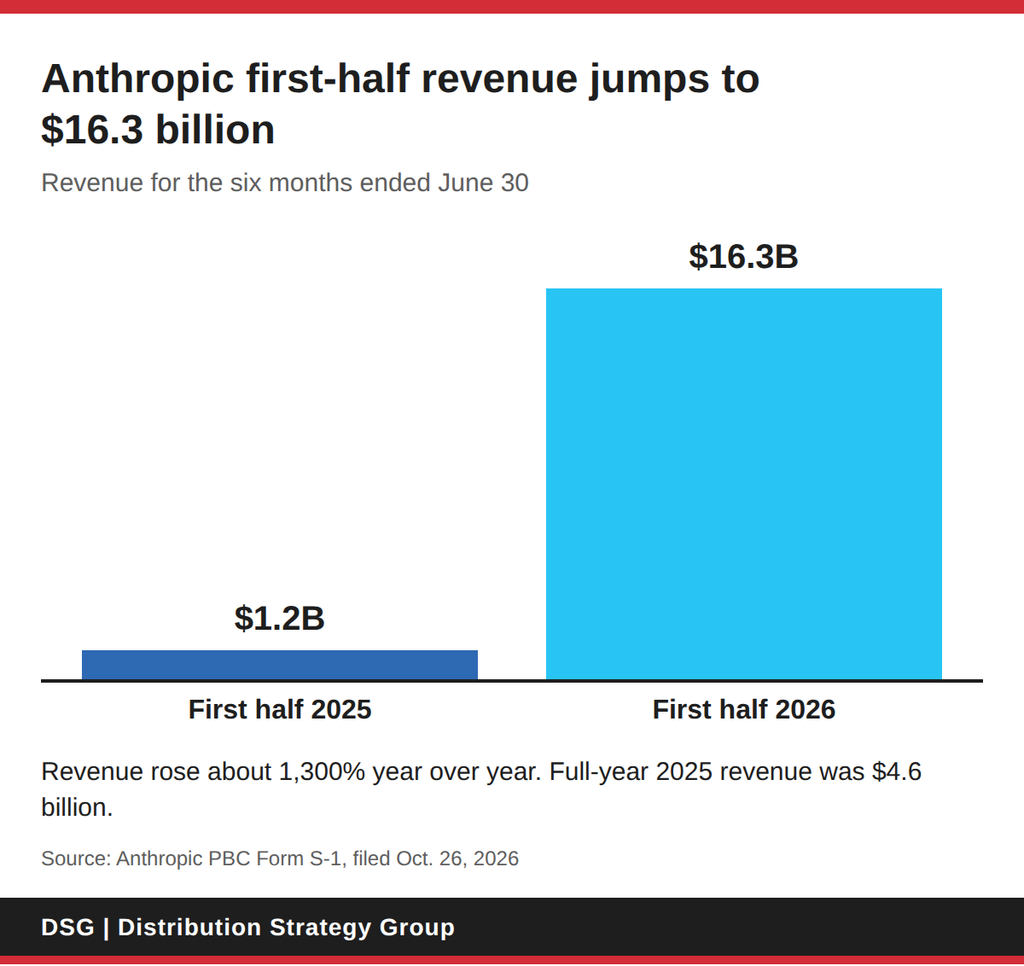
The developer of Claude filed Oct. 26 to list shares on the Nasdaq Global Select Market under the symbol ANT. It reported first half revenue of $16.3 billion, up from $1.2 billion a year earlier, as corporate use of its models and related services expanded. The filing did not specify a share price or offering size.
For distributors, the significance extends beyond Anthropic’s growth. The filing describes tools designed to navigate applications, work with company information and complete tasks involving multiple steps. It also outlines a services venture aimed at midsize businesses, a segment that includes many wholesale distributors.
Those developments point toward a broader role for AI in the work surrounding a transaction: gathering product information, preparing documents, checking orders, and moving information between systems. They also raise questions about the technology, data and oversight distributors will need as adoption expands.
Connecting With Customers’ Purchasing Systems
Anthropic describes its next stage of development around what it calls “Virtual Collaborators,” AI agents that work alongside employees using the information, permissions, and system connections their organizations provide.
Claude Code plans, writes, tests, and debugs software. Claude Cowork applies similar capabilities to general office work, including reading files, navigating applications, and completing tasks on a user’s desktop.
Anthropic released Cowork as a research preview in January. The company said adoption through Sept. 30 exceeded Claude Code’s adoption at the comparable point after its launch. In September, it began combining Cowork and its conversational assistant, Claude.ai, into one application.
For wholesale distributors, these capabilities could affect both sides of the customer relationship.
Internally, agents could assist with work that requires employees to retrieve information from several places, such as assembling quotes, reviewing purchasing records or investigating order discrepancies. Their usefulness would depend on the accuracy of company data, access to business systems and employees’ ability to review the results.
Externally, customers could use agents to gather supplier information and carry out parts of the purchasing process. Distributors would then need to consider how effectively their product catalogs, pricing and inventory information can be accessed by customer software.
That could increase the importance of standardized product descriptions, complete specifications and connections that provide current pricing, availability, and order status. The filing does not establish how quickly automated purchasing will spread or whether it will reduce customers’ reliance on sales representatives and e-commerce sites.
Implementation Help for Midsize Businesses
The filing also describes Ode with Anthropic; an AI services company formed with private equity firms to bring Claude to midsize businesses.
The venture plans to build applications on the Claude Platform and provide ongoing customer support. The filing does not identify its private equity partners or initial customers, and it does not say Ode is targeting wholesale distribution specifically.
The model nevertheless addresses a practical issue for distributors: Access to an AI tool does not provide the integration, process changes and employee training needed to use it throughout a business.
A services company that helps customers connect AI with existing applications could make adoption more accessible to companies with limited internal technology resources. For distributors considering such support, the relevant questions would include implementation costs, responsibility for maintaining connections and how results will be measured.
Anthropic already reaches corporate customers through Amazon Web Services, Google Cloud Platform and Microsoft Azure. It also works with consulting and technology services firms, including Accenture, Deloitte, KPMG and PwC, and platforms such as Salesforce and Snowflake.
Rising Spending, Lower Task Costs
The filing documents a sharp increase in corporate spending on Anthropic’s technology.
As of Sept. 30, more than 11,900 customers spent at least $100,000 with Anthropic during the preceding 12 months. More than 1,900 spent at least $1 million, and about 250 spent at least $10 million.
Those figures show the scale of spending among Anthropic customers overall. They do not indicate how many wholesale distributors use Claude or what those companies spend.
Anthropic also said Claude Opus 5.5 reduced customer costs per task by about 40% compared with Claude Opus 5. The company said lower costs encourage broader use.
For distributors, lower model costs could make additional applications economical. Total costs, however, would also depend on implementation, system integration, employee oversight, and usage. A less expensive individual task would not necessarily produce a lower overall technology bill if use expanded substantially.
Anthropic’s risk disclosures identify dependencies distributors would need to assess before assigning important business processes to Claude.
The company said it has changed usage limits, request limits, and model capabilities. It also acknowledged that customers may resist moving established processes to newer models when older versions are retired.
For a distributor using AI to support quotations, customer service or purchasing, such changes could require additional testing and revisions to established processes. The closely an agent is connected to daily operations, the greater the potential effect of a service limitation or model change.
Anthropic also said demand for computing resources has historically exceeded available capacity. Safety precautions have delayed or limited releases, and a substantial share of revenue comes from a limited number of customers and distribution channels.
The company’s rapid growth has not eliminated its financial losses. Anthropic reported a first-half net loss of $80.7 billion, reflecting a $72.4 billion accounting charge tied to financing instruments that can convert into shares. On an adjusted basis, it reported operating income of $1.6 billion.
Anthropic said it plans to use offering proceeds for computing resources, infrastructure, hiring, and acquisitions. It also plans to expand its direct sales and Applied AI teams, deepen cloud partnerships and enter additional markets.
For wholesale distributors, the filing provides evidence of a growing market for software that performs business tasks with less direct human input. Whether that produces faster service, lower costs or better purchasing decisions will depend on how distributors connect the technology to their operations and measure its results.
Distributors looking to evaluate AI tools and their applications can attend Distribution Strategy Group’s Applied AI for Distributors, June 22-24, 2027, at the Renaissance Schaumburg Convention Center Hotel outside Chicago. The conference will bring together distribution leaders, technology providers and industry practitioners to discuss implementation and measurable results. Register here
Do not miss any content from Distribution Strategy Group. Join our list.
Share this article:
