



This just in.
Researchers studying fighter pilots, surgeons, concert pianists, and corporate learning programs have converged on a discovery that could change how wholesale distributors develop their sales teams.
This breakthrough reduces errors. It builds confidence. It helps salespeople use the skills you paid good money to train. It works for inside sales, outside sales, counter sales, and the managers who lead them. No new software is required (although some can help). It’s available today, and it’s shockingly affordable.
Ready? [Insert drumroll here…]
It’s called practice.
More specifically, and I apologize in advance for swearing, it’s called role play.
(I’ll wait here while you finish groaning.)
Yes, I know. It’s not new. People have been rehearsing important conversations for as long as there have been important conversations. That’s the joke. The most powerful performance-improvement tool available to your sales force has been hiding in plain sight, and most organizations either ignore it completely or barely use it.
Let’s talk about why, what the research says, and how to do it right.
Why Nobody Wants to Do It

Salespeople tend to dread role play. It feels awkward and artificial. Nobody wants to stumble in front of their peers or their manager. Plenty of experienced reps will tell you they’d rather “just do it live” with a real customer. (Hold that thought. We’ll come back to it.)
Sales managers often skip it, too. They’re buried in pricing requests, escalations, and reports. Some aren’t sure how to run a good role play or debrief one. Some just don’t want the eye-rolls.
So practice gets skipped, and reps learn on customers instead.
I understand the resistance. I’ve also seen what happens when you push through it.
Many years ago, I took over a branch office that was the lowest-performing branch in my division. One of the first things I did was implement daily role play, sometimes twice a day. For the first 90 days, the team hated me.
Then something interesting happened. They started making more sales. They started making more money. The branch started climbing in the division rankings. Eventually, they got so into it that they’d start role plays in the hallway as they passed each other. By the end of the year, we were one of the top branches in the division.
I credit a lot of that turnaround to daily practice and feedback. It makes a huge difference.
Your customers deserve a salesperson who practiced on something other than them.
What the Pros Already Know

In most professions where performance really matters, practice isn’t optional. It’s simply how the work gets done. Here are three examples from three very different worlds.
Fighter Pilots
Early in the Vietnam War, U.S. Navy fighter pilots were trading two enemy jets for every one they lost, far worse than in previous wars. The Navy responded by creating the Navy Fighter Weapons School, better known as Top gun. Instructors flew aircraft that mimicked enemy fighters. Pilots fought them in realistic simulated dogfights, then picked apart every engagement in detailed debriefs.
When air combat resumed in 1972, the Navy’s ratio climbed to 12-to-1, with most of the kills credited to Top gun graduates. The Air Force, which hadn’t changed its training, barely improved.
(No beach volleyball was involved.)
Surgeons
In a randomized study published in the Annals of Surgery, one group of surgical residents trained on a simulator until they reached benchmarks set by expert surgeons. A matched group didn’t. Then both groups performed real gallbladder surgeries, and reviewers who didn’t know which resident was in which group scored their work.
The residents who practiced first completed the key part of the procedure 29 percent faster. The residents who hadn’t practiced were five times more likely to injure the gallbladder or burn tissue that should have been left alone.
If you needed surgery, which surgeon would you want? Your customers feel the same way about your salespeople. They’d rather buy from someone who practiced before the conversation that matters.
Concert Pianists
Researchers at the University of Texas videotaped advanced piano students practicing a difficult passage from a Shostakovich concerto, then ranked how well each one played it the next day. How long they practiced didn’t predict who played best. Neither did how many times they played through it.
What separated the top performers was how they handled mistakes. They addressed errors immediately, figured out exactly where and why each one happened, and worked that spot until they got it right. The researchers titled their paper “It’s Not How Much; It’s How.” (Hold onto that one, too.)
Three very different fields, one consistent lesson: structured practice with feedback beats winging it, and it’s especially powerful when mistakes get corrected right away.
Why Practice Works: Confidence
There’s another reason practice matters so much, and it’s the one that has stuck with me most.
Reza Sisakhti’s meta-analysis of 232 business impact studies (spanning 1998 to 2014, multiple industries, and audiences including sales) identified four major reasons training fails to produce business results. One of them: employees didn’t feel competent and confident to apply what they’d learned. When I later heard him present this research at ATD’s International Conference & Expo, he shared a statistically significant correlation between how comfortable and confident learners felt with a new skill and whether they tried it in the field. I don’t remember the exact numbers. I remember the lesson.
Think about what that means for your training investment. If your reps don’t feel ready to use a new skill, they won’t try it with a real customer. If they don’t try it, nothing changes. Your training budget just bought a very expensive binder.
So where does that confidence come from? Psychologist Albert Bandura’s research found that the most powerful source is personal experience of success: actually doing the thing and seeing it work. You can’t lecture someone into that, and you can’t hand it to them in a slide deck. You can give them repeated chances to do it well in a safe setting, with feedback. That’s practice.
If your reps don’t feel ready, they won’t try. If they don’t try, nothing changes.
Bob’s Three Appointments
I once ran a prospecting skills class that almost didn’t happen. Very few people signed up, but we decided to hold it anyway, and I tried an experiment.
We were teaching in small chunks: teach a skill, have people practice it, give feedback, then teach the next skill. The practices were fishbowls, where one person role plays in front of the group and everyone else offers feedback.
Here’s what we changed. After the first salesperson practiced and got feedback, we asked, “Would you like to try that again and incorporate some of what you just heard?” They said absolutely, and they ran it again. Then we did it one more time. Even better, we recorded each role play and its feedback on the seller’s own phone, so they could rewatch it later.
Then we went around the room. Every person got to practice, get feedback, and do two reruns.
I’ve rarely seen that kind of energy during a classroom role play. People could feel themselves getting better in real time. They started encouraging each other. The room was buzzing.
This was right before lunch. When we broke, one guy, Bob, jumped out of his chair and bolted from the room. I remember thinking, “Well, I guess I scared that one away.”
After lunch, Bob came back, and I asked him where he’d gone in such a hurry.
“You know, I’ve been having trouble setting appointments,” he said. “So I went back to my desk and started making calls, using what we just did in class and the feedback I got. Mike, I booked three appointments in less than an hour!”
He was on fire.
That’s Sisakhti’s research, live. Bob didn’t just learn something. He practiced it, got specific feedback, ran it again, and walked out confident enough to pick up the phone and try it for real. It was one of the greatest experiences of my training career, and I’ve tried to build it into everything I’ve done since.
The Secret Formula
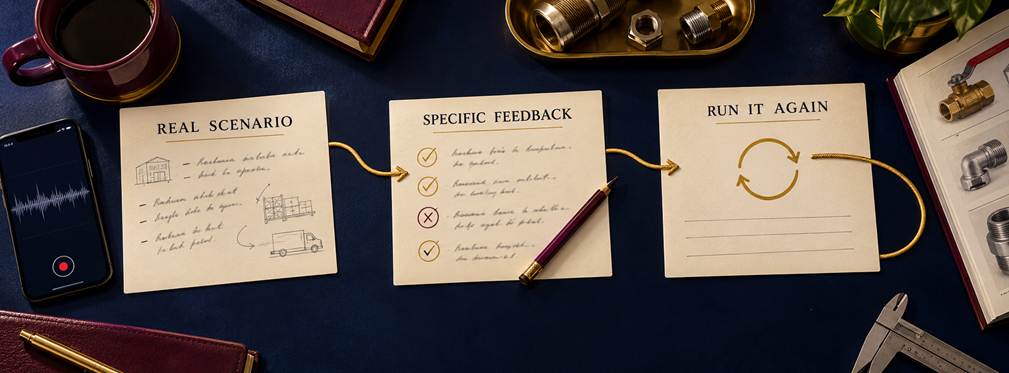
If you want role play to deliver results like that, here’s how to run it. None of this is complicated. It just requires smart planning and disciplined execution.
Make It Real
Start by practicing new skills on generic scenarios. That builds the confidence we talked about earlier. After that, though, generic scenarios produce generic practice. To make practice feel relevant, build role plays around the tough situations your reps face most often. A few examples:
- A contractor tells your rep that Amazon has a lower price on the same product.
- A longtime customer has quietly started shifting volume to another supplier, and your rep just noticed.
- A key item is backordered, and your rep needs to call the customer before the customer calls them.
- An inside rep wants to turn routine order calls into conversations that position your company as a one-stop shop.
- An account manager wants to earn a meeting with a large prospective customer who keeps putting them off.
Once everyone has practiced on a shared scenario, have reps role play upcoming conversations from their own pipeline or account management plans. Research backs this up, too. A review of more than 100 studies on behavior modeling training found that skills transferred to the job best when practice included scenarios the trainees generated themselves.
Debrief in the Right Order
How you debrief determines whether role play builds confidence or crushes it. Use this sequence:
- The seller goes first, starting with what they felt they did well, then what they’d do differently or even better next time. People naturally start by critiquing themselves, so redirect them. Positive first builds the right habit and a safe environment for learning.
- The customer goes second, sharing what it felt like on the receiving end, again positive first, then constructive. I also like to ask the customer how the skills made them feel. New skills often feel stiff and awkward to the seller, but to the customer they usually just sound like a conversation. That’s important for the seller to hear.
- Observers go third, following the same positive-then-constructive pattern.
- The manager goes last and flips the order: constructive first, then positive, so the seller ends on encouragement.
Whatever the role, be specific. My fourth-grade teacher, Mrs. Dietz, was fond of saying, “To be terrific, be specific.” Thank you, Mrs. Dietz. It’s great advice for role play debriefs, too.
If you want a simple structure for being specific, especially when you’re the manager giving the final word, use the SOIL model for feedback. (Yes, SOIL. Good feedback helps things grow. I’ll stop there.)
- Situation: The context in which you observed the seller. In a role play, that’s the scenario and the moment in the conversation.
- Observe: What you saw and heard them do, including their words, tone, body language, and how well they followed the model they were practicing.
- Impact: The result of that behavior, such as how the role-play customer reacted and whether the conversation moved toward the desired outcome.
- Learn: Your feedback, meaning what you recommend they keep doing or do differently next time.
After each step, do a quick Understanding Check to confirm you’re aligned before moving on. It anchors your feedback in what happened, which makes it far more likely to be heard, accepted, and used.
One more thing. Psychological safety doesn’t mean pretending everything went fine. Don’t attack, demean, or be harsh, but be truthful enough to be helpful. If someone skipped a step in the model they were practicing and didn’t catch it themselves, someone needs to point it out. If nobody else does, the manager should.
Run It Again
This is the step most organizations skip, and it’s the one that made Bob’s morning. Remember the pianists? The best ones fixed mistakes immediately rather than moving on. The rerun does the same thing for salespeople. After the debrief, give the rep a few minutes to absorb the feedback, then run the role play again.
If you can’t do it in the moment, do it in a follow-up coaching session. It works well that way, too.
Practice without a rerun is like a pianist who hits a wrong note and keeps on playing.
Record It and Share the Notes
Record the role play on the seller’s phone, and record the debrief, too. Have observers take brief, clear notes. (If you’re training a specific sales methodology, an observer form that tracks the steps you taught helps everyone.) Then give the recordings and notes to the rep, so they can review them later when they’re not all hyped up from being in the hot seat.
Managers Make or Break It
Sisakhti’s research identified lack of management support as one of the major barriers to getting training applied on the job. He summed up what managers need to do as “expecting and inspecting.” The behavior modeling research found the same thing from the other direction: transfer was greatest when the trainees’ managers were trained, too.
In distribution, where so much coaching happens at the branch level, that makes your branch managers and sales managers the linchpin. Train them first. Teach them to run role plays and debriefs well. Then expect them to do it, and inspect to ensure they do.
And if “no time” is the excuse, AI role-play tools now let reps practice realistic customer conversations on their own schedule, with immediate feedback. They don’t replace the manager’s coaching, but they remove a lot of friction.
Build It into Everyday Coaching
Role play shouldn’t live only in the training room. The best sales managers build it into how they develop their people every week. In fact, it’s embedded in two of the four models from my sales coaching system.
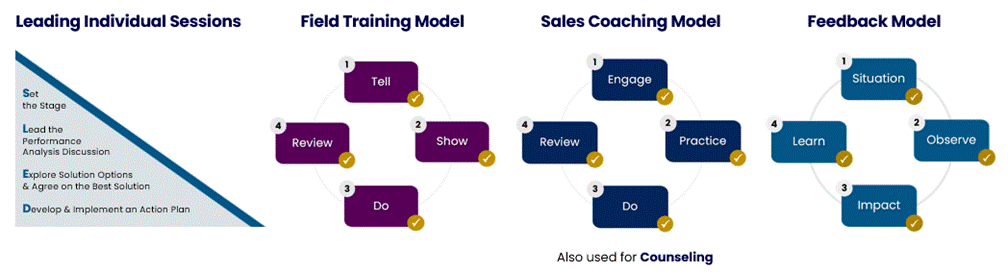
In the Field Training Model (Tell, Show, Do, Review), the manager uses the Show step to demonstrate the skill, usually through a quick role play, so the rep sees what good looks like. Then comes the Understanding Check: the rep role plays it back until they can do it to the manager’s satisfaction. (No, having the rep describe what they’d say doesn’t count. They must say it.)
In the Sales Coaching Model (Engage, Practice, Do, Review), which I also use for Sales Counseling, the rep already knows what to do and needs to do it better. The Practice step is a role play with feedback. Before they take it to customers, the Understanding Check confirms they can demonstrate the skill at the higher level you agreed on.
Those Understanding Checks make both models the ultimate excuse removers. If a rep can summarize what you expect and demonstrate that they can do it, you can hold them accountable for doing it in the field. The SOIL model fits right inside both, for the feedback you give during Show and Practice.
Coaching goes a bit beyond the scope of an article on role play, but it matters. Practice gets sellers to comfort and confidence. Ongoing coaching takes them from there to mastery. We don’t need to cover all four models here, though. If you’d like to go deeper, including the SLED model for leading individual coaching sessions, read 4 Coaching Models That Sales Managers Need to Master right here on DSG. For the full system, Allego and I just released the Sales Coaching Mastery eBook. It covers how to diagnose performance gaps, build skills through deliberate practice, and reinforce new behaviors until performance improves.
And Now, Back to Our Regularly Scheduled Programming
So there you have it. Breaking news from the world of research: practice works.
Fighter pilots know it. Surgeons know it. Concert pianists know it. My branch team figured it out after 90 days of hating me, and young Bob figured it out in a single morning.
The only question left is whether your sales force will keep practicing on your customers or start practicing for them. And that choice, leaders, is up to you.
Film at eleven.
Resources
Since this is a research-based post, I’ll provide a bit more recommended reading than usual for those of you who would like to dig in further. Content includes articles, research, books, related posts from me, and a new sales coaching eBook.
- More on running role plays: Maximizing the Power of Role Play and Sales Simulations
- More on deliberate practice: Sales Leaders: It’s Time to Get Serious About Purposeful Practice & Skill Mastery
- More on the coaching models: 4 Coaching Models That Sales Managers Need to Master, Distribution Strategy Group
- The full coaching system: Sales Coaching Mastery: Framework for Building High-Performing Sales Teams, Allego
- Topgun’s origins and results: Topgun: The Real Life Story of the US Navy’s Elite Pilot Training School, History Hit
- The surgeon study: Seymour et al., Virtual Reality Training Improves Operating Room Performance: Results of a Randomized, Double-Blinded Study, Annals of Surgery (2002)
- The pianist study: Duke, Simmons, and Cash, It’s Not How Much; It’s How: Characteristics of Practice Behavior and Retention of Performance Skills, Journal of Research in Music Education (2009)
- The behavior modeling research: Taylor, Russ-Eft, and Chan, A Meta-Analytic Review of Behavior Modeling Training, Journal of Applied Psychology (2005)
- Bandura’s research on confidence: Self-Efficacy Theory, Simply Psychology (an accessible overview of Bandura’s work, including mastery experiences)
- Reza Sisakhti, Success in Selling: Developing a World-Class Sales Ecosystem
- Anders Ericsson and Robert Pool, Peak: Secrets from the New Science of Expertise
- James Clear, Atomic Habits: An Easy & Proven Way to Build Good Habits & Break Bad Ones
- Doug Lemov, Erica Woolway, and Katie Yezzi, Practice Perfect: 42 Rules for Getting Better at Getting Better
- Jonathan Harnum, The Practice of Practice
Share this article: