



Why This Matters to Distributors: Wholesale sales are growing faster than inventories, suggesting distributors are moving merchandise more efficiently and holding less inventory relative to sales. Industrial, electrical and technology distributors reported particularly strong year-over-year gains, while construction-related and automotive markets remained uneven. The results point to opportunities for distributors to improve inventory management, although rising prices and differences in customer demand complicate the outlook.
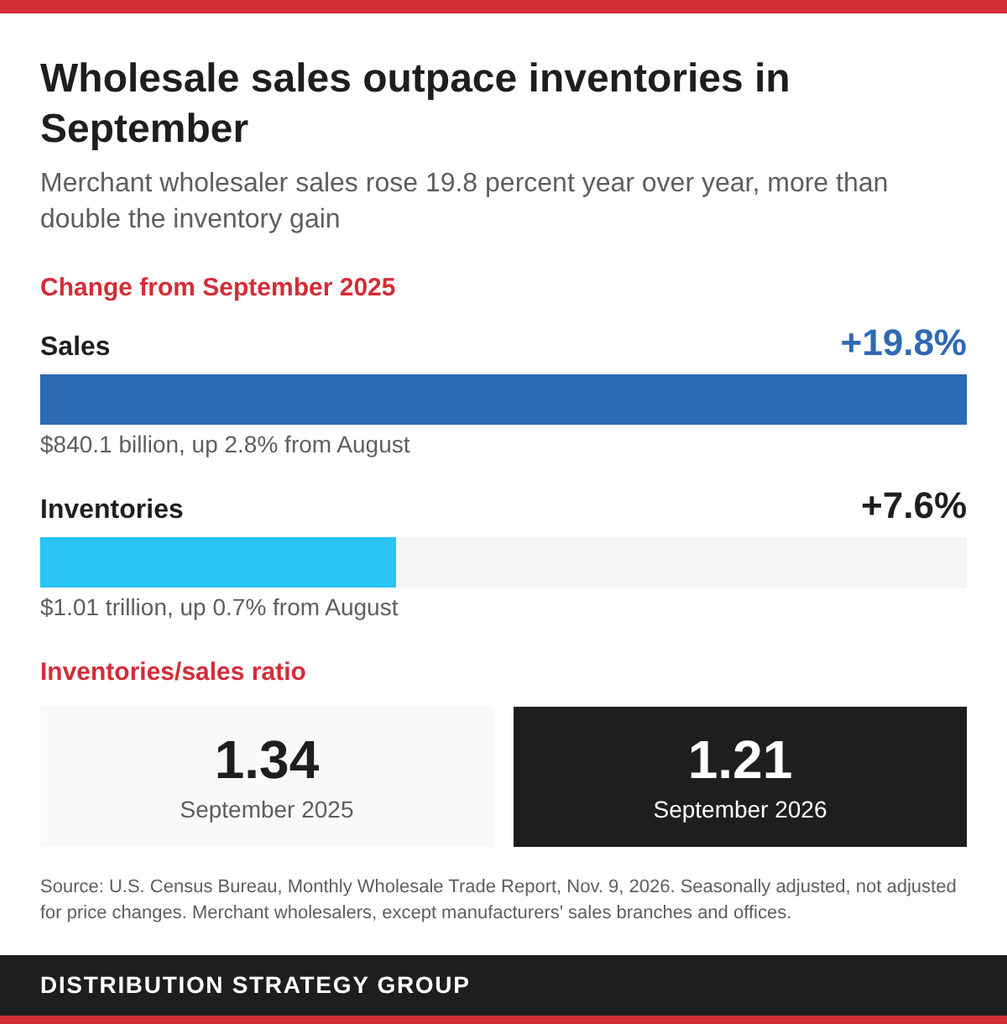
U.S. wholesale sales increased 19.8% in September from a year earlier, led by strong gains among industrial equipment, metals, and electrical products distributors, according to data released Nov. 9 by the U.S. Census Bureau.
Total wholesale sales reached $840.1 billion, up 2.8% from August. Inventories increased at a slower pace, rising 0.7% from August and 7.6% from September 2025 to $1.013 trillion.
The difference between sales and inventory growth reduced the industry’s inventory-to-sales ratio to 1.21, down from 1.34 a year earlier. The ratio measures how many months of merchandise distributors hold at their current sales pace.
The results suggest distributors are selling merchandise more quickly relative to their inventory levels, although growth varied across product categories.
The Census Bureau’s figures are adjusted for seasonal changes but not inflation, meaning higher prices can contribute to reported sales growth.
Industrial and electrical distributors were among the strongest-performing wholesale sectors in September, reflecting higher sales across several categories serving manufacturers, commercial customers, and infrastructure projects.
Metals and minerals distributors reported a 6.7% increase in sales from August and a 37.5% gain from September 2025.
Machinery and industrial supplies distributors posted a 2.7% monthly increase, with sales rising 19.8% from a year earlier.
Electrical and electronic goods distributors reported a 2.6% monthly increase and a 42.9% year-over-year gain. Professional and commercial equipment distributors recorded a smaller monthly increase of 0.2%, although sales were 34% higher than in September 2025.
Computer equipment and software distributors reported a 1% monthly decline, but sales remained 57.2% above year-earlier levels.
The increases in electrical products, computers and commercial equipment are consistent with continued business investment in technology and infrastructure, including artificial intelligence and data centers. However, the Census Bureau does not identify how much of the growth came from those projects.
Other wholesale sectors reported weaker monthly sales, underscoring differences in demand across the distribution industry.
Hardware, plumbing, and heating equipment distributors reported a 0.5% decline in sales from August, although sales increased 6.8% from September 2025.
Lumber and other construction materials distributors posted a 0.1% monthly decline, with sales increasing 6.6% year over year.
Motor vehicle and parts distributors reported a 1.2% monthly decrease, while sales rose just 1.5% from a year earlier.
The results show that the overall increase in wholesale sales was not shared equally across the industry. Distributors serving construction and automotive markets reported softer monthly results even as industrial equipment, metals and electrical products businesses recorded gains.
Those differences could influence purchasing and inventory decisions heading into the final months of 2026.
Petroleum distributors accounted for a significant share of September’s monthly sales increase.
Sales of petroleum and petroleum products rose 18.8% from August and 62.8% from September 2025, reaching approximately $111 billion.
Petroleum accounted for about 13% of total wholesale sales. Excluding petroleum, wholesale sales increased approximately 0.8% from August, compared with the overall 2.8% gain.
The difference highlights the effect of petroleum prices on wholesale sales figures. Changes in fuel prices can increase or decrease the dollar value of sales without a comparable change in the amount of fuel sold.
Overall, nondurable goods sales, which include petroleum, chemicals, agricultural products, pharmaceuticals and groceries, increased 4.4% from August and 15.9% from a year earlier.
Durable goods sales, which include machinery, electrical equipment, metals, construction materials and automotive parts, increased 1.3% from August and 23.8% year over year.
Distributors continued adding merchandise to warehouses in September, but inventory growth remained well below the increase in sales.
Total wholesale inventories reached $1.013 trillion, up 0.7% from August and 7.6% from September 2025.
Durable goods inventories increased 0.6% from August and 8% from a year earlier. Nondurable goods inventories rose 0.9% for the month and 7% year over year.
Inventory changes varied across distribution categories.
Electrical and electronic goods distributors reported a 2.5% monthly increase in inventories, while hardware, plumbing and heating equipment inventories rose 1.3%.
Chemical inventories also increased 1.3%, while petroleum inventories jumped 10.6%.
Other categories reduced merchandise on hand. Farm product inventories fell 7.4%, metals and minerals inventories declined 0.9%, and grocery inventories decreased 0.8%.
The Census Bureau revised its preliminary estimate of September’s overall inventory increase from 0.6% to 0.7%. August inventories increased 0.6% from July.
The figures suggest distributors are continuing to replenish merchandise, although inventory growth remains slower than sales growth.
The decline in the wholesale inventory-to-sales ratio was another significant development in September.
The ratio fell to 1.21 from 1.23 in August and 1.34 in September 2025.
A lower ratio means distributors are holding less inventory relative to monthly sales. That can reduce storage expenses and the amount of cash tied up in merchandise, although it can also leave businesses more vulnerable to supply disruptions if inventories become too lean.
Among durable goods distributors, the ratio declined to 1.49 from 1.50 in August and 1.70 a year earlier.
For nondurable goods distributors, the ratio fell to 0.92 from 0.95 in August and 1.00 in September 2025.
Several industrial categories recorded substantial year-over-year declines.
The ratio for metals and minerals distributors dropped to 1.46 from 1.96. Machinery and industrial supplies distributors reported a decline to 2.65 from 3.03.
The changes indicate that merchandise is moving through wholesale distribution more quickly relative to inventories. However, the figures do not show whether individual distributors have adequate supplies of specific products or whether lower inventory levels could create shortages.
The September wholesale report also comes as business inventory investment has contributed to broader U.S. economic growth.
The U.S. economy expanded at an annual rate of 3.4% during the third quarter, according to the Bureau of Economic Analysis.
Inventory investment contributed 1.61 percentage points to that increase after five consecutive quarters of declines, according to Reuters.
The increase indicates businesses were rebuilding inventories in parts of the economy, although changes in inventory investment do not necessarily signal sustained increases in customer demand.
For distributors, the combination of stronger sales and comparatively slower inventory growth suggests that businesses are managing merchandise levels more closely as demand changes across industries.
September’s wholesale figures point to stronger overall sales but continued differences among major distribution markets.
Industrial machinery, metals, electrical products, and technology distributors reported substantial year-over-year gains. Construction-related and automotive distributors posted more modest results, including monthly sales declines.
Petroleum also accounted for a sizable portion of the overall increase, making it important to distinguish between higher sales values and underlying changes in customer demand.
For distributors, the most important development may be the continued decline in inventories relative to sales.
Holding less merchandise relative to sales can improve inventory efficiency and reduce carrying costs. But distributors must maintain sufficient product availability to serve customers, particularly in markets where demand is growing quickly or supply chains remain unpredictable.
The next indication of whether the trend is continuing will come Dec. 9 when the Census Bureau is scheduled to release October wholesale trade figures.
Do not miss any content from Distribution Strategy Group. Join our list.
Share this article:
