


Why This Matters to Distributors: BlueLinx is investing in supplier relationships, inventory, and customer services to gain business while housing demand remains soft. Its strategy highlights an opportunity for distributors to help manufacturers reach more customers and give dealers smaller, more frequent deliveries.
BlueLinx Holdings Inc. plans to invest an additional $15 million to $20 million in inventory as it expands its decking, railing, siding, and trim offerings, preparing to pursue new customers in early 2027 despite continued weakness in housing.
Executives outlined the strategy during the company’s Nov. 4 earnings call, describing expanded supplier agreements, growth in multifamily construction and national accounts, and investments in pricing systems and digital tools. Most of the sales benefits from the new product agreements are expected next year.
“The idea is to make critical strategic investments now so we’re well prepared for the beginning of the year,” CEO Shyam Reddy said.
The investments come as BlueLinx reports higher sales but lower net earnings. Third-quarter sales increased 8.5% to $812.6 million from $748.9 million a year earlier. The company posted a net loss of $625,000, compared with net income of $1.7 million.
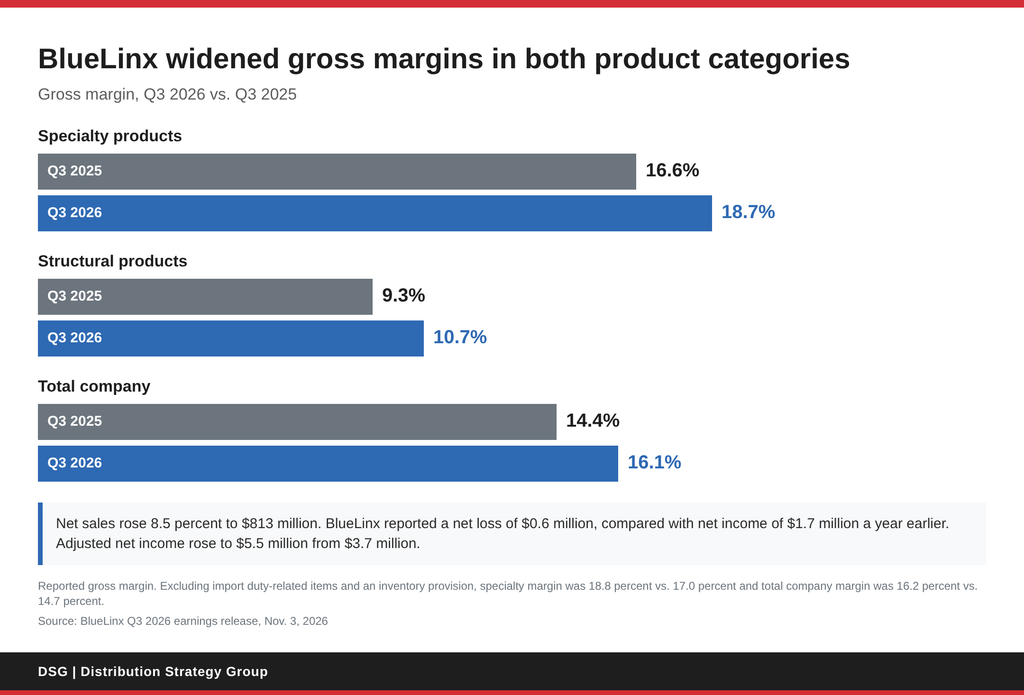
For the first nine months, sales increased 5.3% to $2.36 billion from $2.24 billion. Net income declined 50.7% to $4.3 million from $8.8 million, while diluted earnings per share fell to 54 cents from $1.08. Both reporting periods ended Oct. 3, 2026.
Quarterly profit after product costs, before operating expenses, increased 21% to $131 million. For the first nine months, that profit increased 14.2% to $387.1 million. Higher operating expenses and income taxes weighed on net results.
The company’s growth strategy centers on specialty products such as siding, engineered wood, millwork, and outdoor living products. Those categories represented approximately 70% of quarterly sales and 80% of profit after product costs, Reddy said.
Management is seeking to deepen selected supplier relationships and sell more products through customer programs, rather than simply expand its assortment.
“All of these examples clearly demonstrate our commitment to focusing on our higher-margin specialty products business in a manner that’s strategic,” Reddy said.
BlueLinx’s recent supplier agreements expand its outdoor living and exterior building products offerings. Its RDI railing network grew by eight locations to 21, while its Fiberon offering now includes decking at 34 locations and railing at 15.
Trex products are stocked and being delivered from 11 locations across three of BlueLinx’s five regions, Reddy said. The company also expanded Westlake Royal Building Products’ Kleer polyvinyl chloride trim to 27 locations and increased TruExterior siding and trim availability from 12 locations to 17. Its expanded LP SmartSide agreement covers 20 markets.
Reddy said the broader brand selection creates opportunities to sell more to existing dealers while supporting growth with multifamily customers and national accounts. It also allows BlueLinx to offer more products together for construction projects.
“Obviously the strength of these brands provides us with significant share gain opportunities with our traditional customer base across the country, while also providing us with enhanced opportunities to accelerate our multifamily and national accounts growth,” he said.
The geographic focus includes markets with population growth, such as Texas and the Southeast, along with established repair and remodeling markets in the Northeast. Reddy said outdoor living products fit markets where large production builders have less influence and customers have established brand preferences.
Winning that business will require BlueLinx to persuade customers to change distributors or select different brands. Reddy said the Trex business, for example, competes with Deckorators and TimberTech products.
“The transition is definitely very commercial in the sense of, big picture, you’ve got to convert customers who are buying that product from other distributors and we want to convert them over to us,” he said.
He described that effort as local sales work conducted with suppliers. The company must compete both for customers already purchasing its newly added brands elsewhere and for customers buying competing products.
Chief financial officer Kelly Wall said BlueLinx is incorporating the new brands into purchasing programs being negotiated with its largest accounts.
“From a program perspective, these are brands that we’re talking about this year that we didn’t have last year,” Wall said.
Inventory spending will precede much of the expected sales growth. Wall said the company is bringing in products now, with an additional $15 million to $20 million in inventory expected across the brands involved.
“We’ll see some this year, not much for the reasons that you mentioned, and then we’ll see it ramp into Q1 and Q2 next year,” he said.
BlueLinx also sees an opportunity in dealers’ reluctance to hold large inventories during a slow market. Reddy said customers increasingly want smaller quantities delivered more frequently, making distributors’ stocking and order preparation services more valuable.
Those services include selecting individual pieces, assembling complex orders, and preparing packages of materials for specific jobs. They allow dealers to serve customers without carrying as much inventory themselves.
“I do think the key is going to be taking advantage of how well we manage our inventory and then supporting our customers in an environment where they don’t want to build big inventory positions and where they would prefer to buy less, more often,” Reddy said.
The company is also working to influence product choices earlier in construction projects. Its builder programs encourage the use of selected brands, helping generate orders that move through dealer customers.
Reddy said the approach helps BlueLinx identify opportunities earlier, increase sales of strategic brands and strengthen supplier relationships. Multifamily sales volumes increased by a low-double-digit percentage during the quarter, while national account volumes rose slightly.
Results varied across product categories. Specialty product sales increased 4.6% to $550 million, supported by the acquisition of Disdero Lumber Co. and higher prices, which offset lower volumes. Structural product sales, including lumber and panels, increased 18% to $263 million as both prices and volumes rose.
Wall said specialty product volumes declined across categories. Millwork had the largest decline, while most other categories fell by low-single-digit percentages.
BlueLinx has responded to rising costs by centralizing more of its pricing management, giving branches a more consistent way to handle supplier increases. Reddy said the company dealt with approximately 80 supplier price increases through the third quarter, compared with about 30 a year earlier.
“One of our key business transformation initiatives this year has been centralizing and building capabilities around pricing management,” Reddy said.
He said the changes have helped branches adjust prices more quickly and consistently. BlueLinx has also used fuel surcharges and its transportation management system to address delivery costs.
Technology investments extend to artificial intelligence tools for identifying sales opportunities, customer self-service, quoting, ordering, and inventory planning. Reddy said the spending is intended to improve decisions and strengthen service to customers and suppliers, although executives did not quantify results from those initiatives in the supplied call excerpt.
BlueLinx ended the quarter with $350 million in cash and $339 million available under its credit line. Wall said that financial capacity supports continued investment in products, facilities, and technology, as well as potential acquisitions.
Management nevertheless expects housing conditions to remain difficult. BlueLinx forecast slightly lower daily sales volumes in both specialty and structural products in the fourth quarter compared with the preceding quarter and a year earlier.
Reddy said the company will continue pursuing customer gains through its expanded brands, services and supplier relationships while closely managing inventory and expenses.
“We are also investing selectively in the business and maintaining the financial flexibility necessary to pursue future opportunities that accelerate our growth objectives,” he said.
Do not miss any content from Distribution Strategy Group. Join our list.
Share this article:
