


Why This Matters to Distributors: Service businesses continued adding orders and employees in October, supporting demand in markets distributors serve. But higher fuel and transportation costs and growing pressure on customer budgets could complicate pricing and sales.
U.S. service-sector growth slowed in October as businesses raised prices at a faster pace and confidence fell to a five-month low, according to S&P Global’s Nov. 4 report.
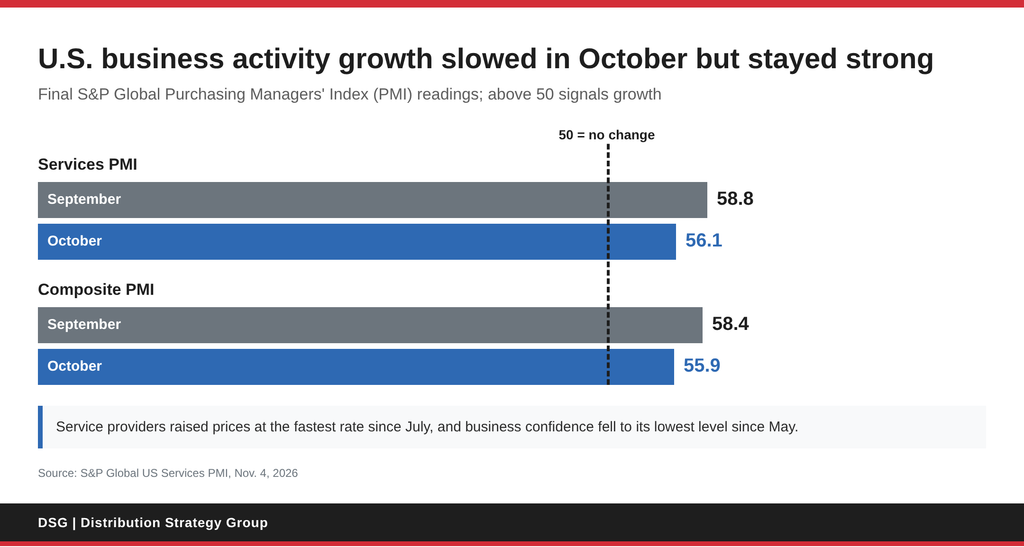
The S&P Global U.S. Services Purchasing Managers’ Index declined to 56.1 from 58.8 in September. The reading remained above the 50-mark separating growth from contraction, extending the sector’s expansion to seven consecutive months.
New business continued to increase sharply, though more slowly than in September. Companies reported strong demand and success converting customer inquiries into contracts despite inflation, high interest rates, and uncertainty about the economy.
Foreign demand strengthened as well. New export business increased for the third consecutive month, posting its strongest growth since mid-2023.
Hiring continued for a fourth consecutive month as companies added staff to handle new orders and support expansion. Employment growth slowed from September’s strongest pace in more than four years but remained solid, S&P Global said.
The additional workers were insufficient to keep up with demand. Backlogs increased at the fastest pace in four and a half years, marking the 20th consecutive month of rising unfinished work.
“The October PMI surveys mark a strong start to the fourth quarter for the US economy, indicative of GDP rising at an annualized rate of over 4%,” said Chris Williamson, chief business economist at S&P Global Market Intelligence.
The growth estimate reflects the survey results rather than an official reading of gross domestic product. Williamson said technology remained the main driver of the expansion, supported by consumer-facing businesses and financial services.
Rising costs nevertheless weighed on businesses. While the pace of cost increases eased from September’s four-year high, it remained above the average for 2026 to date.
Companies cited higher fuel prices that also drove up the cost of other goods and services, particularly food and transportation. Service providers raised their selling prices at the fastest rate since July.
“Average prices charged for services meanwhile rose at one of the fastest rates seen over the past four years,” Williamson said.
Inflation’s effect on customer budgets, along with uncertainty about federal policies, weakened expectations for the coming year. Business confidence fell to its lowest level since May and remained below its historical average, although companies continued to anticipate growth.
The broader private-sector economy also lost momentum. S&P Global’s composite index, which combines service-sector activity and manufacturing output, fell to 55.9 from 58.4 in September, its lowest reading in three months.
Both sectors continued to expand, but growth slowed in each. Across manufacturing and services combined, selling prices increased at the fastest rate since August 2022, even as cost pressures eased from September.
S&P Global’s services survey covers a panel of about 400 companies in industries including transportation, information, communications, finance, insurance, real estate, and business services. October responses were collected Oct. 9-28.
Do not miss any content from Distribution Strategy Group. Join our list.
Share this article:
