



Why This Matters to Distributors: Amazon Business has become one of the world’s largest B2B purchasing platforms, increasing competitive pressure in commodity and transactional product categories. While distributors with strong technical expertise and value-added services remain well positioned, those competing primarily on price and convenience face a rapidly strengthening digital competitor.
Amazon Business has reached an annualized gross merchandise value of $60 billion, another milestone in the company’s decade-long expansion into B2B commerce and a sign of its growing influence over how organizations purchase products.
Amazon announced Tuesday that Amazon Business now serves more than 11 million organizations worldwide, including 1.8 million customers added during the first half of 2026.
The $60 billion figure represents gross merchandise value, or GMV — the total value of products sold through the Amazon Business marketplace — not Amazon’s revenue. Because much of that volume comes from third-party sellers, Amazon records revenue from commissions, fulfillment, advertising, logistics and related services rather than the full value of every transaction.
That distinction is important. Traditional distributors report sales based on products they purchase and resell, making direct comparisons with Amazon Business misleading. Even so, the milestone underscores Amazon’s growing role as one of the world’s largest B2B purchasing platforms.
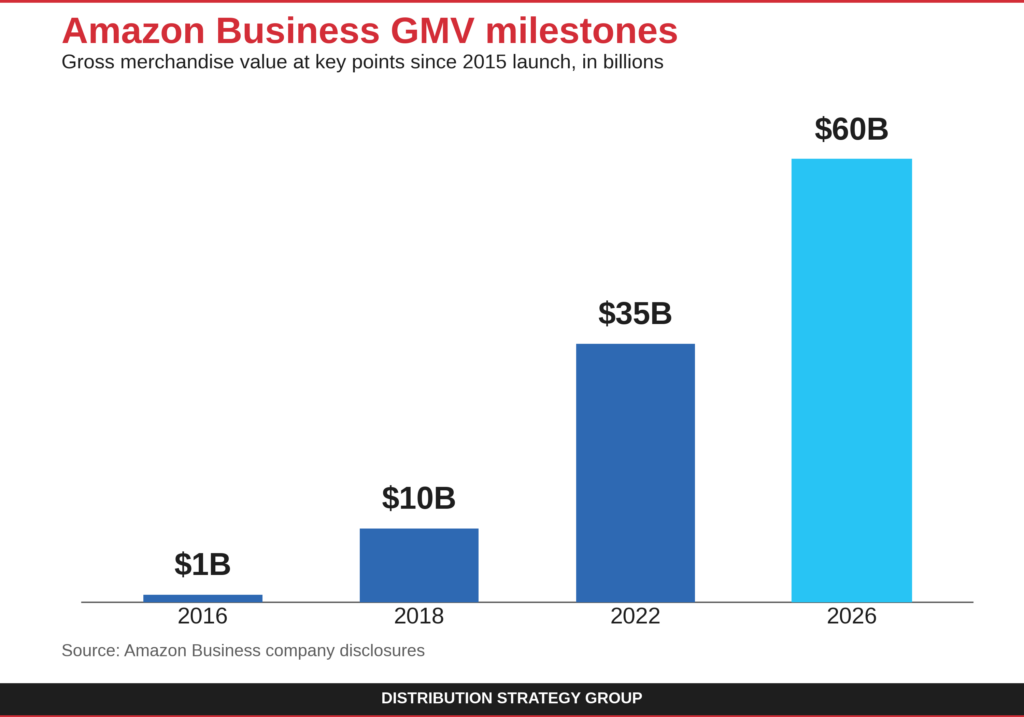
Amazon Business launched in 2015 and surpassed $1 billion in annualized GMV within its first year. It exceeded $10 billion in 2018 and reached $35 billion in 2022. Tuesday’s announcement marks the first public update since then, reflecting several years of steady expansion rather than a single year of explosive growth.
The announcement also highlights how Amazon Business has evolved beyond an online marketplace.
Today, the platform combines marketplace commerce, procurement software, logistics services, financing, and artificial intelligence into a single purchasing ecosystem. Customers can automate replenishment, manage purchasing approvals, analyze spending and access freight, warehousing, and fulfillment services through Amazon’s growing logistics network.
For distributors, the significance extends well beyond the headline number.
Amazon continues to strengthen its position in categories where purchasing decisions are driven primarily by price, broad product selection, and delivery speed. Maintenance, repair and operations products, office supplies, janitorial and sanitation products, breakroom supplies, repair tools, and other standardized items align closely with Amazon’s operating model because they require little technical support and are purchased repeatedly throughout the year.
The company said product selection increased 30% over the past year, led by repair tools, office furniture, and grocery products. More than 85% of U.S. business customers now have access to pallet deliveries, while more than 70% of Prime Business orders in the United States arrive the same day or the next day.
Those investments continue to raise the competitive bar for distributors serving highly transactional markets.
The competitive landscape changes in more technical sectors.
Many industrial and specialty distributors compete less on price than on engineering expertise, application support, and value-added services. Customers purchasing industrial automation systems, flow-control equipment, electrical products, process systems, and specialized construction materials often require product configuration, engineering assistance, fabrication, regulatory documentation, or project management before placing an order.
Many distributors also differentiate themselves through vendor-managed inventory, custom kitting, jobsite delivery, commissioning, field service, and other specialized capabilities that extend well beyond product fulfillment.
Those services remain difficult to replicate through a marketplace model, regardless of how sophisticated the technology becomes.
Amazon is also broadening the competitive battlefield by investing heavily in procurement technology.
Its generative AI-powered Amazon Business Assistant helps purchasing teams identify products and manage buying activities, while spending analytics and anomaly detection tools are designed to improve purchasing controls, identify unusual spending patterns and uncover cost-saving opportunities.
The strategy reflects a broader ambition than simply selling products.
Amazon is increasingly positioning Amazon Business as the platform companies use to manage procurement itself, embedding the service deeper into customers’ purchasing workflows rather than competing only for individual orders.
That represents a different competitive challenge for distributors. Business customers increasingly evaluate suppliers not only on price and product availability but also on digital purchasing capabilities, procurement integration, workflow automation, spend visibility and the overall buying experience.
The announcement also reflects broader changes in business purchasing behavior.
Organizations increasingly expect the same search, ordering and delivery experience they receive as consumers. Those expectations continue reshaping wholesale distribution and forcing distributors to invest in digital commerce, procurement integration and AI-enabled customer experiences alongside their traditional sales and service capabilities.
Amazon rarely discloses financial milestones for Amazon Business, making the $60 billion announcement a notable indication of the business unit’s strategic importance.
For distributors, however, the biggest takeaway is not the size of Amazon Business, but where the company is winning.
Amazon remains strongest in high-volume, standardized product categories where transactions can be automated, fulfillment optimized and purchasing decisions require little human involvement. Those markets are likely to face increasing competitive pressure as Amazon expands its marketplace, logistics network, and AI-powered procurement tools.
The outlook is different for distributors serving more complex markets.
Products requiring technical expertise, engineering support, customization, fabrication, field service, and project management continue to favor distributors that create value beyond simply delivering inventory. In those markets, relationships, application knowledge, and specialized services remain difficult to automate and continue to differentiate traditional distributors from digital marketplaces.
The $60 billion GMV milestone is therefore more than a measure of Amazon Business’ scale. It is another sign that business purchasing is becoming increasingly digital, automated and data driven. For distributors, the challenge is not to match Amazon in every category, but to understand where Amazon’s model is strongest, where their own competitive advantages remain intact and where continued investment in digital capabilities has become essential to protecting market share.
Share this article:
