

Why This Matters to Distributors: C.H. Robinson’s $5.8 billion acquisition of RXO would combine two major transportation networks that distributors use to move products among suppliers, distribution centers, branches, and customers. The deal would expand C.H. Robinson’s scale in truck brokerage and managed transportation while adding RXO’s expedited and last-mile capabilities.
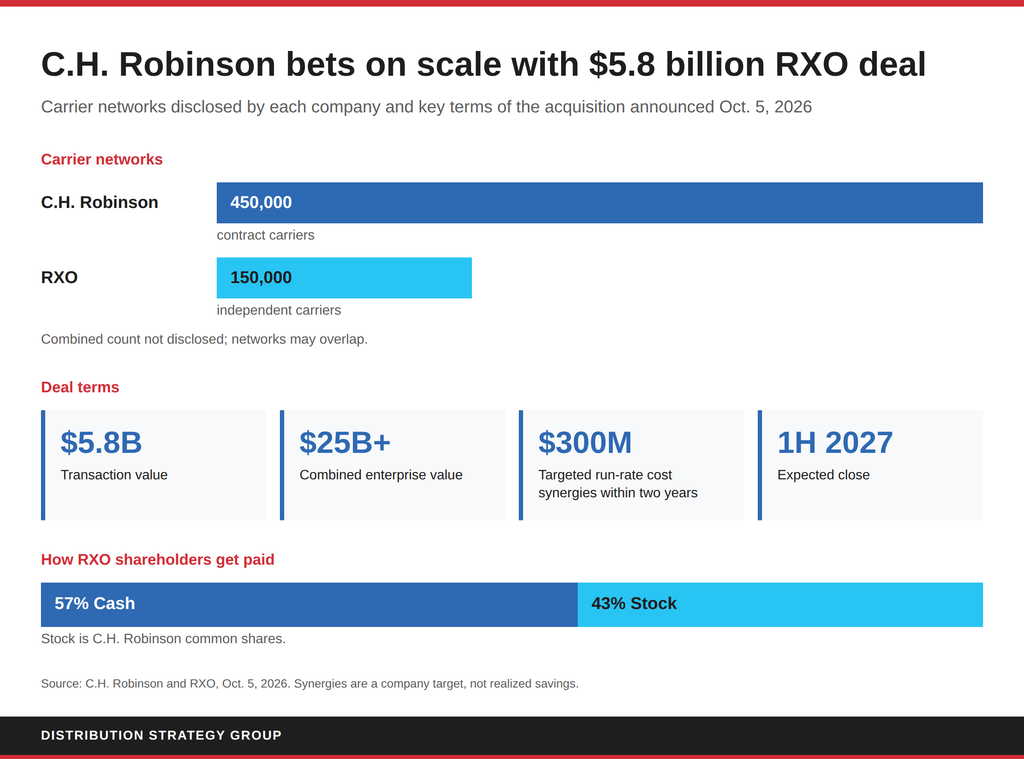
C.H. Robinson Worldwide has agreed to acquire RXO in a $5.8 billion cash-and-stock transaction that would combine two major third-party logistics providers and create a company with an enterprise value of more than $25 billion.
The transaction is expected to close in the first half of 2027, subject to regulatory approval, approval by RXO shareholders and other customary closing conditions.
The acquisition would significantly expand C.H. Robinson’s North American transportation network, combine the companies’ truck brokerage and managed transportation businesses while adding RXO’s strengths in expedited and last-mile delivery.
C.H. Robinson also operates global freight forwarding services, giving the combined company capabilities across truckload, less-than-truckload, ocean, air, expedited and last-mile transportation.
C.H. Robinson said it plans to integrate RXO primarily into its North American Surface Transportation division.
The Eden Prairie, Minnesota-based company currently serves 75,000 customers, works with 450,000 contract carriers, and manages 37 million shipments representing $23 billion in freight annually.
“This transaction is a natural next step in our transformation, allowing us to create a more scaled, resilient North American third-party logistics provider,” C.H. Robinson President and CEO Dave Bozeman said.
For wholesale distributors, the significance of the deal extends beyond its $5.8 billion price tag.
Third-party logistics providers perform functions that directly affect distributor transportation costs and customer service, including truck brokerage, carrier procurement, less-than-truckload shipping, managed transportation, international freight forwarding, expedited transportation and last-mile delivery.
C.H. Robinson and RXO already work with companies operating large and complex distribution networks.
C.H. Robinson publicly identifies Henry Schein, one of the world’s largest distributors of health care products and services, as a long-term customer.
Henry Schein serves more than 1 million customers in 33 countries, manages approximately 300,000 SKUs and ships 140,000 cartons a day, according to a C.H. Robinson case study.
The companies have worked together for more than 20 years on transportation strategy, execution, long-term planning, and managed transportation.
C.H. Robinson said its work with Henry Schein has produced more than $1.2 million in domestic network optimization savings, including more than $500,000 in annual consolidation savings. The logistics provider also reported 15% cost savings across Henry Schein’s North American truckload and less-than-truckload programs.
The relationship illustrates how deeply a third-party logistics provider can become embedded in a distributor’s operations. C.H. Robinson works with Henry Schein across multiple distribution centers and transportation modes, including truckload, less-than-truckload, air, and ocean freight.
C.H. Robinson also has disclosed work with an unnamed global technology distributor of computer parts, printers, and related supplies. That company uses a combination of air, ocean, and less-than-truckload transportation.
RXO has similar relationships with distribution-intensive businesses.
The company has disclosed work with an unnamed national tire distributor operating 30 distribution centers. RXO was hired to manage four facility relocations in one year without disrupting normal operations, including a project involving the movement of 55,000 tires.
Neither C.H. Robinson nor RXO publicly identifies most of its distributor customers, making it difficult to determine the full overlap between their customer bases.
One of the most significant aspects of the transaction for distributors is the additional scale it would give C.H. Robinson in the North American freight market.
Freight brokers connect shippers that need to move products with carriers that have available capacity. The size and density of those networks can affect how quickly transportation can be secured and how efficiently loads can be matched with available trucks.
C.H. Robinson said acquiring RXO would increase its network density, freight volume, and penetration across customer industries.
RXO currently has a network of approximately 150,000 independent carriers and 1.8 million independent trucks across North America, according to the company.
Its managed transportation operation executes transportation strategies for approximately $4 billion of freight annually.
Combining those operations with C.H. Robinson’s existing network could give the company more freight and carrier capacity to match across a larger transportation platform.
For distributors, the potential advantage is access to more transportation capacity and a broader range of services through a single provider.
A distributor importing products, for example, could use C.H. Robinson for international air or ocean freight and then move those products through truckload or less-than-truckload transportation while also gaining access to RXO’s expedited and last-mile services.
Whether that additional scale produces lower freight costs or better service for customers will depend on how successfully C.H. Robinson integrates RXO.
Last mile adds another piece
RXO’s last-mile operation is another important part of the transaction for distributors.
RXO describes itself as the largest provider of outsourced last-mile delivery of heavy goods.
Last-mile capabilities are particularly relevant for distributors that need to move bulky products, equipment or other shipments from distribution centers and branches directly to businesses, jobsites, and other customer locations.
Those deliveries can require scheduled appointments, specialized handling or transportation capacity that differs from traditional truckload and less-than-truckload freight.
Adding RXO’s last-mile network would give C.H. Robinson another capability at the customer end of the distribution chain.
The transaction also would add to RXO’s expedited transportation business, giving C.H. Robinson additional options for urgent, high-value or specialized shipments.
C.H. Robinson targets $300 million in synergies
AI is central to C.H. Robinson’s financial case for the acquisition.
C.H. Robinson expects approximately $300 million in net run-rate cost synergies within two years after the transaction closes by applying what the company calls its Lean AI operating model across RXO.
The company said those projected savings would come from lower costs to serve customers, operating efficiencies, shared services savings and reduced third-party spending.
The $300 million represents an expectation rather than realized savings and will depend on C.H. Robinson successfully integrating RXO.
The acquisition also would significantly increase the amount of proprietary transportation data available to C.H. Robinson.
The company said the larger data set is expected to improve the speed and precision of its AI-driven sales, freight matching, and procurement capabilities.
That could have implications for distributors using the combined company’s transportation services.
Freight brokerage requires continuously matching customer shipments with available carrier capacity and determining the cost of securing that capacity. A larger data set potentially gives C.H. Robinson’s technology more information for making those decisions.
The eventual impact on distributor freight costs and service levels, however, remains to be seen.
RXO shareholders to receive cash and stock
Under the merger agreement, RXO shareholders would receive $17.25 in cash and 0.0856 shares of C.H. Robinson common stock for each RXO share under standard consideration.
That represents implied total consideration of $30.25 per RXO share.
The companies said the offer represents a 27% premium to RXO’s 90-day volume-weighted average share price and a 29% premium to its Oct. 2 closing price.
RXO shareholders can elect to receive the standard cash-and-stock consideration, $30.25 per share in cash or 0.1992 shares of C.H. Robinson stock for each RXO share, subject to proration and adjustment provisions.
In total, approximately 57% of the merger consideration is expected to be paid in cash and 43% in C.H. Robinson shares.
RXO shareholders are expected to own approximately 11% of the combined company after the transaction closes.
The boards of C.H. Robinson and RXO unanimously approved the agreement.
MFN Partners, which owns approximately 17% of RXO shares, has agreed to vote its shares in favor of the transaction, subject to certain conditions.
C.H. Robinson plans to finance the cash portion with new debt and has entered a fully underwritten bridge financing commitment with Morgan Stanley Senior Funding.
Bigger network, bigger implications for distributors
For distributors, the longer-term significance of the acquisition will come down to how C.H. Robinson uses its additional scale.
The combination would put more freight volume, carrier relationships, transportation services, and data on a single logistics platform. It also would broaden C.H. Robinson’s ability to handle freight from international transportation and North American truck brokerage through expedited and last-mile delivery.
That could give distributors another option for consolidating transportation services with a large logistics provider rather than managing separate relationships for various parts of their supply chains.
The other side of that equation is concentration.
The acquisition would make an already large logistics provider bigger and give C.H. Robinson greater scale in North American freight brokerage. Distributors that depend heavily on outside logistics providers will have to weigh the potential benefits of a larger transportation network against the value of maintaining multiple providers and sources of capacity.
C.H. Robinson’s central bet is that combining RXO’s network with its own scale, data and AI technology will allow it to operate the larger business more efficiently.
For distributors, the key question will be whether those efficiencies eventually translate into better transportation capacity, service, or cost.
The transaction is expected to close in the first half of 2027, subject to regulatory and RXO shareholder approval.
Do not miss any content from Distribution Strategy Group. Join our list.
Share this article:
