



Why This Matters to Distributors: Wholesale trade expanded across several key measures in September, including business activity, new orders, and employment. But distributors also faced rising costs, slower supplier deliveries, and growing order backlogs, pointing to continued demand alongside mounting pressure on purchasing, inventory, and supply chains.
U.S. services activity expanded again in September, but at a slower pace as businesses reported rising prices, longer supplier delivery times, and continued supply chain pressures, according to the Institute for Supply Management.
The ISM Services Purchasing Managers’ Index registered 54.9% in September, down from 55.4% in August. A reading above 50% indicates expansion.
September marked the 27th consecutive month of expansion for the services sector. Wholesale trade was among 13 industries reporting overall growth during the month.
Demand remained strong despite the decline in the headline index.
The New Orders Index registered 59.8%, down from 60.9% in August but remaining well above the expansion threshold. Wholesale trade was among the industries reporting an increase in new orders.
The Business Activity Index registered 56.5%, down from 61.7% in August. Wholesale trade also reported increased business activity.
Employment showed improvement. The Employment Index rose to 50.1% from 47.8% in August, returning to expansion after two consecutive months of contraction. Wholesale trade was among the industries reporting employment growth.
The clearest warning in the September report came from prices.
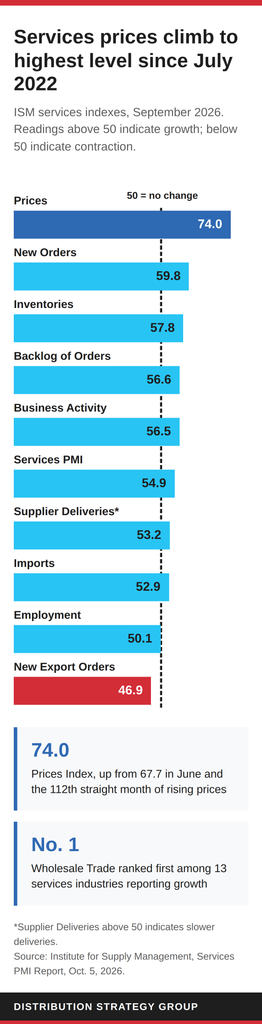
ISM’s Prices Index increased to 74% from 72.6% in August, reaching its highest level since July 2022.
Wholesale trade was among 17 industries reporting higher prices during September. No industry reported lower prices.
The increase points to continued cost pressure for distributors and other services businesses even as the pace of overall growth moderated.
ISM survey respondents cited fuel costs, tariffs and supply chain constraints among the factors affecting costs and business conditions.
Steve Miller, chair of the ISM Services Business Survey Committee, said fuel costs were mentioned twice as often as any other individual issue affecting business performance.
Supply chain conditions also tightened in September.
The Supplier Deliveries Index increased to 53.2% from 51.3% in August. Unlike most ISM indexes, a reading above 50% in the supplier deliveries measure indicates slower deliveries.
September marked the 22nd consecutive month of slower supplier deliveries.
At the same time, the Backlog of Orders Index increased to 56.6% from 55.6% in August, marking the eighth consecutive month of expansion. Wholesale trade was among the industries reporting higher order backlogs.
For distributors, the combination of growing orders, expanding backlogs and slower deliveries suggests demand remains healthy while suppliers face greater difficulty keeping pace.
Inventories continue to increase
Services businesses continued to add inventory during September.
The Inventories Index increased to 57.8% from 56.7% in August, marking the eighth consecutive month of expansion.
The Inventory Sentiment Index registered 51.7%, down from 54.1% in August. A reading above 50% indicates respondents considered their inventory levels too high.
Imports remained in expansion territory but slowed. The Imports Index fell to 52.9% from 56.3% in August.
Export demand weakened more sharply. The New Export Orders Index dropped to 46.9% from 56.3%, moving into contraction after seven consecutive months of expansion.
Wholesale trade appeared across several of ISM’s major growth measures in September, reporting increases in business activity, new orders, and employment as well as higher order backlogs.
At the same time, wholesalers reported rising prices, underscoring the tension running through the September report: Demand remained solid, but the cost and complexity of meeting that demand increased.
Overall, 13 services industries reported growth in September, while four reported contractions.
The September results suggest distributors entered the fourth quarter with continued demand momentum but also faced persistent pressure from prices, supplier lead times, and inventory management.
Do not miss any content from Distribution Strategy Group. Join our list.
Share this article:
