


Why This Matters to Distributors: Second-quarter earnings suggest the industry’s competitive advantage is shifting from pricing power to execution. As inflation-driven growth fades, distributors are relying on manufacturing recovery, artificial intelligence, digital commerce, technical expertise and targeted acquisitions to drive performance. Those that improve productivity and deepen customer relationships appear best positioned to capture market share in the next phase of the distribution cycle.
For the first time since the COVID-19 pandemic upended global supply chains, wholesale distributors are spending less time talking about shortages, inflation and inventory corrections and more time talking about growth.
Second-quarter earnings from many of North America’s largest distributors—including Watsco, Rexel, WESCO International, Fastenal, Motion Industries, Pool Corp. and United Parcel Service—show an industry that has largely moved beyond crisis management. Revenue continues to increase across much of the sector, but the forces driving that growth have changed. Manufacturing activity is strengthening after nearly two years of sluggish demand. Data center construction has become one of distribution’s fastest-growing markets. Artificial intelligence is moving from experimentation into everyday operations. Meanwhile, acquisitions are becoming more targeted, emphasizing technical expertise and customer capabilities rather than geographic expansion alone.
Two major distributors have yet to report comparable second-quarter results. Ferguson, which transitioned to a calendar fiscal year, will report Aug. 10, while Applied Industrial Technologies is scheduled to report its fiscal fourth-quarter results Aug. 13. Their most recently completed quarters, along with MSC Industrial Supply’s latest earnings, provide additional context for industrial demand and are referenced where appropriate.
The shift is significant because the industry’s growth story has fundamentally changed. For much of the past four years, distributors benefited from repeated supplier price increases that lifted revenue even as customer demand remained inconsistent. Today, pricing has normalized. Companies are once again being judged on how well they execute, how effectively they serve customers and how successfully they capture market share.
That change is evident across nearly every major distribution sector.
Inflation No Longer Drives Growth
Perhaps the clearest message from this earnings season is that inflation is no longer doing the heavy lifting.
Between 2022 and much of 2025, manufacturers repeatedly increased prices to offset higher raw material, freight and labor costs. Those increases inflated distributor revenue even when unit volumes remained soft. Higher sales often reflected pricing rather than stronger demand.
That environment has largely disappeared.
Instead, executives across multiple industries described markets that have returned to more conventional operating conditions, where growth depends on selling more products, improving productivity and retaining customers.
Watsco offered one of the clearest examples of that transition.
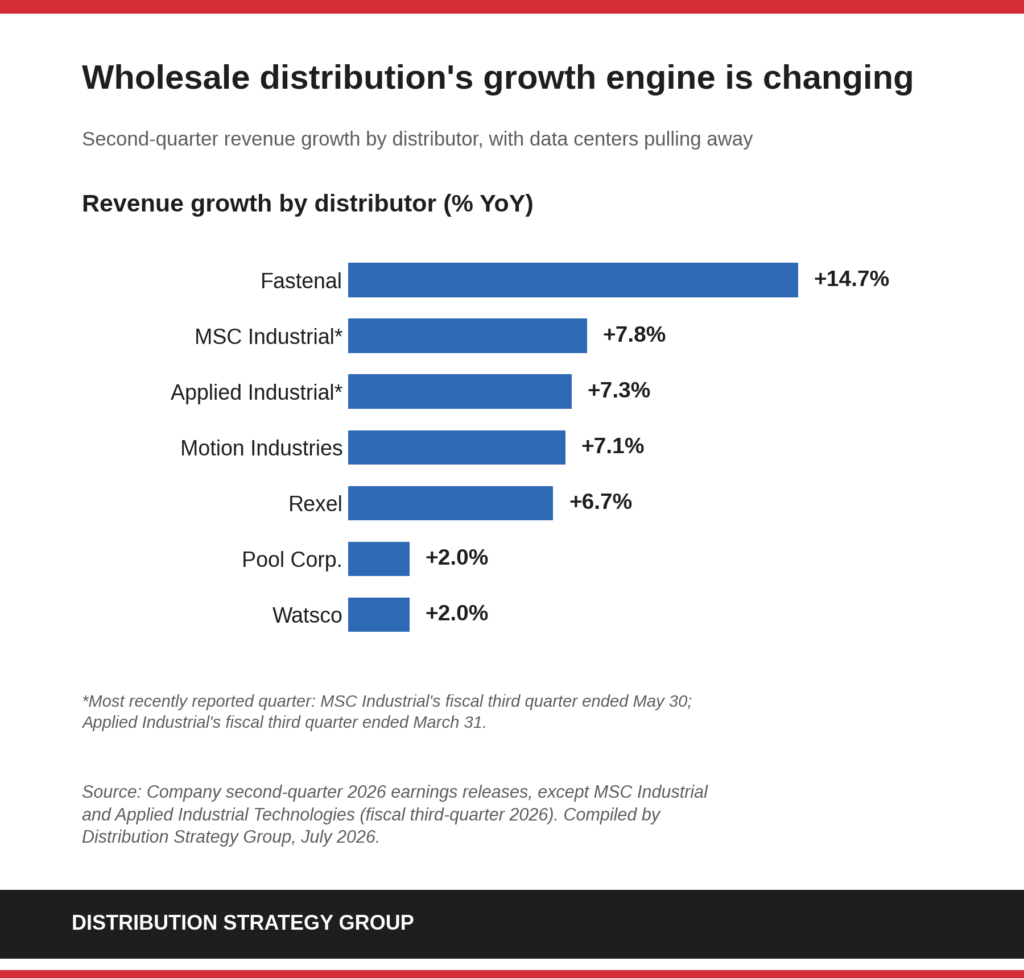
The HVAC distributor reported second-quarter revenue of $2.1 billion, up 2% from a year earlier. Residential HVAC equipment, its largest business, grew 5%, supported by increases in both unit sales and pricing as contractors returned to more typical purchasing patterns following the industry’s transition to A2L refrigerants.
At the same time, gross margin declined to 27.5% from 29.3% a year earlier because 2025 comparisons included unusually large manufacturer price increases tied to tariffs and inflation. Company executives repeatedly emphasized that today’s pricing environment is far more consistent with historical norms than the extraordinary conditions distributors experienced over the past several years.
Investors immediately recognized the implications. Watsco shares fell sharply after earnings, reflecting growing attention to profitability and operating performance rather than headline revenue growth alone.
The message extended well beyond HVAC. Executives throughout the quarter described businesses where customer demand—not inflation—is once again determining financial performance. Inventory management, pricing discipline, customer retention and operational efficiency have become far more important as pricing tailwinds fade.
In many respects, wholesale distribution has returned to a more traditional competitive environment.
Manufacturing Is Providing the Strongest Tailwind in Years
Another consistent theme emerging from second-quarter earnings is the return of manufacturing demand.
Industrial distributors spent much of the past two years waiting for factories to recover from higher interest rates, inventory reductions and slowing capital investment. That recovery is finally beginning to take hold.
The Institute for Supply Management’s Manufacturing Purchasing Managers Index registered 53.8 in July, essentially unchanged from June’s 53.9 and marking a sixth consecutive month above the 50 level that separates expansion from contraction. Manufacturers continue to report higher input costs associated with tariffs and ongoing efforts to regionalize supply chains, but overall activity continues to expand.
That backdrop is increasingly showing up in distributor earnings.
Motion Industries, the industrial business within Genuine Parts Co., reported second-quarter sales of $2.41 billion, an increase of 7.1% from a year earlier. Comparable sales rose 6.1%, while earnings before interest, taxes, depreciation and amortization increased nearly 10%.
Growth was broad-based.
Motion reported higher sales in 11 of its 14 end markets. Maintenance, repair and operations spending increased about 7%, while value-added solutions, including engineering, automation and technical services, grew about 9%, representing the company’s strongest pace since early 2023.
Applied Industrial Technologies also reported broad improvement in its latest quarter.
Net sales increased 7.3% to $1.3 billion, including 6% organic growth. Demand remained healthy across engineered solutions, automation, fluid power and traditional service center operations, prompting the company to raise its full-year outlook.
MSC Industrial Supply likewise delivered one of the strongest margin performances among industrial distributors.
Fiscal third-quarter sales increased 7.8% to $1.05 billion, while adjusted operating margin increased by 170 basis points to 10.6%. Adjusted earnings per share climbed more than 32%, demonstrating that disciplined pricing and improving manufacturing demand can coexist as inflation moderates.
Fastenal continued to post some of the industry’s most consistent results.
Second-quarter sales increased 14.7% to $2.39 billion, supported by growth in manufacturing customers, expanded onsite locations and continued demand for safety and industrial supplies. Fastenal’s digital selling strategy also continued gaining traction. Managed Inventory represented 44.6% of company sales, while electronically enabled transactions reached nearly 62% of total revenue.
Collectively, the results point to something industrial distributors have been waiting to see for nearly two years.
Manufacturing is once again becoming a source of growth rather than a drag on performance.
The recovery remains uneven. Tariffs continue to pressure input costs, regional differences persist and customers remain cautious about capital spending. Even so, industrial demand has become noticeably healthier than it was throughout much of 2024 and early 2025.
More importantly, distributors are beginning to benefit from expanding production rather than simply recovering from contraction.
Data Centers, Artificial Intelligence and the New Competitive Divide
If manufacturing provides the broadest source of demand, data centers have emerged as wholesale distribution’s fastest-growing market.
Few themes appeared more consistently across second-quarter earnings calls than the surge in spending tied to artificial intelligence infrastructure. Electrical distributors, HVAC suppliers, industrial distributors and specialty chemical companies all pointed to data centers as one of their strongest sources of new business, underscoring how a single end market is reshaping demand across multiple distribution sectors.
WESCO International delivered perhaps the clearest example.
Second-quarter data center sales climbed 45% from a year earlier to $1.5 billion and now account for more than one-fifth of the company’s trailing 12-month revenue. The growth helped push backlog to a record level, increasing roughly 60% from a year ago, while prompting WESCO to raise both its full-year earnings and organic sales growth outlook.
The results suggest data center demand is becoming more than a temporary construction cycle. It is evolving into a long-term growth engine supported by cloud computing, artificial intelligence, enterprise software and hyperscale infrastructure investment.
Rexel described a similar trend.
North America remained the company’s fastest-growing region during the quarter, driven largely by continued investment in data centers, industrial automation and electrical infrastructure. Same-day sales increased 7.8% in North America, outperforming every other geography in Rexel’s global portfolio and prompting the company to raise its full-year guidance.
The impact extends well beyond electrical distribution.
Every new data center requires sophisticated cooling systems, creating opportunities for HVAC distributors. Facilities consume large quantities of electrical products, automation equipment, networking hardware, backup power systems and industrial supplies. Construction also drives demand for coatings, specialty chemicals, adhesives and maintenance products distributed through companies such as Univar Solutions.
Unlike many previous construction cycles, data centers generate recurring opportunities long after the initial build. Operators require replacement parts, maintenance services, upgrades and ongoing facility support throughout the life of the asset.
For many distributors, artificial intelligence infrastructure is becoming one of the largest long-term demand drivers in decades.
Artificial Intelligence Moves from Experiment to Execution
While data centers are creating demand, artificial intelligence is reshaping how distributors compete.
Only a year ago, most executives discussed AI as an emerging technology with future potential. This earnings season, the conversation changed dramatically. Companies increasingly describe artificial intelligence as a practical operating tool that is already improving productivity, customer service and sales effectiveness.
Watsco offered one of the industry’s most comprehensive examples.
Over the past five years, the HVAC distributor has invested more than $250 million in digital technology while building what executives describe as the largest repository of customer, pricing and product data. The company is now embedding artificial intelligence across product search, pricing, contractor workflows and customer service.
Those investments are beginning to show measurable results.
Ecommerce sales grew 13% during the first half of 2026 and now account for approximately 37% of company revenue over the past 12 months. In some markets, digital transactions represent as much as 60% to 70% of sales. More than 70,000 customers actively use Watsco’s mobile applications each month.
The company’s OnCall Air platform also continues gaining traction.
During the past year, contractors generated more than 340,000 homeowner proposals through the platform, representing approximately $1.9 billion in gross merchandise value, an increase of 15% from the prior year. Executives said contractors using Watsco’s digital platforms consistently grow faster, remain customers longer and cost less to serve than those relying primarily on traditional ordering methods.
Rexel also highlighted artificial intelligence as an increasingly important tool for improving sales productivity and enhancing customer experience. WESCO emphasized continued investment in digital tools supporting complex project management and customer collaboration, capabilities that have become increasingly valuable as projects grow larger and more technically demanding.
Across the industry, artificial intelligence is becoming less of a technology initiative and more of an operating capability.
Rather than asking whether AI will change distribution, executives are increasingly focused on where it can improve productivity, automate routine work and strengthen customer relationships.
That shift marks an important milestone for an industry that has traditionally adopted new technology cautiously.
Amazon Business Is Changing Competitive Conversation
The industry’s digital transformation is also being shaped by an increasingly formidable competitor.
Amazon Business recently disclosed that annualized gross sales reached $60 billion, up from roughly $35 billion three years ago. The company now serves more than 11 million business customers, including 97 members of the Fortune 100, and added approximately 1.8 million customers during the first half of 2026 alone. Product selection expanded 30% over the past year.
Those numbers reinforce Amazon’s growing influence in business purchasing, particularly for standardized products where convenience, broad selection and competitive pricing carry the greatest weight.
Yet second-quarter earnings suggest Amazon’s growth is not displacing traditional distributors as much as it is redefining where they compete.
Executives increasingly emphasized capabilities that extend well beyond product fulfillment.
Technical sales support, engineered products, fabrication, inventory management, automation consulting, jobsite logistics, project coordination and field service featured prominently across multiple earnings calls. These are services that require specialized expertise, local relationships and deep application knowledge—advantages that are difficult to replicate through a digital marketplace alone.
The distinction is becoming clearer.
Routine purchases of maintenance supplies, office products and other standardized items continue migrating toward digital platforms. Higher-value purchases involving engineering support, technical consultation and complex project execution remain firmly within distributors’ core strengths.
Rather than trying to compete with Amazon on every transaction, distributors increasingly are investing in capabilities that make price only one part of the buying decision.
That strategic shift surfaced repeatedly throughout the quarter.
Companies are spending less time discussing digital commerce as a defensive response to Amazon and more time explaining how technology strengthens the differentiated services that have historically defined wholesale distribution.
The industry’s digital transformation is no longer about becoming Amazon.
It is about becoming a better distributor.
Logistics, Acquisitions and the Industry’s Next Chapter
The same themes reshaping industrial and electrical distribution are also emerging in transportation and adjacent distribution sectors.
Executives are reporting healthier underlying demand, but they also are making it clear that stronger revenue alone is no longer enough. Investors increasingly are rewarding companies that improve productivity, expand value-added services and execute more efficiently while penalizing those whose margins fail to keep pace.
That shift is redefining how distributors think about growth.
Logistics Shows Demand Is Improving
United Parcel Service offered another indication that business-to-business activity is strengthening.
Second-quarter revenue increased 7.6% to $22.8 billion, driven largely by international shipments and supply chain services. International revenue rose 12.5% to $5.04 billion, while Supply Chain Solutions revenue increased 7.8% to $2.86 billion, both outpacing growth in the company’s core U.S. domestic package business.
Although reported operating profit declined because of nearly $900 million in transformation-related costs, the underlying business continued to improve.
The company also raised its full-year outlook after completing its planned reduction in Amazon shipping volume, signaling confidence that its network restructuring is beginning to generate stronger returns.
For distributors, the results suggest improving industrial activity flowing through transportation networks as manufacturing production gradually recovers.
That trend has also appeared in recent less-than-truckload carrier results, where freight is becoming heavier and more industrial after more than two years of uneven demand.
Replacement Markets Continue to Provide Stability
Pool Corp. demonstrated another theme that surfaced repeatedly throughout earnings season: replacement-driven businesses remain resilient even as new construction continues to recover unevenly.
Second-quarter sales increased 2% to $1.8 billion despite continued softness in discretionary backyard construction. Net income declined modestly, but adjusted earnings exceeded analysts’ expectations, and the company reaffirmed its full-year outlook.
The results mirror conditions seen elsewhere in distribution.
Customers remain willing to invest in maintaining existing equipment and facilities even as they remain selective about larger discretionary projects. That dynamic continues benefiting distributors serving repair, maintenance and replacement markets, particularly those with strong service capabilities and recurring customer relationships.
Acquisitions Are Becoming More Strategic
Consolidation remains active across wholesale distribution, but the motivation behind acquisitions continues to evolve.
For years, distributors often pursued acquisitions primarily to expand geographically or increase purchasing scale. Today’s deals increasingly focus on adding technical expertise, specialized products and capabilities that can deepen customer relationships.
Watsco’s acquisition of Jackson Supply illustrates that approach.
The transaction adds approximately $230 million in annual revenue, 25 locations and roughly 5,000 customers across Texas and Louisiana while strengthening Watsco’s position in one of the country’s fastest-growing HVAC markets.
Rexel followed a similar strategy through three North American acquisitions completed during the first half of the year.
The company acquired TC 360 in Canada, Revere Electrical Supply in Illinois and DEE Electronics in Iowa. Each transaction adds specialized technical capabilities—from industrial automation and Rockwell Automation products to wire harnesses, cable assemblies and electronic manufacturing services—rather than simply expanding branch networks.
Univar Solutions’ acquisition of Interpur Chemicals reflects the same philosophy.
The deal expands the company’s specialty chemicals portfolio while adding technical expertise in polyurethanes, resins and powder coatings across Europe, the Middle East and Africa. Rather than pursuing volume alone, the acquisition strengthens Univar’s formulation support and application capabilities in high-value specialty markets.
The common thread is clear.
Distributors increasingly are buying businesses that enhance technical knowledge, engineering support and specialized product expertise—capabilities that are difficult for competitors to replicate and increasingly valued by customers.
The Competitive Playbook Has Changed
Perhaps the most revealing aspect of this earnings season is not what executives discussed but what they largely stopped discussing.
Only two years ago, earnings calls were dominated by conversations about port congestion, product shortages, emergency inventory purchases and supply chain disruptions. Companies devoted significant time to explaining freight costs, supplier allocations and inventory availability.
Those topics have largely faded into the background.
Instead, executives are talking about artificial intelligence, digital commerce, productivity, manufacturing recovery, acquisitions and market-share gains.
Tariffs remain part of the discussion, but the conversation has changed. Rather than treating tariffs as an immediate operational crisis, companies increasingly describe them as another business variable to manage through pricing, sourcing and procurement strategies.
The industry’s priorities have shifted from reacting to disruption to executing growth strategies.
That marks an important turning point.
For several years, extraordinary market conditions often obscured competitive differences among distributors. Nearly every company benefited from supply shortages, inflation-driven pricing and unprecedented swings in customer demand.
Those advantages have largely disappeared.
Success increasingly depends on operational discipline, technology investment, technical expertise and the ability to create value beyond simply delivering products.
Companies that can improve customer productivity, simplify complex purchasing decisions and strengthen long-term relationships appear better positioned to gain market share than those relying primarily on price.
That is the clearest message emerging from second-quarter earnings.
Wholesale distribution is no longer operating in a post-pandemic recovery.
It has entered a new competitive era—one defined less by inflation and disruption than by execution, innovation and the ability to help customers solve increasingly complex business problems.
Do not miss any content from Distribution Strategy Group. Join our list.
Share this article:
