

Why This Matters to Distributors: Global Industrial is betting that the next phase of distribution growth will come from becoming embedded in customers’ purchasing operations rather than simply selling products. The company’s investments in e-procurement, group purchasing organizations, industry expertise and artificial intelligence reflect a broader shift across wholesale distribution toward deeper customer relationships and recurring revenue.
Global Industrial is accelerating investments in digital procurement, group purchasing organizations (GPOs), industry specialization, and relationship-based selling as it works to become a larger part of customers’ day-to-day purchasing operations.
Company executives said the strategy is helping generate larger orders, stronger customer retention and continued organic growth while positioning the distributor to gain market share.
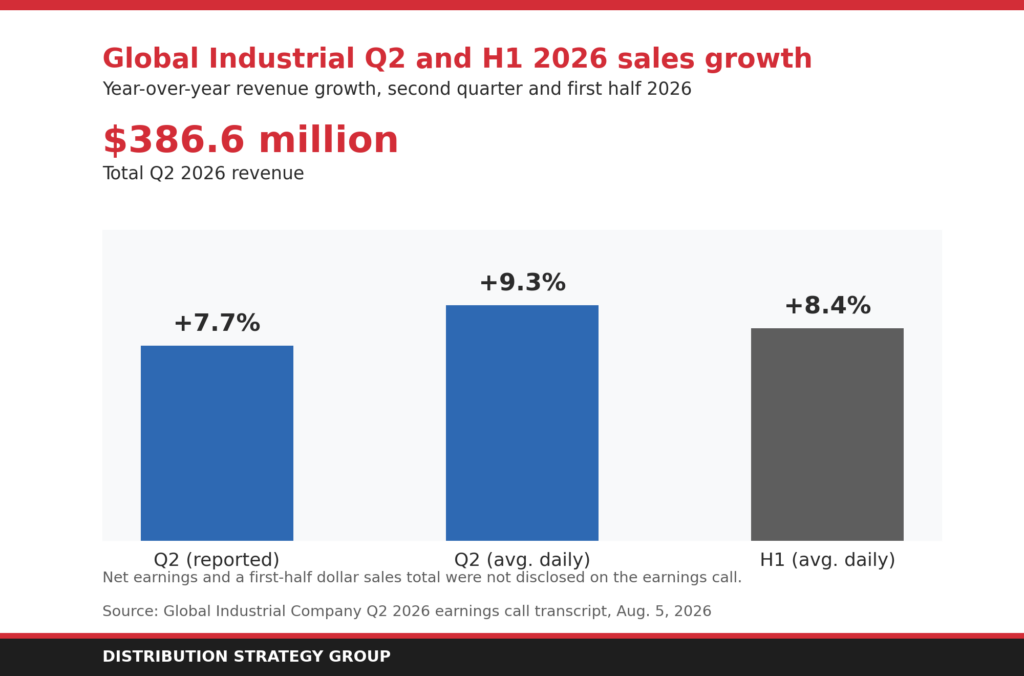
The Port Washington, New York-based distributor reported second-quarter sales of $386.6 million, up 7.7% from $358.9 million a year earlier, or 9.3% on an average daily sales basis. Operating income from continuing operations increased 47.2% to $49.3 million from $33.5 million, while net income from continuing operations rose 47.8% to $37.1 million from $25.1 million. The quarter included a one-time $26.2 million refund of previously paid IEEPA tariffs. Excluding that benefit, operating income totaled $28.2 million.
For the first six months of 2026, sales increased 8.4% to $737.0 million from $679.9 million a year earlier. Operating income from continuing operations rose 35.2% to $69.9 million, while net income from continuing operations increased 35.8% to $52.4 million.
“Over the past year, we have been repositioning Global Industrial toward a deeper relationship-led B2B model,” CEO Anesa Chaibi told analysts. “Our objective is to strengthen our value proposition and become a preferred supplier to our customers by becoming an extension of their team and making it easier for them to transact with us through the channels and systems they use every day.”
A centerpiece of the company’s strategy is expanding its e-procurement capabilities as more organizations automate purchasing.
During the first half of 2026, Global Industrial added more than 50 purchasing connections, increasing its total digital procurement integrations to more than 1,300 customers. More than 60% of company transactions now flow through digital channels.
“By integrating our offering directly into customers’ procurement platforms, we are moving closer to where purchasing decisions are made,” Chaibi said. “This improves ease of use, strengthens customer retention, and provides opportunities to broaden the range of products and solutions customers purchase from us.”
She said customers increasingly purchase through multiple channels, interacting with sales representatives and product specialists before placing orders through integrated digital procurement systems.
The company’s investment in group purchasing organizations has become another important growth driver.
Global Industrial expects annualized GPO sales to reach approximately $100 million this year, providing access to new customers through established purchasing contracts in healthcare, manufacturing, hospitality, and the public sector.
Chaibi said those relationships “provide us access to new customers through established contractual arrangements” while creating “a natural pathway into customers’ e-procurement systems, where purchasing activity can become more recurring and integrated.”
Global Industrial is also reorganizing its sales organization around customer industries rather than product categories.
The company said sales, marketing and merchandising teams are aligning around vertical markets to better understand customer operations and identify opportunities to solve broader business challenges.
“This is more than an organizational realignment,” Chaibi said. “It is a shift towards a 360-degree understanding of our customers’ operating environment and helping them solve a broader set of problems.”
The strategy is already producing results. Accounts managed by sales representatives posted low double-digit growth during the quarter, led by the company’s largest strategic customers. Average order value increased by about 10%, driven primarily by a larger mix of bigger customer orders rather than higher prices.
Artificial intelligence is becoming another tool to strengthen customer relationships and improve sales performance.
Rather than experimenting with emerging technology, Global Industrial said it is concentrating on practical AI applications that improve sales productivity, customer engagement, marketing insights, and decision-making.
“We remain disciplined in how we deploy these technologies, prioritizing solutions that improve the customer experience while empowering our associates to leverage these technologies to be more effective and deliver measurable returns,” Chaibi said.
Canada remains one of Global Industrial’s strongest growth markets.
Revenue increased more than 30% in local currency during the second quarter, marking the fourth consecutive quarter of double-digit growth. After surpassing CAD100 million in annual revenue last year, the Canadian business continues to demonstrate significant long-term expansion potential, management said.
The company also signaled acquisitions could play a larger role in its long-term strategy.
Asked about capital allocation during the earnings call, Chaibi said Global Industrial is actively developing an acquisition pipeline to accelerate growth.
“I’m also looking at M&A opportunities,” she said. “That’s something that we’re building out a pipeline and leaning into more so to help us execute and expand and speed up our go-to-market.”
Management said Global Industrial’s transformation is still in its preliminary stages but believes the combination of digital procurement, stronger customer relationships, industry expertise, and selective acquisitions will support sustainable organic growth.
“The strategy is working,” Chaibi told analysts. “The organization is lining up to do that… but it’s early innings, and I think we still have more to do.”
Do not miss any content from Distribution Strategy Group. Join our list.
Share this article:
