



Why This Matters to Distributors: Home Depot is moving from acquiring specialty distributors to integrating them with its stores, sales teams, digital operations, and delivery network. About 90% of Home Depot stores have completed an SRS Distribution sale through QuoteCenter during the past 12 months, while the company is adding SRS branches and using GMS and other specialty businesses to pursue more spending from professional contractors.
Home Depot is moving deeper into specialty distribution, using SRS Distribution, GMS, and its expanding Pro sales operation to pursue more business from contractors, homebuilders, and commercial customers.
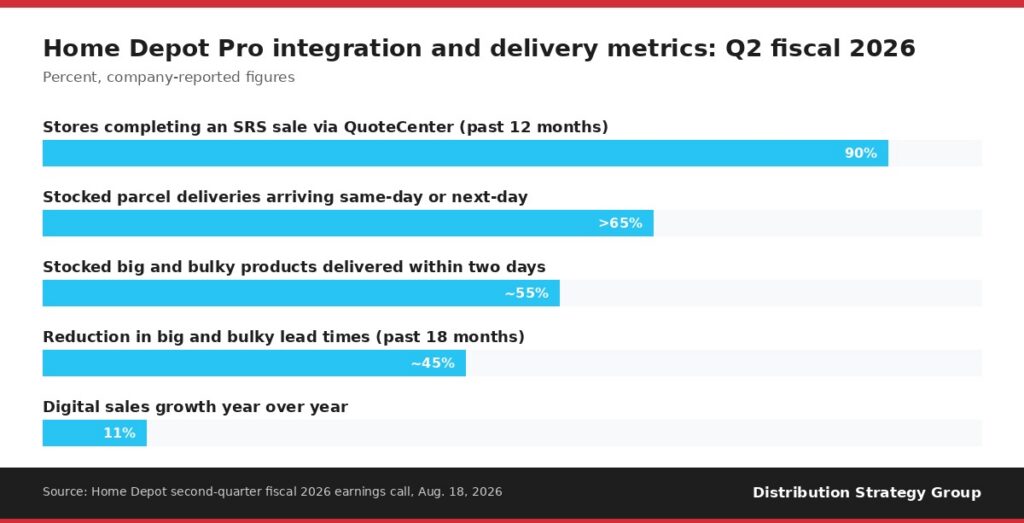
The company said during its Aug. 18 second-quarter earnings call that about 90% of its stores completed at least one SRS sale through Home Depot’s QuoteCenter platform during the past 12 months. The disclosure provides one of the clearest indications, yet that Home Depot is beginning to connect its traditional store network with the specialty distributors it has acquired.
The strategy is taking shape as Home Depot continues to grow. Second-quarter sales increased 5.7% to $47.861 billion from $45.277 billion a year earlier. Net earnings rose 4.7% to $4.766 billion from $4.551 billion.
For the first six months of fiscal 2026, sales increased 5.3% to $89.626 billion from $85.133 billion a year earlier. Net earnings increased 0.9% to $8.055 billion from $7.984 billion.
Comparable sales increased 1.7% in the second quarter, including a 1.3% increase in the U.S.
Behind those numbers, Home Depot is building a business that increasingly reaches beyond its traditional big-box stores. The company is combining SRS, GMS, outside sales, digital tools, and faster delivery to pursue larger professional customers and capture more of their spending.
SRS Moves Into Home Depot’s Sales Network
QuoteCenter is emerging as an important link between Home Depot stores and SRS.
The platform allows Home Depot’s Pro sales teams to source larger orders and products beyond what is stocked in an individual store. With SRS and GMS now part of Home Depot, the company can increasingly fulfill that demand through its own specialty distribution operations.
“Now that we own SRS and GMS, our Pro and sales team have access to this SRS full catalog,” senior executive vice president Ann-Marie Campbell told analysts.
Sales fulfilled by SRS through QuoteCenter are growing rapidly, she said.
“Within the past 12 months, 90% of our stores have closed a sale through SRS,” Campbell said.
For distributors, the significance is that Home Depot no longer needs to stock a product in a store to compete for the sale.
A contractor working with a Home Depot Pro salesperson can access products through SRS and the company’s broader distribution network. That expands the assortment Home Depot can offer while giving its existing sales organization another way to direct contractor spending into businesses the company owns.
SRS Gains Business With Larger Customers
SRS also gained ground during the quarter.
The distributor’s comparable sales grew faster than Home Depot’s overall comparable sales, with positive comparable sales across all of SRS’ business verticals.
Home Depot chief financial officer Richard McPhail said the company believes SRS is gaining market share and continues to expect the business to generate mid-single-digit organic sales growth in fiscal 2026.
SRS also is expanding with larger customers.
“We’re capturing significant incremental sales to homebuilders, commercial customers and remodelers across the verticals,” McPhail said.
That expansion is central to Home Depot’s business development strategy.
Home Depot acquired SRS in 2024, gaining a specialty distribution platform with operations in roofing, landscaping, pools, and other building products. The subsequent acquisition of GMS expanded that network into wallboard, ceilings, steel framing, and related construction products.
SRS also completed its acquisition of HVAC distributor Mingledorff’s in May, adding another specialty trade to Home Depot’s growing distribution network.
Home Depot plans to open 40 to 50 additional SRS locations during fiscal 2026.
The expansion gives Home Depot multiple routes to the same professional customer: stores, outside sales representatives, QuoteCenter, SRS branches, GMS locations, specialty distribution businesses, and digital channels.
Pro Sales Outperform DIY
Professional customers continued to outperform do-it-yourself customers during the quarter.
Home Depot said comparable sales to Pros were positive, with growth across its Pro customer groups.
Several categories with significant professional demand also posted gains, including portable power tools, decking, dimensional lumber, pipe and fittings, fasteners, hand tools, and concrete.
The Pro gains came despite continued weakness in large discretionary home improvement projects. High borrowing costs and limited housing turnover continue to weigh on larger remodeling projects, while customers remain more active on smaller repair and maintenance work.
That makes professional contractors increasingly important to Home Depot’s growth strategy while the company waits for a broader recovery in housing and remodeling.
“There is more to do, but it is evident that we are serving our Pros better than ever,” Campbell said.
Faster Delivery Targets the Job Site
Home Depot also is expanding delivery capabilities aimed directly at professional contractors.
The company has expanded Express Delivery nationwide, offering delivery of tens of thousands of products in three hours or less for a flat fee.
Jordan Broggi, executive vice president of customer experience and president of online, said most Express Delivery orders are already arriving in less than an hour.
Professional contractors are a specific target for the service. Home Depot cited the example of a plumber discovering that a product is missing while already working at a job site and ordering it for delivery rather than leaving the project to make a store run.
That puts Home Depot into more direct competition with one of the traditional strengths of local and regional distributors: getting products to contractors quickly enough to keep crews working.
Home Depot said more than 65% of deliveries of stocked parcel products now reach customers the same day or next day.
For stocked big and bulky products, about 55% are delivered within two days. The company said it has reduced lead times for those products by about 45% during the past 18 months.
Home Depot Adds More Pro Products
Home Depot also is expanding supplier relationships in categories important to professional contractors.
The company said it is expanding its relationship with USG and will be the exclusive big-box retail launch partner for the manufacturer’s new UltraLight Tough gypsum panels.
Home Depot also is expanding its Ruco joint treatment assortment across its stores.
The move takes on greater significance following the addition of GMS, a major specialty distributor of wallboard, ceilings, steel framing, and related products.
Home Depot can increasingly pursue those categories through its stores, Pro sales organization, and specialty distribution network instead of relying primarily on products stocked in retail locations.
That gives the company more ways to compete for larger residential and commercial projects that traditionally have been served by specialty building products distributors.
Digital Sales Rise 11%
Home Depot’s digital business also continued to grow.
Sales through its digital platforms increased 11% from a year earlier, marking the fifth consecutive quarter of double-digit growth. The company said both traffic and conversion increased, while its mobile app remained its fastest-growing digital channel.
Home Depot also is expanding Magic Apron, its artificial intelligence-powered shopping assistant, into stores. The technology can recognize the store a customer is visiting and use local inventory when responding to product and project questions.
The company said Magic Apron is managing millions of customer questions each month.
For professional customers, Home Depot also is developing AI-enabled tools such as Material List Builder, which can turn project information from spreadsheets, emails, texts, and other sources into lists of products that can be priced and ordered.
For distributors, those tools are significant because they are being connected to a much larger Pro sales and fulfillment operation.
A contractor can increasingly build a materials list digitally, work with a salesperson, access products beyond an individual store’s inventory and have the order fulfilled through Home Depot’s stores or specialty distribution businesses and delivered to a job site.
Home Depot Moves From Acquisition to Integration
Home Depot’s second-quarter results show its Pro strategy entering a new phase.
Buying SRS gave the company a large specialty distribution platform. Adding GMS and other businesses expanded that platform into additional product categories, geographies, and customer segments.
Home Depot is now working to connect those businesses with the customer relationships, stores, salespeople, technology, and delivery capabilities it already has.
The 90% store participation rate for SRS sales through QuoteCenter is an early indication that the integration is moving into day-to-day selling.
For traditional distributors, that creates a more direct competitive challenge than Home Depot’s conventional retail model.
Home Depot is not simply trying to persuade contractors to make more purchases inside its stores. It is combining a national store network with specialty distribution branches, outside sales, broader product assortments, digital tools, and job-site delivery.
That allows Home Depot to compete for purchases that previously might have gone directly to an independent or specialty distributor.
The company also continues to expand its physical distribution footprint, with 40 to 50 additional SRS locations planned this year.
Home Depot’s financial scale gives it substantial resources to support that strategy. The company generated $47.861 billion in second-quarter sales, up 5.7%, and $4.766 billion in net earnings, up 4.7%. Through the first six months of the year, sales reached $89.626 billion, up 5.3%, while net earnings totaled $8.055 billion, up 0.9%.
For distributors, however, the more consequential numbers may be the operational ones: 90% of Home Depot stores have already completed an SRS sale through QuoteCenter, SRS is expanding with homebuilders and commercial customers, digital sales are growing at a double-digit rate and another 40 to 50 SRS locations are planned this year.
Together, those moves show Home Depot shifting from acquiring distribution businesses to integrating them into a broader Pro growth strategy — one designed to compete with traditional distributors on product breadth, sales relationships, digital capabilities, availability, and delivery to the job site.
Do not miss any content from Distribution Strategy Group. Join our list.
Share this article:
