



Why This Matters to Distributors: Wholesale distributors reported higher orders, business activity, and employment in October, but rising product costs, slower supplier deliveries and concerns about excess inventory complicated operating conditions. The latest Institute for Supply Management report points to continued demand across much of the services economy, although weakness in construction and uneven export activity present challenges for distributors heading into the final months of 2026.
The U.S. services economy expanded for the 28th consecutive month in October, with wholesale distributors reporting increased orders, business activity and employment despite persistent cost pressures and slower supplier deliveries, according to the Institute for Supply Management.
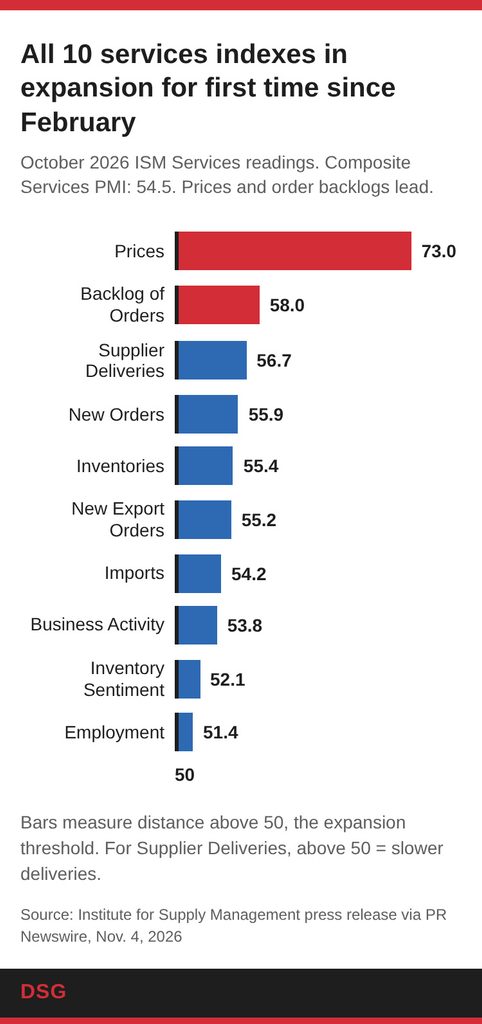
ISM’s Services Purchasing Managers Index registered 54.5 in October, down from 54.9 in September. A reading above 50 indicates expansion, while a reading below 50 signals contraction.
The Nov. 3 report showed continued growth across much of the services economy, including wholesale trade, transportation and warehousing, health care, and professional services. However, several indicators pointed to slower growth and continued pressure on purchasing and inventory decisions.
Wholesale trade was among 15 industries reporting increased new orders and 13 reporting higher business activity. Distributors also reported employment growth and an increase in order backlogs, suggesting that demand remained positive despite uncertainty about costs and future purchasing activity.
The overall New Orders Index fell to 55.9 from 59.8 in September, while the Business Activity Index declined to 53.8 from 56.5. Both remained in expansion territory.
Construction was the only industry reporting a decline in new orders for the third consecutive month, signaling continued weakness in a market that supports demand for building materials, plumbing, heating, ventilation and air conditioning equipment, electrical products, and other construction supplies.
Supplier delivery times lengthened in October, adding another complication for distributors managing inventory and customer orders.
ISM’s Supplier Deliveries Index increased to 56.7 from 53.2 in September. A reading above 50 indicates slower deliveries, unlike most other ISM indexes, where readings above 50 indicate expansion.
Wholesale trade was among the industries reporting longer supplier delivery times.
The results suggest that distributors continued to face supply chain constraints even as overall economic growth moderated. Longer lead times can force companies to place orders earlier, carry additional inventory or adjust delivery commitments to customers.
Survey respondents also reported scheduling problems and delays involving suppliers and transportation providers. Those disruptions can increase purchasing uncertainty and make it more difficult for distributors to maintain product availability without building excess inventory.
Prices continued to rise across the services economy in October, although the pace of increases moderated slightly.
ISM’s Prices Index registered 73, down from 74 in September but above its 12-month average of 69.2. The index remained well above the 50-point threshold separating rising and falling prices.
Prices paid by services businesses have increased for 113 consecutive months.
Wholesale trade was among 17 industries reporting higher prices.
Products and operating expenses identified as increasing in price included aluminum, copper, steel products, wire and cable, diesel fuel, equipment parts, and insurance.
Copper prices were reported as increasing for the 11th consecutive month, while diesel fuel prices rose for the eighth consecutive month. Steel products were listed as increasing for the seventh consecutive month.
Those increases are particularly relevant to electrical, industrial, metalworking, and construction supply distributors, which purchase and sell products containing substantial amounts of copper, aluminum, and steel.
Higher diesel costs also affect distributors operating delivery fleets and distribution networks.
Although the report does not measure individual distributors’ profit margins, continued increases in product and transportation costs can put pressure on earnings when companies cannot pass those expenses along to customers.
Inventories continued to increase in October, although at a slower pace than in September.
ISM’s Inventories Index declined to 55.4 from 57.8, indicating that businesses continued adding inventory but at a reduced rate.
At the same time, the Inventory Sentiment Index increased to 52.1 from 51.7, indicating that more businesses considered their inventory levels too high relative to demand.
Wholesale trade was among the industries reporting excessive inventories.
The findings highlight a continuing challenge for distributors: maintaining sufficient stock to meet customer orders while avoiding the costs associated with carrying products that may not sell quickly.
The combination of rising orders, slower deliveries and concerns about excess inventory also suggests that demand varies by product category and customer market.
Distributors serving stronger industrial and commercial markets may need additional inventory to maintain service levels, while companies exposed to slower construction activity could face pressure to reduce stock.
Outstanding orders continued to increase in October, providing another indication that businesses were struggling to keep pace with demand.
ISM’s Backlog of Orders Index rose to 58 from 56.6 in September, reaching its highest level since July 2022.
Backlogs expanded for the ninth consecutive month, with wholesale trade among 11 industries reporting an increase.
Higher backlogs can indicate continued customer demand, but they can also reflect supply shortages, transportation delays or other constraints preventing businesses from completing orders.
Employment conditions improved modestly. The Employment Index increased to 51.4 from 50.1 in September, marking the second consecutive month of employment growth.
Wholesale trade was among six industries reporting increased employment.
The increase suggests that some distributors continued adding workers to support sales and operations, although the overall employment index indicated only modest growth.
International demand improved throughout the broader services economy, but wholesale trade was among the industries reporting declining export orders.
ISM’s New Export Orders Index increased to 55.2 from 46.9 in September, returning to expansion territory.
However, wholesale trade was among five industries reporting a decrease in export orders.
The divergence suggests that international demand remained uneven, with conditions varying across industries and customer markets.
For distributors serving manufacturers and other businesses with international customers, weaker export orders could limit sales opportunities even as domestic demand continues to expand.
October’s ISM report points to continued growth in wholesale distribution, but the operating environment remains challenging.
Higher orders, business activity, employment, and backlogs indicate that distributors continued to benefit from customer demand. At the same time, rising product costs, slower supplier deliveries and concerns about excess inventories complicate purchasing and fulfillment decisions.
The weakness in construction orders is another concern for distributors serving building products and related markets.
For distribution executives, the report underscores the importance of monitoring customer demand by industry rather than relying solely on broader economic indicators.
The services economy continues to expand, but the combination of slower growth, elevated costs and uneven demand suggests distributors will need to balance inventory availability, pricing, and operating expenses carefully through the end of 2026.
Do not miss any content from Distribution Strategy Group. Join our list.
Share this article:
