


Why This Matters to Distributors: Medline has signed more than $650 million in new customer business this year and is adding distribution centers, automation, and workers to manage growth. At the same time, a fire at its Tracy, California, distribution center is testing the resilience of the network and accelerating a major expansion of its California capacity.
Medline is accelerating investments in distribution capacity and automation as new customer wins drive double-digit sales growth, while the medical-surgical distributor rebuilds its Northern California network following a June distribution center fire.
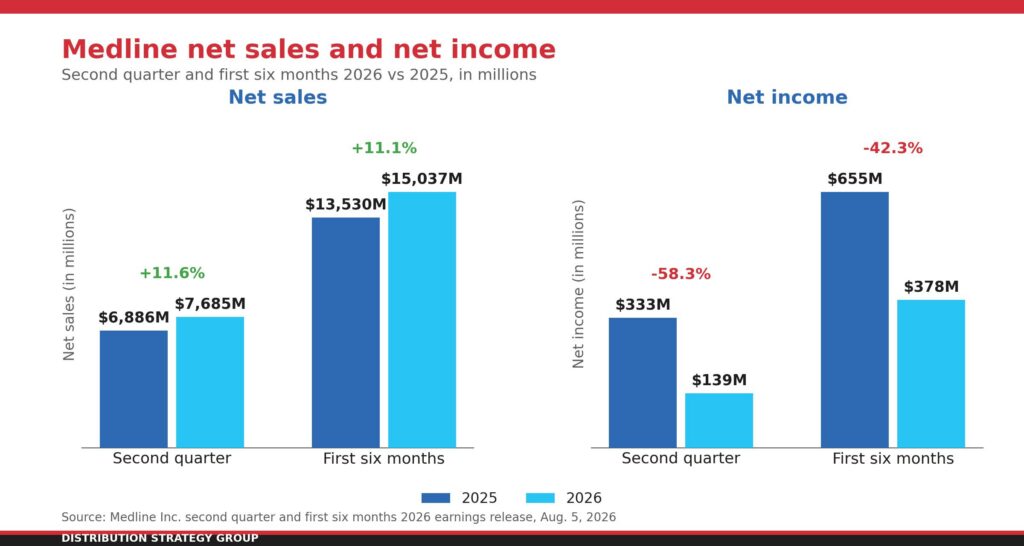
Second-quarter sales increased 11.6% to $7.685 billion from $6.886 billion a year earlier. Net income fell 58.3% to $139 million from $333 million, largely because of $336 million in losses related to the fire at Medline’s Tracy, California, distribution center before expected insurance recoveries.
For the first six months of 2026, sales increased 11.1% to $15.037 billion from $13.530 billion. Net income declined 42.3% to $378 million from $655 million, also reflecting the Tracy fire, along with higher operating and product costs.
Behind the sales growth is a broader business development push. Medline secured more than $650 million in new customer signings during the first half, more than 65% of its $1 billion full-year goal. The agreements span acute care, physician offices, laboratories, skilled nursing, senior living, home health, and hospice.
CEO Jim Boyle said Medline expects to exceed the $1 billion target.
“We’re ahead of pace to achieve the $1 billion, and we’re confident that we’re going to hit the $1 billion plus,” Boyle told analysts.
Unlike the previous year, when several large agreements helped produce $2.4 billion in new business, Boyle said this year’s gains have come from a larger collection of smaller contracts.
That strategy is producing particularly robust growth in Medline’s distribution operation. Supply Chain Solutions sales increased 16.3% to $4.145 billion in the second quarter from $3.564 billion a year earlier. First-half sales increased 15.7% to $8.032 billion from $6.944 billion.
Medline’s strategy is to use those supply chain relationships as an entry point for broader customer growth. Winning a prime vendor agreement puts the distributor in a position to expand into additional healthcare settings and convert more of the customer’s purchases to Medline-branded products.
The company estimates it has about $5 billion in potential Medline Brand conversion opportunities within its existing business.
One of Medline’s recent wins is an expanded prime vendor agreement with Allina Health in the Upper Midwest. The agreement broadens an existing relationship across acute care, physician offices, and other operations.
Boyle called Allina a “sizable deal” but did not disclose its value. He said the agreement went live in July.
Medline is also expanding relationships beyond traditional hospital supply contracts. The company said new business in physician offices and laboratories has come from both existing acute-care customers and organizations where Medline previously did not serve as the prime vendor.
That creates an opportunity to move in both directions: from hospital supply into physician offices, laboratories, and surgery centers, or from an initial laboratory relationship into a broader prime vendor agreement.
“It is a part of our playbook” to win new business and expand sales within existing customer networks, Boyle said.
U.S. acute-care sales increased 15% to $5.4 billion in the second quarter, while non-acute sales increased 4% to $1.7 billion. International sales increased 9% to $533 million.
The customer gains are forcing Medline to invest before all the new sales reach its distribution network.
The company is adding workers, distribution centers, and automation to accommodate new contracts and growth from existing customers. Medline said it has been bringing about $2.4 billion in previously signed business onto its network.
Boyle said labor sometimes must be added three to six months before the corresponding customer volume begins moving through Medline’s facilities.
Medline is also installing AutoStore automation in facilities where rising volumes have created labor inefficiencies. The company is adding distribution capacity in Texas and California and is considering two additional distribution centers in the Midwest.
“As we add new distribution centers, as we add automation, we expect to see those inefficiencies subside and ultimately see some savings in our business,” chief financial officer Mike Drazin said.
The spending reflects a longstanding strategy of putting capacity in place before expected demand arrives.
“We’ve been intentional for many, many years of investing in our business for growth ahead of the growth,” Drazin said.
That expansion strategy took on greater urgency after the mid-June fire at Medline’s Tracy distribution center.
The company used inventory elsewhere in its network, other distribution centers, and its MedTrans transportation fleet to continue serving customers after the fire.
Within a month, Medline secured 1.6 million square feet across two distribution centers, increasing its customer-facing Northern California footprint by 45%.
Medline has already taken occupancy of a replacement Tracy distribution center and expects it to begin serving customers during the fourth quarter. A new Stockton facility is scheduled for occupancy in January 2027.
The company separately plans to open a 1 million-square-foot Southern California distribution center. Together, the projects are expected to bring Medline’s California footprint to 5 million square feet by mid-2027. The facilities are expected to use automation technologies deployed elsewhere in Medline’s network.
“This is about more than scale,” Boyle said. “It reinforces resiliency and redundancy across our network.”
The fire had a significant effect on Medline’s reported earnings. The company recorded $336 million in losses related to inventory, fixed assets, and other costs during the second quarter. Medline said it believes it has sufficient insurance coverage and expects future recoveries.
Medline expects another $50 million to $100 million in fire-related costs during the second half, including cleanup, product rerouting, airfreight, leases, and labor inefficiencies as replacement operations come online.
The combination of customer wins and the California disruption is accelerating a broader buildout of Medline’s distribution network.
The company spent $207 million on capital projects during the first half, primarily on distribution center improvements and automation and expansion of its kitting manufacturing operations.
Medline also raised its full-year sales growth expectation to 9% to 10% from 8.5% to 9.5%, citing demand from new and existing customers.
For distributors, the more consequential development is where Medline is putting capacity.
The company is using prime vendor wins to expand across customer locations and care settings, then investing in distribution centers, automation, and labor before all that volume arrives. At the same time, the Tracy fire has led Medline to build additional redundancy into a California network that is expected to approach 5 million square feet by mid-2027.
The strategy links business development directly to distribution infrastructure: win the customer, expand the relationship across its network, and put enough capacity in place to manage the resulting volume.
Do not miss any content from Distribution Strategy Group. Join our list.
Share this article:
