

Why This Matters to Distributors: New tariffs on Canadian goods add another layer of costs for distributors importing building materials, industrial products, and other merchandise. Recent earnings commentary from major public distributors shows companies are relying primarily on pricing to recover tariff-related costs rather than counting on refunds or making broad changes to sourcing.
New 50% U.S. tariffs on $20 billion of Canadian goods took effect Aug. 22, expanding import costs across products ranging from cement and plywood to furniture and other goods sold through distribution.
The Trump administration imposed the duties under Section 338 of the Tariff Act of 1930, opening another front in a trade dispute with Canada while distributors continue to adjust pricing and purchasing strategies to a U.S. tariff system that has changed repeatedly this year.
President Donald Trump signed three proclamations July 20 targeting Canadian dairy products, alcoholic beverages, and motor vehicles over trade practices the administration considers discriminatory.
The tariffs were initially scheduled to take effect Aug. 19 but were delayed three days while U.S. and Canadian officials continued negotiations. The talks ended without an agreement, and U.S. Trade Representative Jamieson Greer said no additional discussions were planned.
Canadian Prime Minister Mark Carney said Canada would retaliate “dollar for dollar.”
The affected products extend well beyond the categories highlighted by the administration. Annexes to the proclamations include cement, plywood, furniture, wine, clothing, seeds, fishing rods, hockey sticks, and swimming pools, among hundreds of tariff classifications.
The duties apply even to products that qualify for preferential treatment under the United States-Mexico-Canada Agreement, eliminating an exemption that had shielded many Canadian products from previous U.S. tariffs.
Canada responded with tariffs on U.S. products including steel, dairy products, appliances, agricultural machinery, paper, and electronics.
U.S. Tariff Policy Continues to Shift
The Canadian tariffs are the latest change in a U.S. trade policy that has been reshaped several times in 2026 by court decisions and new administration actions.
The U.S. Supreme Court ruled 6-3 on Feb. 20 that the International Emergency Economic Powers Act did not give the president authority to impose tariffs, invalidating duties imposed under the law. Those included the administration’s 2025 reciprocal tariffs and fentanyl-related tariffs on Canada, Mexico, and China.
U.S. Customs and Border Protection stopped collecting the affected duties following the decision. A process for refunding previously collected tariffs is underway, although the government has not completed procedures for returning all the money.
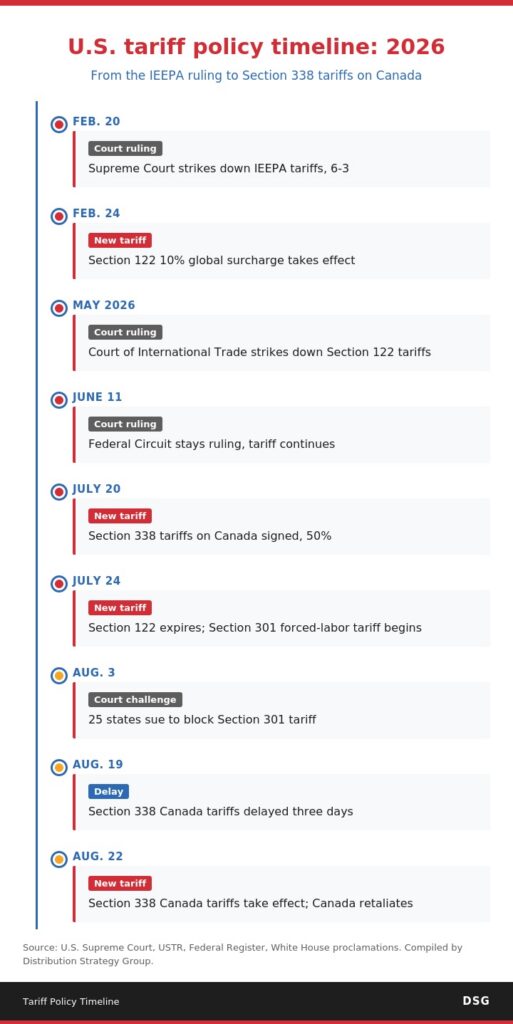
The administration responded by invoking Section 122 of the Trade Act of 1974, which permits temporary import surcharges of up to 15% for no more than 150 days under certain balance-of-payments conditions.
A 10% global surcharge took effect Feb. 24.
The U.S. Court of International Trade ruled against the surcharge in May. The administration appealed, and the U.S. Court of Appeals for the Federal Circuit stayed the decision June 11, allowing collection to continue during the appeal.
The Section 122 surcharge expired July 24. The U.S. Trade Representative then imposed tariffs of 10% to 12.5% on imports from about 60 trading partners under Section 301, citing forced-labor enforcement.
Twenty-five states sued Aug. 3 in the Court of International Trade seeking to block those tariffs and recover duties already collected.
Section 232 national security tariffs have remained on a separate track. Steel and aluminum duties were increased from 25% to 50% in 2025 and subsequently expanded to additional derivative products.
The administration completed a Section 232 investigation into polysilicon on Aug. 6, resulting in a 15% tariff and minimum import prices on the material used in semiconductor and solar manufacturing. A Section 201 tariff on quartz surface products took effect July 31.
A separate Section 301 investigation into structural manufacturing overcapacity covering 16 countries remains open. Brazil has faced a 25% Section 301 tariff since July 22.
For distributors, the result is a patchwork of tariffs imposed under different laws, covering different countries and products and carrying different expiration dates and legal risks.
Public Distributors Turn to Pricing
Second-quarter earnings reports provide a clearer picture of how distributors are responding to those costs.
W.W. Grainger reported $43 million in refunds related to invalidated IEEPA tariffs during the second quarter, adding about 90 basis points to gross margin.
CEO D.G. Macpherson said the refunds were smaller than the cumulative tariff-related cost increases Grainger had absorbed and said the company does not expect refunds of similar magnitude going forward.
Grainger adjusted prices during the quarter as tariff policy changed and is planning another pricing action in September. The company expects the increase to add about 1% to annual revenue and help offset freight and tariff-related costs.
Third-quarter operating margin is expected to decline sequentially as the tariff-refund benefit does not repeat.
Fastenal executives also said tariff-related costs pressured gross margin during the first half of the year. Pricing actions have helped offset those increases and broader inflation, with the company continuing to target price-cost neutrality rather than using tariff-related increases to expand margins.
Watsco has seen a similar shift.
Chairman Albert Nahmad cited tariffs alongside the pandemic, supply chain disruptions and regulatory changes as challenges the HVAC distributor has managed during the past five years.
Executive Vice President Barry Logan said aggressive manufacturer price increases in 2025 reflected the unusual combination of tariffs and inflation and should not be considered a new pricing baseline. He said that pricing behavior in 2026 has moved closer to historical patterns, he said.
Ferguson executives said the distributor has not received tariff refunds from branded suppliers and does not expect to receive them. Ferguson is the importer of record for only a small portion of its own-brand products, limiting its direct exposure to potential refunds.
Core & Main is seeing tariff effects primarily through product pricing rather than direct import costs.
CEO Mark Witkowski said the company remains cautious about private construction because of geopolitical and tariff uncertainty, interest rates, and builder confidence.
Chief Financial Officer Robyn Bradbury said PVC pipe prices had declined about 15% during the year, although recent supplier increases could provide modest revenue benefit during the second half of fiscal 2026.
The distributor also reported higher steel prices in its fire protection business, which Witkowski attributed in part to tariff-related costs moving through the supply chain.
WESCO International said its direct tariff exposure remains limited because it is the importer of record for only a low-single-digit percentage of its cost of goods sold. The company does not expect significant recoveries through the IEEPA refund process.
WESCO said it adjusts prices to maintain margins as tariff-related costs increase. Executives said indirect effects, including transportation costs, have been more noticeable but remain manageable.
Applied Industrial Technologies reported a pricing contribution of about 2% to 2.5% from tariff-related supplier increases during fiscal 2026. The company expects that contribution to moderate to about 1.5% to 2% during fiscal 2027.
CEO Neil Schrimsher said trade policy and geopolitical conditions could affect industrial production and customer spending. Chief Financial Officer David Wells said tariff conditions were stabilizing, heading into the new fiscal year.
Across the seven distributors, the response has been broadly consistent: Companies are passing on higher costs through pricing while not counting on tariff refunds or making significant changes to their sourcing networks.
Canadian Tariffs Add to 2027 Planning
The new Canadian duties add another cost variable as distributors begin planning purchasing, inventory, and pricing for 2027.
Section 338 allows tariffs of up to 50%, meaning the administration has already reached the statute’s maximum rate on the affected Canadian products. How long those duties remain in place could depend on whether Washington and Ottawa resume negotiations.
For distributors importing affected Canadian building materials and industrial products, the more immediate issue is how quickly higher landed costs move through inventories and into customer prices.
Recent results from major public distributors suggest the industry’s response is becoming increasingly consistent: recover tariff-related costs through pricing rather than wait for trade negotiations, court decisions, or refunds to provide relief.
Do not miss any content from Distribution Strategy Group. Join our list.
Share this article:
