



Why This Matters: Data center construction, warehouse automation and manufacturing reshoring are emerging as major drivers of U.S. industrial demand, potentially creating new opportunities for distributors serving electrical, automation, construction, material handling and industrial markets.
Artificial intelligence infrastructure, warehouse automation and manufacturing reshoring are driving a new wave of U.S. industrial demand as companies seek more space for data centers, advanced manufacturing and highly automated distribution facilities.
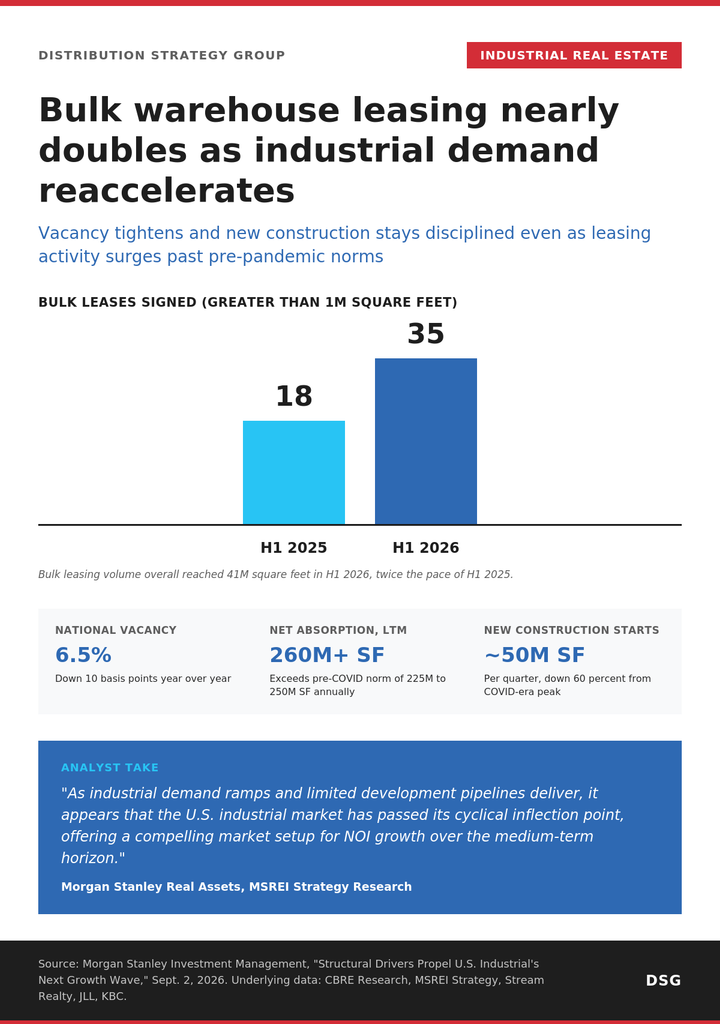
Industrial net absorption across major U.S. markets exceeded 260 million square feet during the four quarters through the second quarter of 2026, surpassing the pre-pandemic annual range of 225 million to 250 million square feet, according to a Sept. 2 analysis from Morgan Stanley Real Assets published by Eaton Vance.
Industrial demand also accelerated from a year earlier. Trailing 12-month demand in the second quarter grew at twice the pace recorded in the second quarter of 2025, while the national industrial vacancy rate declined 10 basis points from a year earlier to 6.5%.
The stronger demand comes as construction of new industrial properties remains constrained. Construction activity has fallen 60% from its pandemic-era peak, while new development starts have averaged about 50 million square feet per quarter during the past three years.
Morgan Stanley Real Assets identified three forces behind the shift: the buildout of the data center supply chain, increased use of artificial intelligence and automation in warehouses, and expansion of advanced U.S. manufacturing.
Data center investment is already reshaping industrial demand in several markets.
Companies supporting data center construction and operations are leasing industrial space for semiconductor operations, equipment development, power technology, server testing, construction services and hardware storage.
In Dallas, data center-related companies have accounted for 30% of gross industrial leasing since the fourth quarter of 2024 and 40% of leasing for facilities larger than 700,000 square feet, according to Stream Realty data cited in the report.
Data center-related bulk industrial leasing in Dallas exceeded 7 million square feet during the past 12 months and accounted for nearly all the increase in leasing activity compared with pre-pandemic levels. Similar activity is occurring in Virginia and Midwest markets including Ohio and Kansas City.
The trend could have broader implications for distributors because the data center supply chain extends well beyond servers and computing equipment. Construction and operation of those facilities require electrical and power equipment, cooling systems, automation, construction products and other industrial supplies.
Warehouse automation is creating another source of demand.
Companies deploying artificial intelligence and next-generation automation are increasingly seeking large, modern distribution facilities capable of supporting autonomous mobile robots, conveyor systems, automated storage and retrieval systems and automated packaging equipment.
Leasing of U.S. industrial facilities larger than 1 million square feet reached 41 million square feet during the first half of 2026, twice the pace of the first half of 2025. Thirty-five leases exceeding 1 million square feet were signed during the period, compared with 18 a year earlier.
Ecommerce companies accounted for 50% of that large-building leasing volume. According to the report, the supply of modern facilities is tight, with only 12 bulk properties under construction and available for lease nationally. Some companies are now preleasing facilities scheduled for completion in 2027 and 2028.
Manufacturing expansion is adding another layer of industrial demand.
Advanced manufacturing now accounts for 19% of active U.S. industrial tenant requirements, according to JLL data cited in the report. The square footage associated with active manufacturing requirements has increased at a compound annual growth rate of more than 40% since 2020, with Texas, Georgia, Arizona and Ohio leading leasing activity.
Reshoring, increased logistics requirements and higher defense spending are contributing to the increase. The age of the country’s manufacturing infrastructure is another factor. More than half of U.S. manufacturing properties are between 30 and 60 years old, increasing demand for modern facilities capable of supporting advanced production.
Defense manufacturing is also contributing to growth in some markets. Aerospace and defense leasing in greater Los Angeles during the first half of 2026 was 30% higher than for all of 2025 and more than 140% above full-year 2024 levels, according to CBRE data cited in the report.
Taken together, the trends point to a changing mix of industrial demand. Traditional warehousing and logistics remain major users of industrial space, but data centers, advanced manufacturing, defense and highly automated distribution operations are accounting for a growing share of activity.
For distributors, the opportunity extends beyond construction of the facilities. Once operating, data centers, factories and automated distribution centers become continuing customers for electrical products, power and cooling equipment, automation and controls, material handling systems, safety equipment, fasteners, tools and maintenance, repair and operating supplies.
Morgan Stanley Real Assets said the U.S. industrial market appears to be moving from a cyclical recovery toward another growth cycle, with demand accelerating while development remains constrained. The firm expects AI infrastructure, automation and manufacturing reshoring to become increasingly important sources of industrial demand.
Do not miss any content from Distribution Strategy Group. Join our list.
Share this article:
