

Why This Matters to Distributors: The 2026 branch expansion is concentrated among distributors tied to infrastructure, heating and cooling, industrial demand, and stronger regional markets, while distributors more exposed to weak new residential construction are consolidating capacity. Home Depot’s SRS expansion raises the competitive stakes because national platforms increasingly are combining capital, technology and purchasing scale with the local inventory and market coverage that historically have been important advantages for regional and independent distributors.
Wholesale distributors are opening branches again in 2026, but the expansion is concentrated in specific markets and end sectors rather than spread evenly across the industry. Roofing, heating, and cooling, electrical, waterworks and industrial distributors are adding locations where contractor demand, infrastructure investment and geographic growth can support more local inventory.
At the same time, some distributors with greater exposure to new residential construction are reducing locations. The contrast shows that the branch is not simply making a comeback across wholesale distribution. Companies are adding physical capacity where they see stronger demand and consolidating it where market conditions have weakened.
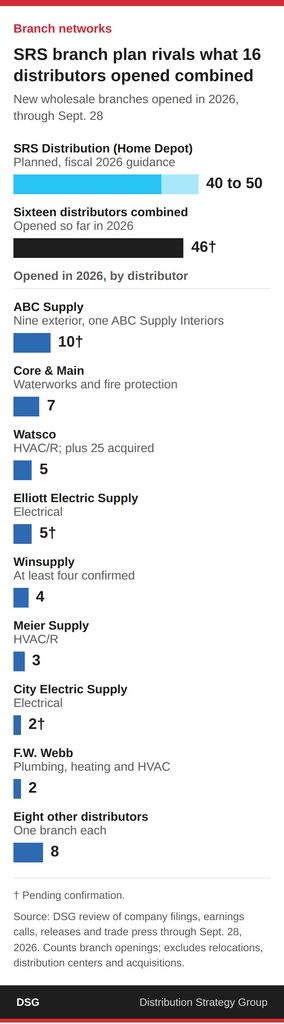
A Distribution Strategy Group review identified at least 16 wholesale distributors that have disclosed U.S. branch or sales location openings in 2026 through Sept. 28. The review examined company filings, earnings calls, company announcements, and other public disclosures and separated organic openings from acquired locations, relocations, and consolidations wherever companies disclosed enough information to make that distinction.
That distinction is critical. Acquiring 25 existing locations expands a distributor’s network but does not add 25 new physical locations to the industry, while replacing an existing branch with a larger facility can increase capacity without increasing the company’s location count.
There also is no comprehensive industry database tracking every distributor branch opening and closing. Private distributors do not consistently disclose location changes, making DSG’s count a verified minimum rather than a complete census of every wholesale distribution branch opened in the United States this year.
The activity identified so far points to a consistent strategy. Distributors are putting inventory closer to customers, filling geographic gaps between existing branches, and building density in markets where contractors and large projects are creating enough demand to support additional locations.
ABC Supply Builds Local Density
ABC Supply is among the most active organic expanders identified in the review. The roofing and building products distributor announced three new locations in Fremont, Ohio; San Juan Capistrano, California; and Shelby, North Carolina, in January, followed by four more in Laredo and Mesquite, Texas; Sandy, Utah; and Wisconsin Rapids, Wisconsin, in June.
ABC Supply added Hattiesburg, Mississippi, and Royse City, Texas, in September, bringing the number of primary ABC Supply locations announced in those three rounds to nine. The company said the latest openings were intended to provide additional local support to contractors.
The pattern is as important as the total. ABC Supply is adding locations both in existing states and new local markets, increasing the number of places where contractors can obtain products without depending on a more distant branch or distribution center.
That illustrates one of the basic economics behind the 2026 branch expansion. A distributor does not have to enter a new state to gain an advantage from another branch if the new location shortens delivery routes, reduces contractor drive times, or gives outside salespeople tighter geographic coverage.
SRS Is Expanding on a Different Scale
The largest announced expansion program belongs to Home Depot’s SRS Distribution. Home Depot has said SRS plans to open 40 to 50 branches during fiscal 2026, which runs through late January 2027.
That plan is significant because it combines organic branch growth with Home Depot’s broader acquisition strategy for professional contractor distribution. Home Depot acquired SRS in 2024 and has continued using the platform to expand into additional specialty distribution markets.
SRS completed its acquisition of Mingledorff’s on May 11, adding an established heating, ventilation, and air conditioning distributor with 42 locations in five Southeastern states. Home Depot said the acquisition added heating and cooling distribution as a new SRS vertical and estimated the addressable market for the category at $100 billion, increasing Home Depot’s overall addressable market to $1.2 trillion.
Those 42 locations should not be counted as new 2026 branch openings because they existed before SRS acquired the company. The transaction nevertheless increases the scale and geographic density of the SRS network and gives Home Depot an established heating and cooling distribution platform rather than requiring it to build one branch at a time.
Home Depot said in July that its broader professional customer network included more than 1,300 branches and 325 customer facing warehouses, in addition to more than 2,360 Home Depot stores. The company is working to connect Home Depot Pro, HD Supply, SRS and other operations through shared customer relationship management, product catalog, and fulfillment capabilities.
The strategy makes branch density part of a larger effort to sell more products to professional customers. Home Depot is pairing local specialty distribution with the capital, technology, product assortment, and logistics resources of a much larger company.
For regional and independent distributors, that raises the competitive stakes. SRS is not simply acquiring distributors and adding revenue. It is also adding physical locations and building denser local networks in markets where independent distributors historically have competed on proximity and customer relationships.
Winsupply Puts Local Control Behind Expansion
Winsupply is expanding through a different model that combines national resources with local ownership and decision making. Winsupply Kernersville NC opened April 6 in a 10,000 square foot facility serving heating and cooling contractors in North Carolina’s Triad region.
The company specifically cited Kernersville’s construction and subdivision pipeline in explaining the location. Winsupply also said the opening extended its reach in the Mount Airy, Lexington and Triad markets, including Greensboro, Winston Salem, and High Point.
Winsupply said Kernersville was its third new local company in North Carolina in 2026, following Winsupply of North Wilmington and Winsupply Clayton NC. LaGrange Winair in Georgia also opened June 15 to serve heating, cooling, and refrigeration customers in western and southwestern Georgia.
The expansion reflects a model in which local operators make many of the decisions about their individual markets while receiving purchasing and operating support from Winsupply. Area leader Rob McCullough said that when the company recruits operators, “it always comes down to our culture and autonomy; the local decision making.”
That local authority is important to the branch strategy. National scale can improve purchasing, technology, and logistics, while local management can make decisions about inventory, customers and market opportunities based on conditions around an individual branch.
Elliott Electric Pushes Into New Markets
Elliott Electric Supply also is extending its network beyond its traditional Texas base. Its current location information shows new operations in markets including Hendersonville, Tennessee, while the company has announced that its first Alabama location is scheduled to open in Mobile this fall.
The employee owned electrical distributor also has been expanding in Florida and other Southern markets. The strategy gives Elliott additional points of local coverage as it extends its network eastward from Texas rather than relying solely on isolated locations far from its core footprint.
That type of expansion can create operating advantages beyond the sales generated by a single new branch. Locations positioned within reach of one another can share inventory, logistics resources and customer relationships while giving contractors more places to pick up products.
Meier Supply Adds Three Northeast Branches
Meier Supply has followed a similar strategy in heating, ventilation, air conditioning, and refrigeration distribution. The company opened branches in Chicopee, Massachusetts, on May 18; Poughkeepsie, New York, on June 1; and King of Prussia, Pennsylvania, on June 29.
The Chicopee opening took Meier Supply into Massachusetts, while Poughkeepsie increased its coverage of New York’s Hudson Valley and King of Prussia strengthened its presence in southeastern Pennsylvania. In each announcement, the company emphasized giving contractors more convenient local access to products, technical resources, and support.
The three openings show how a regional distributor can expand without attempting to build a national network. Each branch extends or deepens Meier Supply’s existing Northeast footprint, giving the company another local base from which to serve contractors.
F.W. Webb Combines New Branches With Larger Facilities
F.W. Webb is using both new locations and relocations to expand its Northeast network. The company opened new locations in Somerdale, New Jersey; Middlebury, Vermont; and Central Islip, New York, while also moving existing operations into larger facilities in Whippany, New Jersey, and Queensbury, New York.
The distinction between the two types of investment matters. The Whippany facility replaced F.W. Webb’s Madison, New Jersey, location, while the 90,000 square foot Queensbury facility replaced an existing Queensbury store. Those projects increased capacity and product availability but did not represent net additions to the company’s branch count in those markets.
The new Central Islip operation provides a clearer example of organic expansion. The 143,000 square foot store and warehouse stocks more than 20,000 products for plumbing, heating, heating, and cooling, refrigeration, and industrial customers on Long Island.
“This convenient location is built for busy trade professionals, who can order from the jobsite or office, pick up quickly, and return to work,” General Manager Scott Brown said. He added that the company maintains a large inventory so trade customers can get needed parts without waiting.
That combination of digital ordering and local inventory helps explain why branches remain relevant despite years of investment in ecommerce. The customer can place an order electronically while still relying on a nearby physical location to get the product quickly.
Infrastructure Investment Is Driving Another Branch Cycle
Core & Main is expanding for a separate set of reasons. The St. Louis based waterworks and infrastructure distributor reported in September that it had opened seven greenfield locations in fiscal 2026, including two opened during or after its second quarter.
The company said municipal demand remained strong and that fire protection and large capital projects, including treatment plants and data centers, produced robust growth. Core & Main operates in more than 370 locations and serves water, wastewater, storm drainage, and fire protection markets.
Large infrastructure projects create a particular need for local distribution. Pipe, valves, fittings and fire protection products are bulky, project driven products, while much of the installation work is performed by contractors that need inventory, delivery, and technical support close to the project.
Core & Main’s expansion therefore is not simply about adding sales offices. New branches provide additional places to stage products and serve contractors working on municipal systems, treatment plants, data centers, and other capital projects.
Data centers are particularly important because their construction creates demand across several distribution sectors. Electrical, waterworks, fire protection, heating and cooling and industrial distributors can all participate in different parts of the same project.
World Electric Follows Florida Growth
World Electric, a Sonepar company, opened a branch in Port St. Lucie, Florida, on Sept. 18 and said it plans additional branches in Homestead and St. Augustine this fall. The company said those investments are intended to support residential and commercial electrical contractors, industrial customers, and data center builders.
World Electric said it has more than 20 locations across Florida and Georgia and plans a new central distribution center in Lakeland, Florida, in 2027. The company opened an Atlanta area central distribution center in 2026 to support its Georgia operations.
The strategy combines local branches with larger logistics facilities rather than treating them as competing models. Central distribution can improve inventory efficiency, while local branches provide contractors with nearby access to products and services.
Industrial Distribution Makes the Same Bet
Industrial distributors are making similar investments on a smaller scale. Baldwin Supply opened its 14th branch in Omaha, Nebraska, effective April 1, expanding its network of power transmission, belting, bearings, motors, pumps, and industrial automation products.
“Omaha is a thriving industrial market with a strong manufacturing base and a growing food processing sector,” President Rob LaRue said. He said the local branch would provide customers with faster response times, local inventory, and service.
The Omaha location serves manufacturing, agriculture, aggregate, construction, and food processing customers across Nebraska. Baldwin said the opening followed its acquisition of Construction & Aggregate Products, which had added existing locations in Des Moines, Iowa, and Lenexa, Kansas.
Again, the distinction matters. Omaha represents a newly opened branch, while the Iowa and Kansas locations represent existing operations brought into Baldwin Supply through an acquisition.
Watsco Shows How Acquisitions Change the Math
Watsco provides one of the clearest examples of why acquired branches and organic openings need to be counted separately. The heating and cooling distributor ended 2025 with 695 locations and had 723 at June 30, 2026.
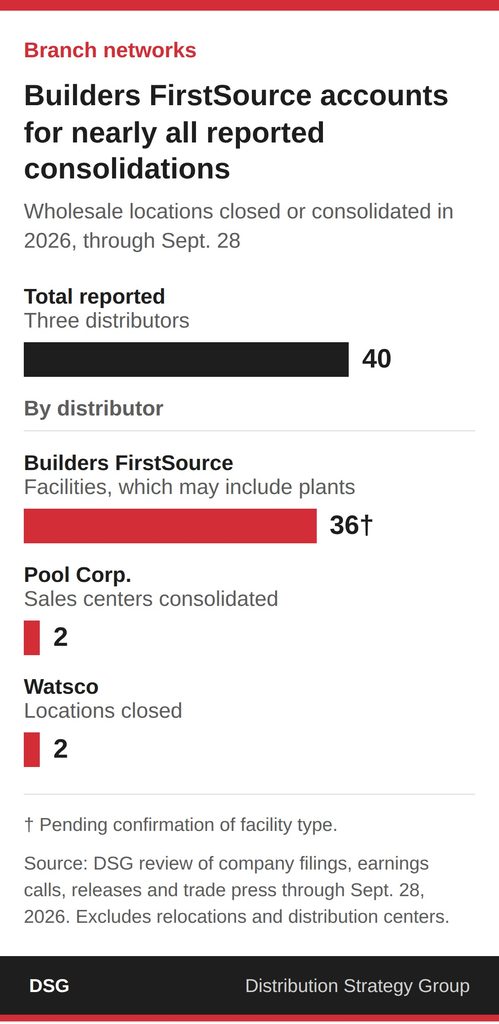
During the first half of 2026, Watsco opened five locations, acquired 25 and closed two, producing a net increase of 28 locations. Only five of those 28 represented organic openings, while the 25 acquired locations were existing businesses brought into Watsco’s network.
The acquired locations came through Jackson Supply, which Watsco said increased its density in important Sun Belt markets. The transaction illustrates why acquisitions can change competitive conditions even when they do not add physical distribution capacity to the industry.
A branch acquired by a national distributor may operate from the same building with many of the same employees and customers. Its competitive position can nevertheless change because it gains access to a larger company’s purchasing scale, technology, supplier relationships, and capital.
Pool Corp. Takes a More Selective Approach
Pool Corp. is moving more cautiously. The company began 2026 with 456 sales centers and ended June with 455 after opening one location and consolidating two during the first six months.
That is a markedly different approach from the aggressive organic expansion underway at SRS or the greenfield program at Core & Main. Pool Corp.’s numbers show why branch strategy cannot be reduced to a single industry trend, even among distributors serving contractors and outdoor construction markets.
The location count also reinforces the importance of distinguishing a consolidation from a simple closure. A distributor can combine operations while continuing to serve the same geographic market from another location, meaning the loss of a facility does not necessarily mean the loss of local market coverage.
Builders FirstSource Moves in the Opposite Direction
The sharpest contrast comes from Builders FirstSource. The building materials distributor said it consolidated 36 facilities during 2026 through the second quarter and 91 over the previous three years as it adjusted capacity to weaker demand.
Management also increased its 2026 cost action target to $115 million as lower housing activity pressured the business. The company said its second quarter sales declined about 9% from a year earlier, reflecting weakness in residential construction and related pricing pressure.
The comparison with Core & Main, Watsco and SRS is significant because the companies are responding to different end markets. Builders FirstSource has substantial exposure to new residential construction, while infrastructure, replacement heating and cooling and industrial maintenance demand follow different economic cycles.
That helps explain how distributors can be opening branches aggressively while another large distributor consolidates dozens of facilities in the same year. The dividing line is increasingly the customer and end market rather than whether a company is large, small, public, or privately held.
The Branch Is Not Disappearing
The 2026 expansion also challenges the idea that ecommerce and centralized fulfillment would steadily eliminate the need for local distributor branches. Those investments have changed what happens inside the branch and how customers interact with it, but they have not eliminated the economic value of proximity.
A contractor can place an order electronically at night and still want to pick it up near the jobsite the next morning. An industrial customer can use digital inventory tools and still need a replacement bearing immediately when a production line goes down.
F.W. Webb’s Central Islip operation illustrates how the two models can work together. Customers can order from a jobsite or office and then retrieve the products from a facility stocked with more than 20,000 items.
The digital system makes ordering easier, while the branch makes fulfillment faster. For many contractor and industrial markets, those capabilities complement each other rather than compete.
Density Is Becoming a Competitive Asset
The larger strategic issue is network density. A distributor with several locations across a metropolitan area or region can shorten deliveries, share inventory, provide more pickup points, and give outside salespeople tighter customer coverage.
That is what makes the SRS expansion particularly important for regional distributors. Home Depot is combining national capital, technology and purchasing scale with a distribution model that remains heavily dependent on local branches and contractor relationships.
Private distributors are making many of the same investments. ABC Supply is adding locations, Winsupply is creating locally operated companies, Meier Supply is filling geographic gaps and Elliott Electric is extending its network into additional Southern markets.
The competition therefore is not simply between national scale and local service. Increasingly, large distribution platforms are trying to deliver both.
The 2026 activity also shows why branch growth needs to be measured more carefully. A useful industry scorecard should identify each disclosed location by distributor, city, state, opening or closing date, vertical and type of transaction.
Organic openings, acquired locations, relocations, consolidations, and outright closures should be reported separately. That would allow DSG to calculate gross organic openings and closures while also showing how acquisitions are changing control of existing distribution capacity.
Watsco demonstrates the value of that approach. Its network increased by 28 locations during the first half of 2026, but that increase consisted of five openings, 25 acquired locations and two closures.
F.W. Webb presents another example because its Whippany and Queensbury investments were replacement facilities rather than net additions. Pool Corp. provides the opposite case, with one new sales center and two consolidations producing a net decline of one location through June.
That approach produces a more defensible industry number than simply adding every location mentioned in an expansion announcement. It also reveals where distributors are creating new physical capacity, where they are buying existing capacity and where they are taking capacity out of the market.
What Comes Next
The branch count is likely to continue changing through the final months of 2026. World Electric has announced additional Florida openings for the fall, Elliott Electric lists Mobile, Alabama, as coming this fall, and Home Depot still has time remaining in its fiscal year to execute the SRS expansion program.
The larger trend already is becoming clearer. Distributors are investing in branches where infrastructure projects, contractor density, industrial activity, and stronger regional markets make proximity valuable, while companies facing weaker end markets are consolidating locations and emphasizing productivity.
For all the technology being added to wholesale distribution, the reasoning behind much of the branch investment remains straightforward. Customers may order digitally and inventory may flow through increasingly sophisticated distribution centers, but distributors still see value in putting products and people close to the customers who need them.
Do not miss any content from Distribution Strategy Group. Join our list.
Share this article:
