

Why This Matters to Distributors: AutoZone is making the professional repair market a bigger part of its growth strategy, using Mega Hubs, deeper local inventory, technology, and faster delivery to take share. Commercial sales reached $5.76 billion in fiscal 2026, and management says expanding that business will be a top priority in fiscal 2027.
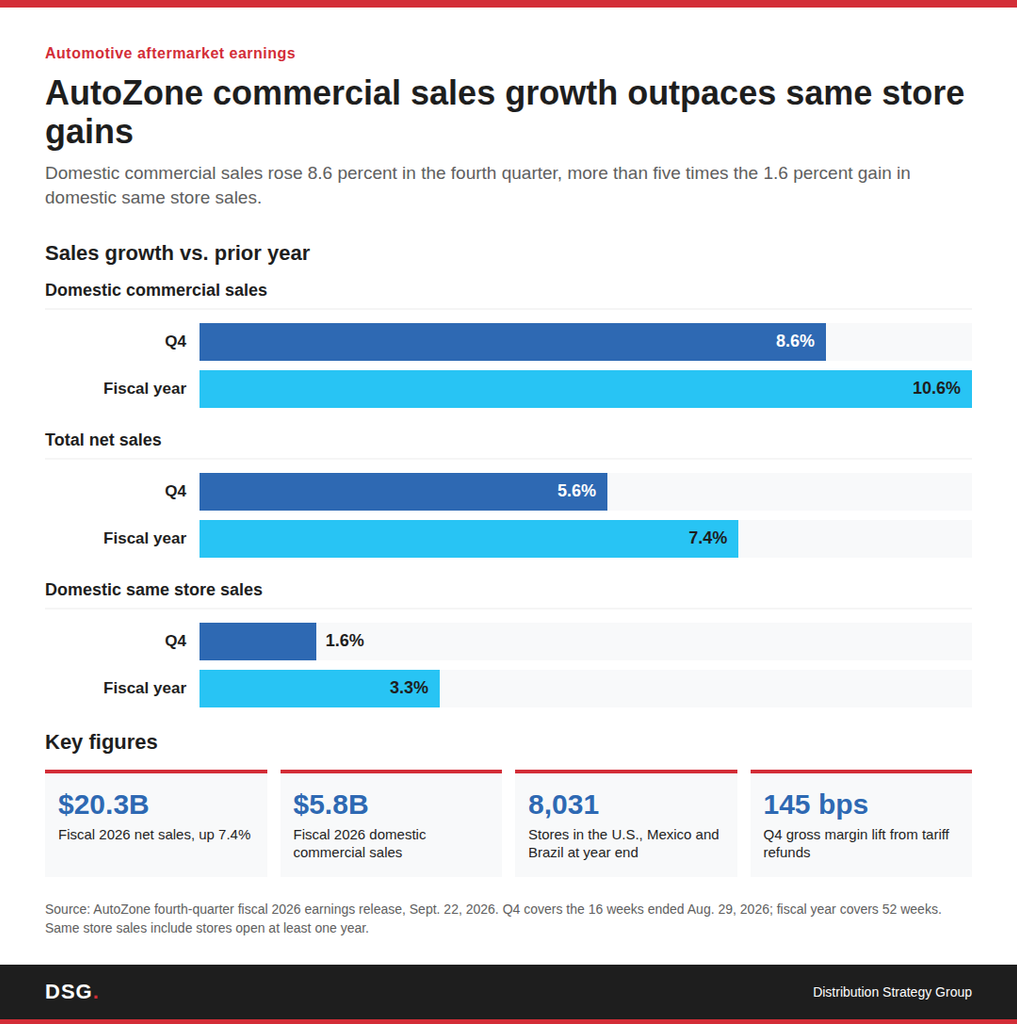
AutoZone is putting more of its growth strategy behind professional repair shops after U.S. commercial sales increased 10.6% to $5.76 billion in fiscal 2026, outpacing the company’s overall sales growth.
Memphis, Tennessee-based auto parts distributor and retailer, is expanding its Mega Hub network, opening more commercial programs, and putting additional inventory closer to repair shops as it pursues a larger share of a professional automotive aftermarket that management estimates are approaching $100 billion.
The strategy is becoming increasingly important to AutoZone’s overall business. Commercial sales accounted for 34% of domestic auto parts sales and 29% of total company sales in the fourth quarter. AutoZone ended the year with commercial programs in 6,443 stores, or 94% of its U.S. locations, after adding 345 programs during fiscal 2026.
AutoZone’s fiscal 2026 sales increased 7.4% to $20.34 billion from $18.94 billion a year earlier. Net income rose 3% to $2.57 billion from $2.50 billion. Fourth-quarter sales increased 5.6% to $6.59 billion from $6.24 billion, while net income rose 11.3% to $931.6 million from $837 million. The quarter covered 16 weeks and ended Aug. 29.
Commercial continued to outperform the company’s do-it-yourself business. U.S. commercial sales increased 8.6% in the fourth quarter to $1.91 billion from $1.76 billion a year earlier. Domestic DIY comparable sales declined 0.6%.
AutoZone CEO Phil Daniele said the company’s commercial gains are coming from greater inventory availability, expanded Hub and Mega Hub coverage, its Duralast brand and faster delivery. “Our commercial sales results continue to be driven by our improved satellite store inventory availability, significant improvements in hub and Mega Hub coverage,” Daniele told analysts.
AutoZone’s strategy is based in part on a basic distribution principle: A broader assortment located closer to customers increases the likelihood that the company has the part a repair shop needs and can deliver it quickly enough to keep the service bay operating.
Mega Hubs are central to that strategy. The larger AutoZone stores typically carry more than 100,000 SKUs and supply surrounding stores, effectively creating additional local inventory nodes within the company’s distribution network.
AutoZone opened 39 Mega Hubs in fiscal 2026, including 16 in the fourth quarter, bringing the total to 172. The company plans to open more than 40 in fiscal 2027 and is targeting about 300 within three years. The company says it is already seeing a measurable difference in markets served by those locations.
About 2,000 commercial programs are connected to a Mega Hub network. Those programs generate 16% more annual sales than AutoZone’s other commercial programs, according to chief financial officer Jamere Jackson. “When you jam more parts in the local market closer to the customer, then to Phil’s point, it drives sales,” Jackson said.
Jackson said AutoZone expects the benefits to continue as it expands the network and connects more stores to Mega Hubs. “As our commercial business continues to mature over time and we continue to grow our market share and grow our presence, as we expand that Mega Hub network and attach it to more stores, we expect that profile to be as good or better on a go-forward basis,” Jackson said.
AutoZone is coupling the physical expansion with technology designed to improve parts movement and delivery. “We know where our drivers are, we know where the parts are,” Daniele said. “We know how to fastest get those parts to those customers in the shops that are waiting to turn their bay.”
That focus on repair-shop productivity is important to AutoZone’s competitive strategy. For professional customers, availability alone is not enough. The distributor also must locate and deliver the correct part quickly enough to minimize the amount of time a vehicle occupies a repair bay.
Daniele said putting a Mega Hub into a market improves parts proximity and allows AutoZone to accelerate delivery to repair shops and DIY customers. “That’s why we’re so focused on driving the store counts in both those hubs and Mega Hub stores,” he said.
AutoZone sees significant room to expand the commercial business. Daniele estimated the company holds only a 5% to 6% share of a professional automotive aftermarket approaching $100 billion.
A particular focus is smaller independent repair shops, which AutoZone refers to as undesignated shops, or UDS customers. They account for most of the company’s commercial business. “We continue to see fairly significant share gains in that portion of the business,” Daniele said. He added that AutoZone also sees opportunities to expand with national accounts.
Management has set a goal of growing its commercial business at twice the rate of the broader market over time. “We think we should be able to, it won’t always be smooth, but grow essentially 2x the market’s growth,” Daniele said on the earnings call.
AutoZone expects total domestic commercial sales to increase by a high-single-digit to low-double-digit percentage in fiscal 2027. Management expects average ticket growth of about 4% and additional market share gains from its growth initiatives.
The commercial push comes as AutoZone reaches the later stages of a multi-year investment cycle in distribution and technology.
The company said its U.S. distribution center expansion is complete after adding two distribution centers and two direct-import facilities. A new distribution center in Brazil is operating, and AutoZone’s expanded Monterrey, Mexico, distribution center is more than twice the size of the facility it replaced.
AutoZone also has started construction on another distribution center in León, Mexico, scheduled to begin operating in late fiscal 2028.
Technology investments are also moving from implementation toward optimization. Daniele said AutoZone has built cloud-based platforms designed to support its more complex supply chain, improve customer service, and allow the company to use newer technologies. “Many of them are in the implementation and optimization stage,” Daniele said of the company’s distribution and technology investments. “So those will start to moderate.”
That changes where AutoZone is directing incremental investment. Instead of another major U.S. distribution center buildout, more spending is moving toward stores, Hubs and Mega Hubs that place inventory closer to customers.
AutoZone spent $1.50 billion on capital projects in fiscal 2026, up 9.6% from $1.37 billion a year earlier. The company expects capital spending of about $1.65 billion in fiscal 2027.
“The majority of our investments are in accelerated store growth, including hubs and Mega Hubs,” Daniele said. “These investments place more inventory closer to our customers and will continue to reduce the time it takes us to serve both our DIY and professional customers.”
AutoZone opened a record 374 stores in fiscal 2026, compared with 304 a year earlier, and ended the year with 8,031 locations. The company plans to open about 400 stores in fiscal 2027.
The company is also refining where it expands. AutoZone reduced its fiscal 2028 new-store target to about 430 from 500 and plans to slow expansion in Brazil while concentrating more heavily on the U.S. and Mexico. “We really think the opportunity is to continue to double down on our performance in Mexico and the U.S.,” Daniele said.
The shift comes as the company’s traditional DIY business faces greater pressure from inflation and weaker customer traffic. AutoZone said DIY transactions declined more than 5% during part of the fourth quarter, with financially pressured consumers deferring maintenance or trading down to lower-priced products.
Commercial has been moving in the opposite direction. AutoZone’s professional business grew 11% in fiscal 2026, and management expects another high-single-digit increase to low-double-digit this year. With its major U.S. distribution and technology projects moving closer to completion, the company’s next phase of investment is increasingly centered on using stores, Mega Hubs, inventory, and delivery technology to increase its share of the professional repair market.
“The top focus for fiscal 2027 will remain growing market share in our domestic commercial business and re-accelerating our international growth,” Daniele said.
Do not miss any content from Distribution Strategy Group. Join our list.
Share this article:
