


Why This Matters to Distributors: U.S. manufacturing strengthened sharply in September, with production and new orders growing at their fastest rates in more than four years. The stronger demand is good news for industrial distributors, but it is also straining supply chains and driving up fuel, transportation, and other input costs.
U.S. business activity accelerated in September to its fastest pace in more than five years as manufacturing production and new orders strengthened, but the expansion also brought longer supplier lead times and rising transportation and other costs.
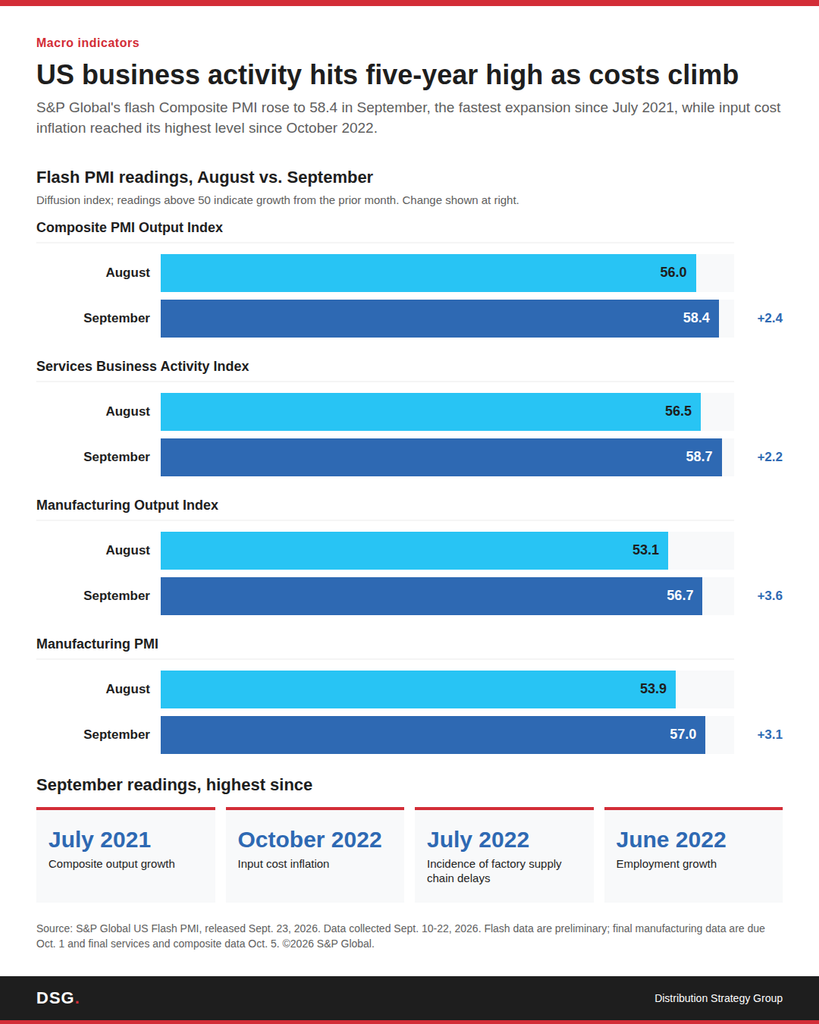
The flash S&P Global U.S. Composite Purchasing Managers’ Index Output Index rose to 58.4 in September from 56 in August, its highest reading in 62 months and the fourth consecutive monthly acceleration. A reading above 50 indicates business activity increased from the previous month.
Manufacturing posted an even sharper improvement. The flash U.S. Manufacturing Purchasing Managers’ Index rose to 57 from 53.9, reaching a 52-month high. The Manufacturing Output Index increased to 56.7 from 53.1, its highest level in 53 months. New orders increased in both manufacturing and services, with manufacturing order growth reaching its fastest pace since April 2022. Domestic demand drove most of the increase, while exports of goods continued to decline.
The manufacturing index improved across all five components used to calculate it. Production grew at its fastest pace since April 2022, while new-order growth was the strongest in 4½ years. Manufacturing employment increased at its fastest rate since February 2021, and inventories also grew at a faster pace.
The stronger demand, however, is putting additional pressure on supply chains and operating capacity.
Backlogs of unfinished work across manufacturing and services increased at their fastest rate since May 2022. Supplier delivery times also lengthened sharply, with manufacturers reporting the most widespread supply chain delays since July 2022.
For distributors, the September results point to two competing trends. Faster manufacturing production and order growth could support demand for industrial, electrical, MRO and other products, while longer supplier lead times and higher costs could increase pressure on inventory availability, pricing, and fulfillment.
S&P Global Chief Business Economist Chris Williamson said the September survey indicated unusually strong economic growth. “US business continues to boom, with output growing at the fastest rate for over five years in September,” Williamson said.
Based on historical comparisons, Williamson said the survey is consistent with annualized economic growth of about 5% and approximately 4% growth for the third quarter. Excluding the surge associated with the economy reopening after COVID-19 lockdowns, he said September’s improvement in business activity was the strongest since early 2015.
Hiring also accelerated as companies sought additional workers to keep up with demand and growing backlogs. Overall employment increased at its fastest pace since June 2022 and at a rate S&P Global said has rarely been exceeded since comparable data began in 2009. Manufacturing employment increased at its fastest pace since February 2021.
The expansion came with a significant increase in costs. Average input costs across manufacturing and services rose at their fastest rate since October 2022. Companies cited higher fuel and transportation expenses, along with increasing wage pressure. Manufacturers also reported higher raw material prices that were frequently linked to supply shortages.
“Firms’ input costs have meanwhile jumped in September at the steepest rate for four years, with fuel and transport costs spiking higher thanks to the rise in oil prices seen during the month,” Williamson said. Selling prices also increased at a faster pace in September, although competition limited increases in some sectors. Overall selling-price inflation remained below the levels recorded from March through July.
Supply chain conditions could pose another challenge for distributors and manufacturers if demand remains strong. Williamson said the current bottlenecks rank among the most severe in the survey’s two-decade history when the pandemic period is excluded. Companies also reported increasing difficulty finding workers, contributing to a buildup of unfinished orders.
Services remained the strongest part of the economy. The flash Services Business Activity Index rose to 58.7 from 56.5, reaching a 59-month high. But September’s acceleration in manufacturing broadened the expansion, with factory production and orders strengthening at the same time.
Manufacturers remained confident about the year ahead, with factory sentiment back to their long-term average. Service-sector confidence remained below its historical trend amid concerns about the cost of living, higher borrowing costs, and political uncertainty.
S&P Global collected responses for the flash survey from Sept. 10-22. The survey panels include about 650 manufacturers and 500 service providers. Flash results are based on 80% to 90% of the responses used in the final monthly data.
Final September manufacturing data are scheduled for release Oct. 1, followed by final services and composite results Oct. 5.
Do not miss any content from Distribution Strategy Group. Join our list.
Share this article:
