



Why This Matters to Distributors: AI adoption is accelerating among plumbing, electrical and HVAC contractors, important customer groups for distributors serving the skilled trades. The survey found 69% of plumbing contractors, 64% of electrical contractors and 62% of HVAC contractors are using AI. But contractors report stronger gains in productivity and decision-making than in revenue or profitability, suggesting the next phase of adoption will depend increasingly on demonstrating measurable business returns.
Artificial intelligence is moving deeper into U.S. contracting businesses, with 61% of trade contractors surveyed now using at least one AI tool even as concerns about accuracy and reliability remain widespread.
A new ServiceTitan survey found 77% of contractors consider AI relevant to their industry, up five percentage points from its previous survey. The share calling AI highly relevant increased seven points to 45%, while 30% said they were very willing to invest in AI, also up seven points.
The findings come from ServiceTitan’s The Update: 2026 State of AI in the Trades. Thrive Analytics surveyed 1,017 verified U.S. residential and commercial contractors in HVAC, plumbing, electrical, roofing, garage doors, pest control, landscaping, and fire and life safety from May 26 through June 15. The survey has a margin of error of plus or minus 3.7 percentage points for the overall sample, with wider margins for individual trade groups.
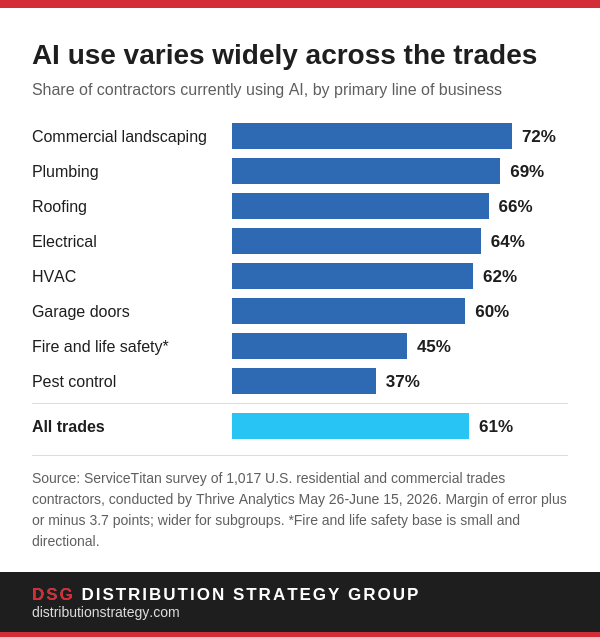
The results show particularly high adoption in several markets served by wholesale distributors. AI use reached 69% among plumbing contractors, 64% among electrical contractors and 62% among HVAC contractors. Commercial landscaping led the industries surveyed at 72%, followed by plumbing, roofing at 66%, electrical and HVAC.
Contractors are reporting measurable operating benefits from the technology, although those gains are not translating as broadly into higher revenue and profits.
Among AI users, 64% reported productivity gains and 55% cited faster decision-making. Forty-seven percent reported improved profitability and 43% reported higher revenue. Another 43% reported improved customer satisfaction, while 34% cited higher employee satisfaction.
Time savings were also significant. Sixty-six percent of AI users reported saving at least three hours per week, and 40% of that group said they were saving five hours or more.
Workforce pressures are helping drive adoption. Thirty-seven percent of respondents cited difficulty hiring and workforce shortages as a reason for experimenting with AI, followed by providing off-hours support at 34% and reducing costs at 33%.
At the same time, the survey found a significant gap between AI use and confidence in its output.
Only 11% of respondents reported high or complete trust in the AI tools they use, while 58% reported little or no trust. Among AI users, accuracy and reliability ranked as the leading concern, cited by 35%.
The obstacles to further adoption also appear to be shifting away from price.
Forty-four percent of contractors cited understanding how to use AI in their businesses as a barrier, while 43% cited a lack of clear use cases. Integration with existing software was cited by 40%, down four percentage points from the previous survey, while 38% cited a lack of AI skills within their businesses, down six points.
High purchase costs, meanwhile, were cited by 17% of respondents, down 12 percentage points from the previous survey and the lowest-ranked barrier measured.
The findings indicate contractors increasingly want AI tied more closely to existing business systems and industry-specific applications. Forty percent said clearer return on investment would encourage greater adoption, while 38% cited AI trained on trade-specific data. Among current users, 61% said they prefer AI and automation built into their core business platform.
“AI adoption in the trades started with point solutions — a specific fix for a specific problem,” Vincent Payen, ServiceTitan senior vice president of product, said in the report. Payen said adoption is now shifting toward broader AI-powered automation across business operations.
Expectations for further adoption remain high. Sixty-nine percent of contractors surveyed expect AI to have a significant or moderate impact on the trades within one to three years, including 40% who expect significant transformation.
Do not miss any content from Distribution Strategy Group. Join our list.
Share this article:
