


Why This Matters to Distributors: Distributors are beginning to put real money and people behind their AI strategies. Current job openings show companies hiring employees to build AI agents, improve inventory decisions, automate customer interactions and warehouses, and sell AI-powered technology to customers.
Wholesale distributors are starting to build an artificial intelligence workforce, creating new jobs, and adding AI responsibilities to existing positions as the technology moves deeper into sales, inventory management, ecommerce, and operations.
A review of current distributor job openings shows AI-related hiring stretching from industry giants Ferguson and Wesco to privately held McMaster-Carr and other distributors and business units focused on industrial automation.
The jobs vary considerably. Ferguson is hiring employees to build and deploy AI agents. Wesco is recruiting executives to capitalize on demand for AI infrastructure. McMaster-Carr is putting AI into management and software engineering positions, while Olympus Controls, part of Applied Industrial Technologies, is seeking a sales specialist focused on physical AI and robotics.
Some of the jobs pay well into six figures.
The hiring activity offers a more concrete measure of AI adoption than corporate announcements about experimentation and pilot projects. Distributors are beginning to decide which AI capabilities they need to own, which business problems they expect AI to solve and what they are willing to pay for the people who can make that happen.
Ferguson Builds an AI Team
Ferguson offers one of the clearest examples.
The plumbing, HVAC and industrial distributor is hiring a Lead Builder for its Artificial Intelligence Studio, part of the company’s AI Center of Excellence.
The position is not primarily a research job. Ferguson wants someone who can turn AI concepts into working business applications.
The employee will design, build, and deploy AI agents, automated workflows and conversational applications using platforms including Microsoft Copilot Studio and Google’s Gemini Enterprise. The job also involves technologies such as retrieval-augmented generation, semantic search, and workflow automation.
Ferguson wants the employee to work with business units to identify problems that can be automated and then move those applications into production. The person also will work with the company’s legal, information security, privacy, and risk teams to establish boundaries around what individual AI agents can do.
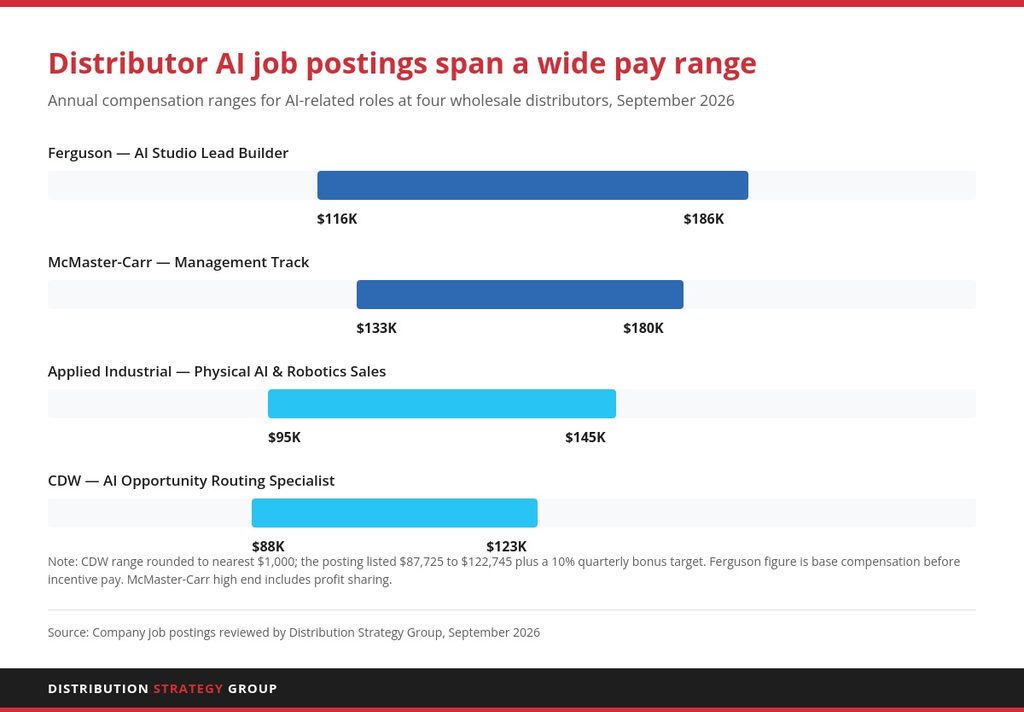
The company lists compensation of $9,700 to $15,517 per month, or about $116,000 to $186,000 annually, before potential incentive compensation.
Ferguson’s job description also points toward a broader deployment model. The lead builder will help employees in other business units create their own AI applications under guidelines established by the company’s AI Center of Excellence.
That suggests Ferguson is preparing for AI development to spread beyond a centralized technology team.
The company has approximately 36,000 employees across 1,700 locations.
Ferguson’s hiring is significant because it shows the distributor moving beyond buying AI software. It is developing internal expertise to determine how AI agents are designed, governed, and deployed across the company.
AI Becomes a Sales Opportunity at Wesco
Wesco is approaching AI from another direction.
The electrical, communications and utility distributor is recruiting a director of advanced infrastructure solutions specializing in artificial intelligence and high-performance computing.
The position combines technical expertise with customer-facing responsibilities around accelerated computing, advanced data centers, and AI infrastructure.
Wesco also has been recruiting a sales director for its Global Enterprise Data Center AI business.
Taken together, the jobs show Wesco treating AI as more than an internal productivity technology. It is also a market the distributor intends to sell into.
That distinction is becoming increasingly important as companies invest billions of dollars in data centers, computing capacity, networking, and electrical infrastructure needed to support artificial intelligence.
For distributors serving electrical, communications and data center markets, AI spending can translate directly into demand for products and services.
Wesco’s hiring suggests the company builds technical and sales expertise specifically around that opportunity.
McMaster-Carr Pushes AI Into Management
McMaster-Carr is taking a different approach by putting AI responsibilities into jobs that do not necessarily carry AI titles.
The industrial distributor’s current management recruiting program says employees may use large language models to automate routine work, analyze customer feedback, and improve the process of creating product information.
Other assignments can include warehouse automation, fulfillment and improving the order-to-payment process. That makes AI one of the tools McMaster-Carr expects future managers to use rather than a capability reserved exclusively for software engineers or data scientists.
The compensation underscores the value the company places on those employees. McMaster-Carr has advertised starting base compensation of about $133,000 for some management-track positions, with total cash compensation reaching $165,000 to $180,000, including profit sharing.
The company recruits candidates from a range of academic backgrounds rather than limiting the program to computer science graduates.
McMaster-Carr’s current career site also shows openings across technology leadership, automation, operations and management, including software engineering and leadership positions tied to customer service, fulfillment, and automation.
The strategy points toward what could become a larger shift in distributor employment: AI expertise becoming part of traditional management jobs rather than remaining a separate technical specialty.
AI Moves onto the Distributor Sales Floor
Applied Industrial Technologies provides another example through Olympus Controls, its automation business. Olympus has been recruiting a Physical AI and Robotics Sales Specialist in Fremont, California. The position combines technical expertise with sales responsibilities and is aimed at customers developing robotics and advanced automation applications.
The employee is expected to work with technologies including robotics, machine vision and motion control while helping customers design and deploy production automation systems. Compensation has been listed at $95,000 to $145,000, depending on experience and incentives.
The job represents a potentially important development for industrial distribution. AI does not have to be an internal cost-saving initiative to generate returns for distributors. Companies that already sell automation, controls, electrical equipment, and other industrial technology can turn AI investment by their customers into additional revenue.
That could create demand for a new type of distributor employee who combines the skills of an application engineer, automation specialist, and technical salesperson.
CDW Applies AI Directly to the Sales Pipeline
CDW is taking the concept a step further by applying AI to its own revenue operations.
The technology distributor recently posted an opening for an AI Opportunity Routing Specialist supporting AI Central, which CDW describes as its central hub for activating AI sales opportunities.
The employee will manage the intake, qualification and routing of AI-related sales leads and help develop an agentic system capable of automating portions of that process.
The system is intended to automate lead intake, qualification, routing recommendations, and customer relationship management updates while maintaining human review for selected decisions.
CDW estimates human intervention eventually could be required for less than 15% of opportunities handled through part of the routing process.
The job also includes maintaining sales dashboards, tracking pipeline performance, and measuring how quickly AI opportunities move from initial contact to the appropriate sales or technical team.
CDW lists annual compensation of $87,725 to $122,745, plus a quarterly bonus target of 10%. CDW’s approach is notable because the employee is not being hired simply to develop AI software. The job connects AI directly to the distributor’s sales process and revenue pipeline.
Builders FirstSource Expands AI Investment
Builders FirstSource also is expanding its use of AI across its digital operations. The building materials distributor has been hiring across business analytics and data functions while simultaneously increasing its investment in AI-enabled technology.
In August, Builders FirstSource announced a strategic partnership with Digs, an AI platform for homebuilders and homeowners. Builders FirstSource is leading a $25.3 million Series A investment in Digs and entered into a five-year commercial agreement with the company.
The companies plan to use AI to connect plans, specifications, product information, approvals, warranties, and other construction data while automating workflows stretching from estimating and procurement through construction and homeowner service.
Builders FirstSource said the technology is intended to reduce manual work, accelerate decisions and improve productivity for its more than 140,000 customers.
The company also said earlier this year that 120 engineers had been trained on AI-native development workflows as part of another technology initiative.
That combination of hiring, employee training and outside investment illustrates another way distributors are assembling AI capabilities. They do not necessarily need to build everything internally. They can develop internal expertise while investing in or partnering with specialized AI companies.
Smaller Distributors Target Specific Problems
The hiring strategy becomes more targeted farther down the distributor market. Rather than creating large AI organizations, smaller and mid-size distributors are more likely to seek employees who can apply AI, machine learning, and advanced analytics to a specific operating problem.
Inventory is one of the most obvious targets. For a distributor carrying tens of thousands of stock-keeping units across multiple distribution centers, small improvements in demand forecasting and inventory allocation can reduce working capital while improving product availability.
Customer service and product discovery are another target. Generative AI can potentially interpret complicated customer requests, search large product catalogs, and automate routine inquiries that previously required employee intervention.
Warehouse operations provide another opportunity as AI increasingly intersects with robotics, machine vision, and traditional industrial automation.
The emerging jobs therefore look less like the positions created during previous technology cycles and more like hybrids. A distributor may need an inventory expert who understands machine learning, a salesperson who understands robotics, a software engineer who understands product data or a manager who knows when an AI agent can safely automate a business process.
Six-Figure Salaries Raise the Stakes
Those skills are not inexpensive. Current distributor postings reviewed by Distribution Strategy Group show AI-related positions ranging from $88,000 at the lower end to more than $180,000 in annual compensation for some senior positions, depending on experience, location, incentives, and profit sharing.
Ferguson’s AI Studio position can reach $186,000 in annual base compensation. Applied Industrial Technologies’ Olympus Controls business has advertised total compensation approaching $145,000 for its physical AI and robotics sales position. CDW’s AI opportunity position reaches about $123,000 before its targeted bonus.
McMaster-Carr’s management positions can reach $165,000 to $180,000 in total cash compensation. That puts distributors into direct competition for talent with software companies, manufacturers, consulting firms, and technology providers.
The challenge could be particularly acute for smaller distributors that cannot match the salaries or career opportunities available at multibillion-dollar companies. Instead of building large internal teams, those companies may hire a small number of employees capable of connecting AI technology supplied by outside vendors with the distributor’s data, workflows, and industry expertise.
AI Starts Becoming Part of the Job
The bigger workforce change may be visible in jobs that do not have “AI” in their titles. McMaster-Carr’s management recruiting is one example. Builders FirstSource’s training of engineers on AI-native workflows is another.
The implication is that distributors eventually may not count AI employees separately any more than they count employees who know how to use spreadsheets or customer relationship management software.
AI could become another expected business skill. That transition is still in its preliminary stages, but current hiring provides evidence that it has begun.
Distributors spent much of the initial generative AI boom testing tools, launching pilots and determining where the technology might fit. The next phase requires people who can connect those tools to actual distribution processes.
That means deciding how much inventory to buy, helping customers find products, automating sales workflows, improving warehouse operations, and selling increasingly sophisticated technology to customers.
The job postings show distributors beginning to put salaries and responsibilities behind those ambitions. For an industry that has spent the past several years talking about what AI might eventually do, the hiring market provides a more tangible signal. Distributors are starting to pay people to do it.
Do not miss any content from Distribution Strategy Group. Join our list.
Share this article:
