



Why This Matters to Distributors: Amazon Business used Reshape 2026 to expand the tools that help customers choose products, control spending, and manage purchasing. The announcements increase competition for the account support, reporting and procurement connections distributors provide alongside products.
Amazon Business used its Reshape 2026 conference in Nashville, Tennessee, to expand artificial intelligence purchasing tools, introduce spending reports and strengthen connections with customers’ procurement software.
The announcements during the Oct. 27-28 event at the Gaylord Opryland Resort and Convention Center covered product selection, approvals, payments, purchasing oversight, and delivery requirements. Together, they outlined a strategy to make Amazon Business more deeply involved in how organizations manage purchasing, beyond placing and fulfilling orders.
For distributors, the competitive implications extend to services that help retain business accounts: recommending products, managing purchasing policies, documenting savings, and connecting with customers’ internal systems.
An expanded Amazon Business Assistant was a central announcement. The tool uses customers’ account information to answer questions and support tasks such as tracking orders, identifying purchases awaiting approval, reviewing savings opportunities, and allocating payments.
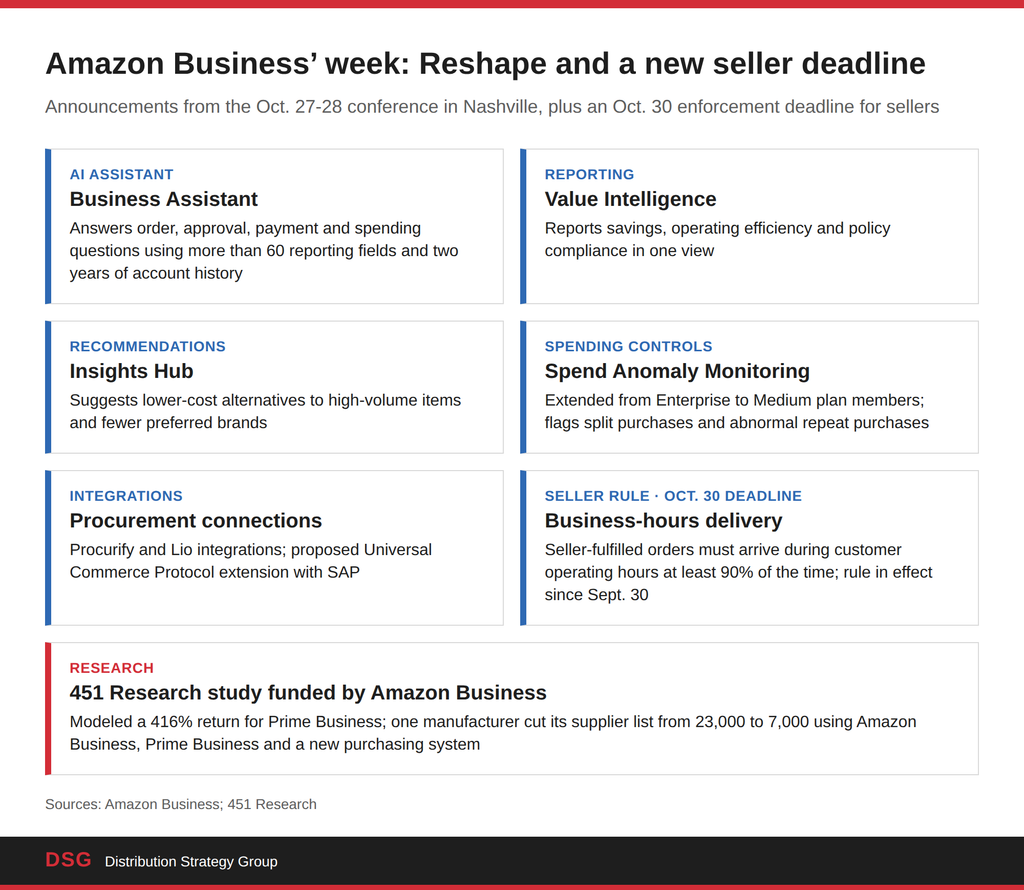
For spending analysis, the assistant draws on more than 60 reporting fields and up to two years of account history covering orders, shipments, payments, refunds, products, and sellers. Amazon said the capabilities are available to all U.S. Amazon Business customers.
The assistant follows each organization’s approval requirements, spending limits, and purchasing policies, according to Amazon. Employees can access only information permitted by their assigned roles, and transactions requiring authorization remain subject to approval.
“Every hour a procurement team spends chasing approvals or manually reconciling invoices is an hour they’re not spending on the work that moves their organization forward,” said Shelley Salomon, worldwide vice president of Amazon Business.
The company also introduced Value Intelligence, which combines measures of cost savings, operating efficiency, and purchasing policy compliance in one report. It calculates item-level savings by comparing purchase prices with what Amazon calls a validated reference price and estimates efficiency gains using purchasing data and third-party benchmarks.
Amazon said customers can review the methods and adjust some input. The announcement did not identify the research providers or explain how reference prices are established.
“Procurement has always been about more than price, but price is what gets reported because it’s the easiest thing to measure,” Salomon said.
For distributors, the reporting tool adds another dimension to competition over large accounts. Purchasing teams can use such reports to evaluate suppliers and justify spending decisions, putting greater emphasis on documenting the value of services provided alongside products.
On Oct. 28, Amazon Business introduced an Insights Hub for Prime Business members that brings purchasing recommendations into one view. A lower-price feature reviews products purchased at high volumes over the previous 12 months and recommends similar or alternative items that cost less.
Another feature identifies purchases of products that serve the same function across brands. Administrators can use those findings to narrow preferred selections and restrict alternatives, potentially concentrating on purchases enough to qualify for quantity discounts.
A third feature, scheduled for release by year-end, will recommend alternatives with sustainability attributes. These tools could influence which products customers reorder and which brands they designate as preferred purchases.
That presents a direct competitive issue for distributors. Recommendations based on purchasing history can put alternative products in front of buyers before a salesperson has an opportunity to discuss the choice.
Amazon also expanded Spend Anomaly Monitoring from Enterprise plan members to medium plan members. The tool flags unusual repeat purchases, excessive daily spending, split purchases, deliveries to nonstandard addresses and luxury-item purchases, with optional real-time notifications.
The additions extend Amazon Business’s purchasing controls to more membership customers. They also give procurement teams another way to identify purchases that warrant review.
Procurement software connections were another part of the conference announcements. Integrations with providers including Procurify and Lio allow participating systems to share purchasing policies, budgets, order histories, and search information with Amazon Business, which returns product recommendations within the customer’s procurement software.
Amazon said it also is collaborating with partners, including SAP, on a proposed business-to-business procurement extension of the Universal Commerce Protocol. The proposed extension would cover requisitions, approvals, purchase orders, invoices, and reconciliation.
“Every feature we build maps back to a real opportunity across the procurement lifecycle,” said Doug Gray, vice president of technology at Amazon Business.
For distributors already connecting with customer systems through electronic catalogs and electronic data interchange, the announcements point to competition within the purchasing software itself. Product information, pricing, and purchasing recommendations could reach buyers without requiring them to visit a supplier’s website.
Amazon Business also tightened delivery requirements for third-party sellers. A notice to U.S. sellers set an Oct. 30 enforcement deadline for sellers fulfilling their own business orders to deliver at least 90% of shipments during customers’ operating hours, measured over a rolling 14-day period.
Sellers falling short risk having their seller-fulfilled offers deactivated for business customers. Distributors using Amazon Business as a sales channel therefore face an explicit platform requirement to deliver when customers can receive shipments.
The conference also provided a forum for Amazon Business to make its case for supplier consolidation and purchasing controls. On Oct. 27, the company presented research funded from S&P Global’s 451 Research examining its Prime Business membership program.
The study combined detailed research involving six large organizations with a survey of 305 Prime Business customers. Researchers built a composite organization with about 12,400 employees, $9.2 billion in annual revenue, $65 million in annual spending on goods and services supporting operations, and about $2 million in annual Amazon Business purchases.
For that composite, the model calculated a 416% return on investment, a 3.8-month payback period and a five-year net benefit of $973,400. Those figures are modeled results, not average returns reported by survey participants.
The report acknowledged that some benefits depend on the broader Amazon Business platform rather than Prime Business alone. Researchers worked with Prime Business to recruit participants, and all six organizations used for the model had been members for at least four years.
“Procurement leaders are making real investment decisions, and they deserve more than a membership program’s own account of its value,” said Nicolas Easton, worldwide head of Prime Business.
Among surveyed customers, 93% said purchasing and spending visibility improved after adopting Prime Business. Average invoice payment terms increased from 30 days to 40.5 days.
One global food and beverage manufacturer with more than 10,000 employees used Amazon Business, Prime Business and a new purchasing system to reduce its active supplier list from 23,000 to 7,000. Because the changes involved multiple systems, the reduction cannot be attributed to Prime Business alone.
For distributors, that example illustrates the stakes of supplier consolidation. When customers centralize purchasing and restrict product choices, suppliers must demonstrate why their products, expertise and service capabilities merit a continuing place in the purchasing program.
Reshape’s announcements put that competition across several parts of the buying process. Amazon Business is adding tools that recommend products, enforce purchasing policies, report results and connect those functions with customers’ existing software.
Distributors competing for those accounts will face greater pressure to make their own services easy to use and their value easy to document. The conference showed Amazon Business building a broader role in purchasing decisions, with consequences for both distributors competing against the platform and those selling through it.
Do not miss any content from Distribution Strategy Group. Join our list.
Share this article:
