

Why This Matters to Distributors: Grainger is strengthening its position inside customer facilities while improving its online businesses’ ability to retain buyers. Its inventory technology acquisition and Zoro’s repeat-purchase growth illustrate two approaches to building customer relationships. Data center investment is also generating demand beyond construction, reaching contractors, manufacturers, and facility operators.
Grainger plans to integrate newly acquired artificial intelligence technology into its inventory management services over the next year, allowing customers’ employees to collect supplies without a conventional checkout process.
The initiative is part of a broader growth strategy that includes expanding repeat purchases at Zoro, winning customer contracts and serving demand associated with data centers and power generation. Executives discussed those priorities during the company’s Nov. 4 earnings call.
“Our team remains focused on simplifying our customers’ buying journey and providing value inside customer operations through our expertise and suite of technology and on-site solutions,” CEO D.G. Macpherson said.
Grainger reported third-quarter sales of $5.18 billion, up 11.3% from $4.66 billion a year earlier. Net earnings attributable to Grainger increased 99.7% to $587 million from $294 million.
For the first nine months of 2026, sales increased 10.6% to $14.94 billion from $13.52 billion. Net earnings attributable to Grainger rose 36.4% to $1.71 billion from $1.26 billion. Both earnings comparisons reflect a loss recorded a year earlier related to the company’s exit from the U.K. market.
AI Acquisition Expands Customer Inventory Services
Grainger acquired technology assets from Adroit Worldwide Media Inc. during the third quarter. The acquisition adds capabilities to its High-Touch Solutions business in North America, which combines product distribution with sales support and customer services.
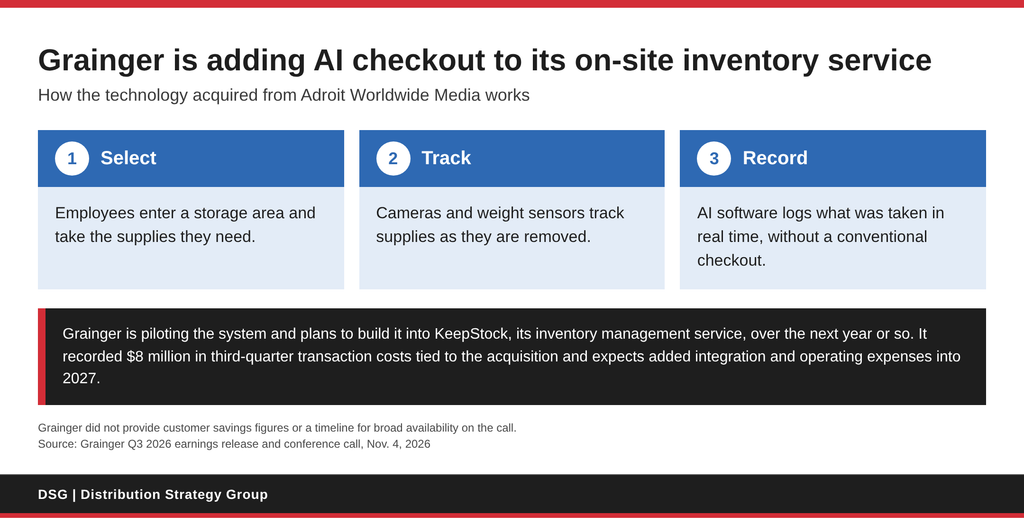
Technology uses cameras, weight sensors and software to track supplies as employees remove them from storage. Grainger is piloting the system and integrating it into its existing inventory management services.
“This new technology uses computer vision and AI to enable real-time inventory tracking and frictionless checkout to help customers reduce labor needs and operating costs,” Macpherson said.
The acquisition supports KeepStock, Grainger’s inventory management offering. Macpherson described a process in which employees enter a storage area, select products and leave, with the system recording what they take.
“The idea is that we’re going to build that into our core processes over the next year or so,” he said.
Grainger had tested the technology before completing the acquisition. Management expects additional integration and operating expenses into 2027 as the company expands its use, with the longer-term goal of generating sales through a more differentiated service.
The call did not provide measured customer savings or a timetable for broad availability.
Repeat Customers Drive Zoro’s Acceleration
At Zoro U.S., sales increased 25.2% per selling day during the quarter. Macpherson said the acceleration came entirely from existing customers purchasing more, reflecting efforts to improve customer selection, retention, and purchasing frequency.
Zoro has spent the past several years improving how it attracts customers likely to return, while strengthening its product selection, pricing, marketing, and delivery.
“I think we are going to see that continue for the next several years as we continue to improve our marketing capabilities, our pricing capabilities, our delivery capabilities,” Macpherson said.
The change addresses a previous weakness in the business. Zoro needed new customers to offset declining purchases from existing buyers. Existing customers are now contributing to growth, Macpherson said.
“A big portion of the business is now sort of frequent purchasers that have been around for a long time and that’s a big part of the growth, too,” he said.
Zoro is also attracting customers without relying as heavily on discounts. Macpherson linked that improvement to better marketing, product selection, and efforts to turn initial purchases into continuing relationships.
“So, it’s basically acquiring the right customers, not having to discount as much to do that and then turning those customers into frequent buyers,” he said.
Laurie Thomson, vice president and interim chief financial officer, said Zoro’s growth was led by business customers and improving retention. At MonotaRO, Grainger’s Japan-based online business, she cited continued growth with enterprise customers and repeat purchasing by core business customers.
MonotaRO sales increased 13.6% after adjusting for local selling days and currency changes, according to the call.
Data Center Spending Reaches Several Markets
Grainger’s High-Touch Solutions business in North America reported sales growth of 13.8%, supported by double-digit growth in product volume and additional contributions from higher prices.
All major customer markets grew from a year earlier. Macpherson said data center and power generation investment contributed through several customer groups, making its full effect difficult to isolate.
Some purchases appear in Grainger’s retail category because those customers operate their own data centers. Other orders come from contractors serving the facilities and manufacturers participating in the projects.
“We’re also seeing a lot of the growth show up in terms of contractors and particularly, contractors serving those data centers and power generation projects,” Macpherson said.
Branches near those projects have experienced particularly robust growth, he said. However, management did not quantify how much of Grainger’s overall growth came from data center investment.
“It’s tough to size how much of the market acceleration is data centers,” Macpherson said.
New customer agreements are another source of business. Macpherson said Grainger’s contract wins and its performance serving those accounts have contributed to gains alongside the improving market.
“In terms of our share gain, a lot of that’s new contracts and contract execution and that has been very strong through the year as well,” he said.
Higher Costs Shape Pricing Decisions
Grainger is balancing those growth efforts against higher freight and product costs. Thomson said September price increases covered most of the cost increases known at the time, but subsequent diesel price changes will influence pricing decisions for early 2027.
Macpherson said the company continues negotiating with suppliers. Grainger’s objective is to recover higher costs over time while maintaining competitive prices and communicating changes to customers.
“We’ve been pretty consistent about communicating clearly with customers in terms of the price increases,” he said.
Strong demand has helped customers absorb the increases, but Macpherson acknowledged limits to that acceptance.
“Continued price increases can create friction over time. So, we’re mindful of that,” he said.
Grainger expects supplier rebates tied to its strong annual sales performance to help offset freight pressure in the fourth quarter. Management said those benefits would primarily affect its North American business.
Stronger Demand Supports Higher Forecast
Preliminary October sales increased approximately 18% per selling day after adjusting for currency changes and the U.K. exit. Macpherson said about 2 percentage points of that increase reflected comparison with the government shutdown a year earlier.
Management expects growth to moderate during the fourth quarter as Grainger compares against stronger prior-year sales and earlier price increases. Macpherson nevertheless described a steady improvement in demand throughout 2026.
Grainger raised its full-year sales forecast to $19.8 billion to $20 billion, from $19.4 billion to $19.7 billion. It also increased its adjusted earnings forecast to $47 to $48 per share, from $45.50 to $47.25. The adjusted measure excludes specified costs and other items.
Macpherson said both market conditions and the company’s execution have contributed to growth. Its investment remains focused on making purchasing easier and helping customers manage supplies within their operations.
“When we focus on things that matter most to our customers, we perform well and we gain share,” he said.
Share this article:
