


Why This Matters to Distributors: Medline is investing in distribution capacity and automation to support growing demand from hospitals and other health care providers. The company plans to add 3 million square feet of warehouse space across three states while expanding customer contracts and increasing sales of its own branded products. Its results also underscore the financial challenges of expansion, as higher operating costs and supply chain investments put pressure on earnings.
Medline is adding approximately 3 million square feet of distribution space in Texas, California and Michigan as the medical supply distributor expands its national warehouse network to support new hospital contracts and growing demand from health care providers.
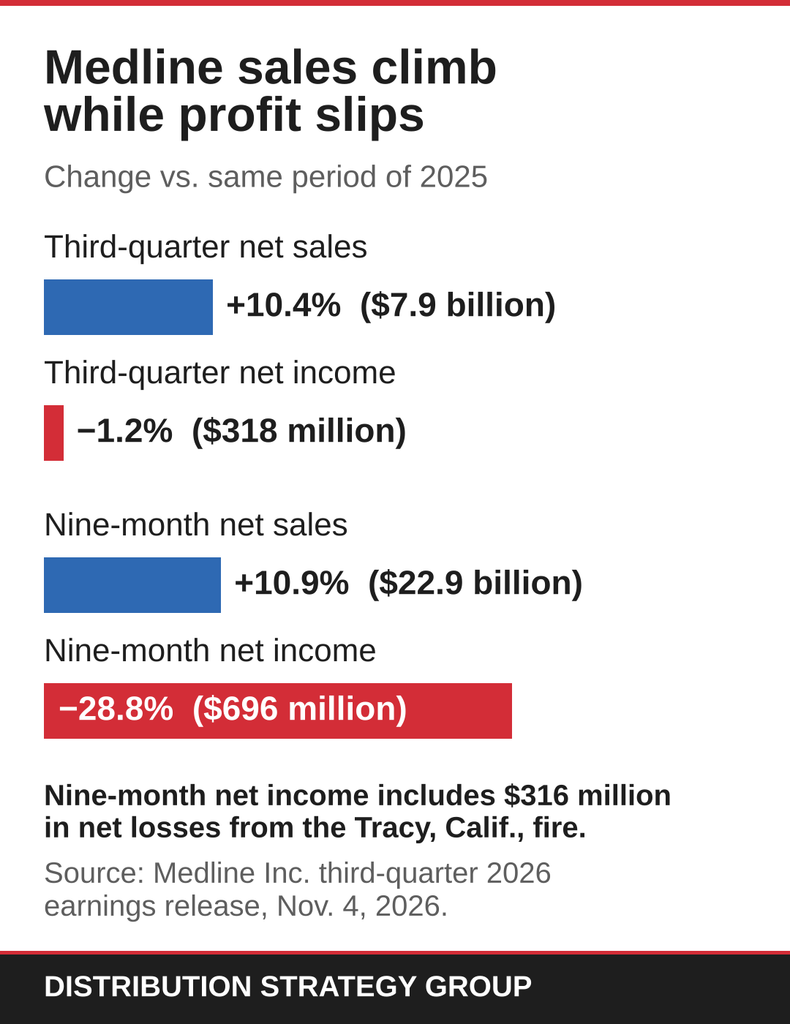
The Northfield, Illinois-based company is also investing in warehouse automation, expanding its Canadian distribution business, and pursuing additional customer contracts. The investments come as Medline reported third-quarter sales of $7.86 billion, up 10.4% from $7.12 billion a year earlier.
Net income declined 1.2% to $318 million from $322 million, reflecting higher operating costs and other expenses. The company reported its results Nov. 4 for the quarter ended Sept. 26.
Medline raised its full-year sales growth forecast for the third consecutive quarter, projecting an increase of 10% to 10.5%, compared with its previous forecast of 9% to 10%.
The results highlight Medline’s effort to expand its share of the medical supply market through larger distribution facilities, automated order fulfillment, and broader customer relationships.
Medline outlined plans for three distribution facilities during its third-quarter earnings call.
The projects include a 1.2 million-square-foot distribution center in the Dallas-Fort Worth area, a 1 million-square-foot facility in Southern California and an 800,000-square-foot facility in Michigan.
Together, the facilities will add approximately 3 million square feet of distribution capacity to support increasing order volumes and new health care contracts.
Medline is also preparing to open a distribution center in Tracy, California, following a June fire that disrupted operations at its previous facility.
The new Tracy center is scheduled to open by the end of 2026 and will feature the company’s largest installation of AutoStore, an automated storage and retrieval system.
The technology is designed to handle individual products and smaller orders, reducing manual picking requirements and increasing warehouse productivity. Medline expects the system to improve order processing and operating efficiency by mid-2027.
The Tracy fire also affected the company’s financial results. Medline said fire-related expenses reduced third-quarter net income by $80 million. The company expects to recover additional costs through insurance and has recognized $100 million in insurance recoveries through the end of the quarter.
The warehouse investments are intended to increase distribution capacity while improving service to hospitals, physician practices, and other health care customers.
New customer contracts and increased purchases by existing customers helped drive Medline’s third-quarter sales growth.
The company’s supply chain solutions business, which distributes medical products and provides related services to health care organizations, reported sales growth of 14%. Its Medline-branded products business grew 7%.
Medline signed an agreement during the quarter to supply physician offices affiliated with one of the nation’s largest health systems. The company also secured a contract to distribute laboratory supplies to hospitals operated by a large Midwestern nonprofit health care network.
Medline did not identify either customer.
The company said it remains on track to meet its annual goal of signing $1 billion in new customer contracts.
Medline’s U.S. hospital business generated $5.5 billion in third-quarter sales, up 12% from a year earlier. Sales to physician offices, outpatient surgery centers and other health care providers outside traditional hospitals increased 6% to $1.9 billion.
International sales rose 8% to $518 million, led by growth in Canada and Europe.
The expansion of customer contracts also creates opportunities for Medline to increase sales of its own products, including surgical supplies, examination gloves, laboratory products, and medical equipment.
Medline is extending its distribution services in Canada through an agreement with Mohawk Medbuy, a Canadian health care purchasing organization.
The agreement represents Medline’s first prime vendor partnership in Canada. Under that model, a distributor provides a broad range of medical products while managing purchasing, inventory, and delivery requirements for participating health care organizations.
Medline said it was serving five hospitals under the agreement as of Nov. 4 and expects to complete the rollout by the end of the first quarter of 2027.
The agreement expands Medline’s role beyond supplying individual products by giving it responsibility for a larger portion of customers’ medical supply needs.
It also extends a distribution model the company has used extensively in the United States into another North American market.
Medline reported higher sales for both the third quarter and the first nine months of 2026, although net income declined during both periods.
For the first nine months, sales increased to $22.89 billion from $20.65 billion a year earlier, a gain of approximately $2.25 billion.
Net income declined to $696 million from $977 million, a decrease of 28.8%.
Higher product costs, operating expenses, and costs associated with the Tracy distribution center fire contributed to the decline.
Medline spent $348 million during the first nine months on projects that included warehouse automation, distribution center construction, and manufacturing expansion.
The company generated $2.2 billion in cash from operations during the period.
Medline expects higher transportation, product, and operating costs to continue affecting its business into 2027.
During its third-quarter earnings call, executives cited higher diesel prices, raw material costs and finished goods expenses as factors increasing the cost of serving customers.
The company plans larger-than-usual price increases in early 2027 to recover some of those expenses.
Medline also announced a restructuring program intended to simplify operations, eliminate overlapping functions, and improve productivity.
The company expects restructuring expenses of $20 million to $30 million in the fourth quarter of 2026. It projects annual savings of $80 million to $90 million, with most of the benefits beginning in 2027.
Medline did not specify the number of jobs that could be affected by the restructuring in the earnings-call remarks reviewed.
The cost-cutting measures come as Medline continues to invest in distribution capacity, manufacturing quality, and technology.
Medline is also expanding a companywide effort to strengthen manufacturing quality and product oversight.
The company has engaged independent organizations to assess more than 30 manufacturing facilities worldwide under its Global Quality Action Plan.
The assessments are expected to continue over several years.
Medline is investing in additional personnel, technology, and operating procedures to improve manufacturing standards and address product quality concerns.
Those expenses are included in the company’s financial outlook and are expected to continue affecting operating costs in 2027.
Medline executives said acquisitions remain a potential source of growth as the company expands its distribution operations and product offerings.
Management identified smaller acquisitions involving products, distribution channels, and related services as potential opportunities.
The company did not announce a specific acquisition in its third-quarter earnings materials.
Medline also authorized a $1 billion share repurchase program in October and repaid $750 million in outstanding debt.
The company said its priorities include expanding distribution capacity, improving productivity and maintaining the financial resources to pursue additional growth opportunities.
Medline expects sales to grow by a high-single-digit percentage in 2027, supported by new customer contracts, higher purchasing volumes, and continued expansion of its distribution network.
However, the company expects earnings to grow more slowly as it absorbs higher operating costs and continues investing in warehouse automation, manufacturing quality, and distribution infrastructure.
The company’s latest results illustrate the competing demands facing large distributors: expanding capacity and services to win customers while controlling the costs of supporting that growth.
For Medline, the next test will be whether its investments in new facilities, automation and customer contracts translate into stronger earnings as its distribution network expands.
Do not miss any content from Distribution Strategy Group. Join our list.
Share this article:
