

Why This Matters to Distributors: Distributors that shifted sourcing from China to Vietnam or India to limit tariff exposure could face higher costs from those suppliers, too. With hearings set for late January, distributors may have to issue price lists and quote jobs before they know what duties will apply to future shipments. The impact will vary by product, even within a single supplier’s catalog, because duties depend on country of origin, tariff classification, and exemptions.
The United States proposed tariffs Nov. 25 on imports from 14 trading partners, including China, the European Union, Vietnam, and India. The proposal calls for rates of up to 35% on Vietnamese goods and up to 25% on Indian goods. The initial proposal for most Chinese goods is up to 20%, with an alternative rate of up to 40% if U.S. officials determine that talks with Beijing have failed to address their concerns.
U.S. Trade Representative Jamieson Greer said policies that sustain excess manufacturing capacity in the 14 economies burden or restrict U.S. commerce. His office proposed the duties under Section 301 of the Trade Act of 1974. The agency also investigated Mexico and Norway and has yet to issue findings for either country.
Trade talks could change several of the proposed rates. Vietnam could see its rate lowered to 20% and India to 17% if they reach qualifying agreements with the United States. Singapore faces a proposed rate of up to 20% that could fall to 10% depending on negotiations.
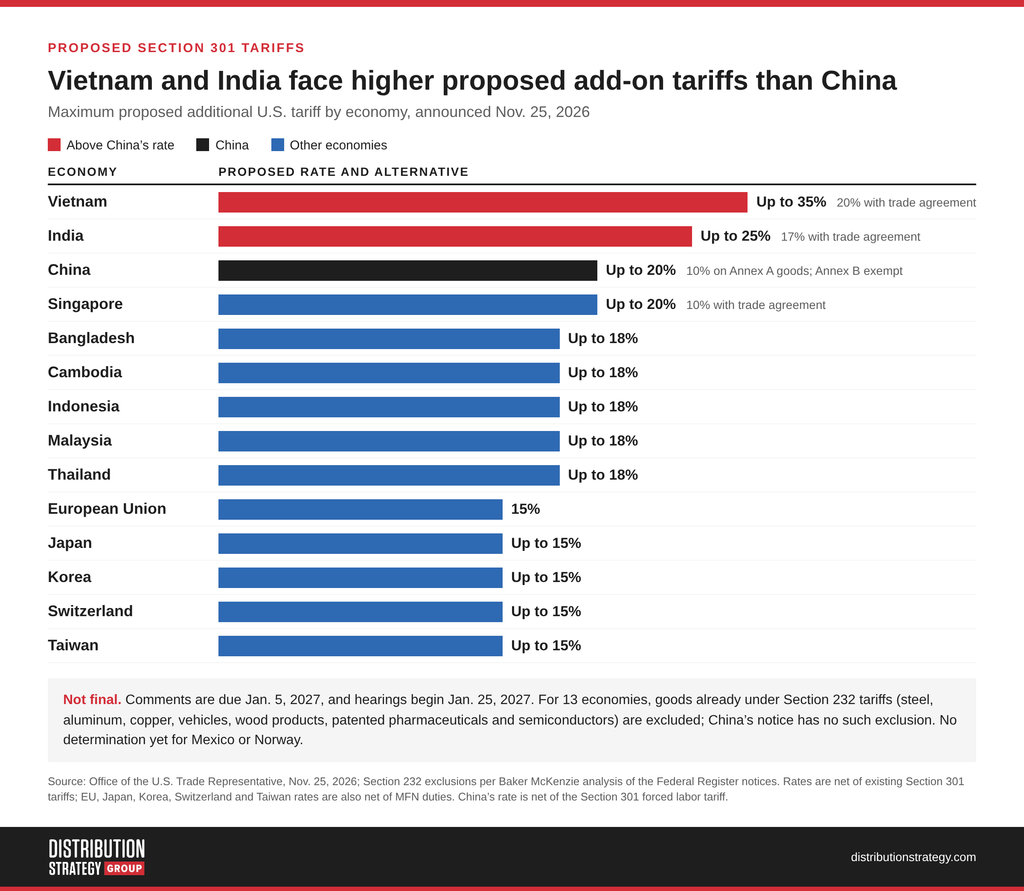
Bangladesh, Cambodia, Indonesia, Malaysia, and Thailand face initial proposed rates of up to 18%. The European Union faces a proposed rate of 15%, while Japan, South Korea, Switzerland, and Taiwan face rates of up to 15%. The proposal includes higher alternatives for those nine trading partners if U.S. officials find that talks or existing commitments fall short.
For 13 of the 14 economies, the proposals exclude goods already subject to Section 232 tariffs, including certain steel, aluminum and copper products, according to law firm Baker McKenzie. That could spare covered products such as steel pipe or copper wire from an additional duty. China’s proposal has no blanket Section 232 exemption, leaving some Chinese metal products potentially subject to both measures. Under the initial China proposal, some products would face a lower rate of up to 10%, while others on a separate list would be exempt.
Most of the proposed rates account for certain existing Section 301 duties, including tariffs announced in July over forced labor enforcement. For the European Union, Japan, South Korea, Switzerland and Taiwan, the initial rates also account for standard U.S. import duties. Baker McKenzie said the notices leave open how those offsets would be calculated. For distributors comparing supplier quotes, which makes the tariff classification and current duties on each item as important as the proposed country rate.
Written comments and requests to testify are due Jan. 5, 2027. Hearings begin Jan. 25 at the U.S. International Trade Commission in Washington. The trade representative’s office is seeking input on which products should be covered, what rates should apply and how existing duties should factor into the calculation. Distributors and trade associations can use the comment period to document the cost impact on specific products and ask for exclusions.
Do not miss any content from Distribution Strategy Group. Join our list.
Share this article:
