


Why This Matters To Distributors: A driverless truck running every day is not yet proof that technology can lower distribution costs. EASE’s Ohio shuttle and McLane’s Texas service point to the most practical place for distributors to test it: predictable, high-volume trips between facilities, with people still handling local delivery. Before committing, distributors need route-level evidence on cost per load, truck utilization, uptime, safety and the work required at each handoff.
Two electric trucks without human hands on the steering wheel and feet on the gas pedal are now moving freight every day between EASE Logistics warehouses in Marysville, Ohio. The deployment marks another step for driverless trucking, but it does not signal broad adoption in wholesale distribution. At least not yet.
Autonomous-truck developers and their customers want driverless hauling to become a regular part of logistics. Yet among wholesale distributors, the public rollout remains limited to one announced operator: McLane Co.
Einride and EASE said Oct. 6 that their Society of Automotive Engineers Level 4 trucks are running scheduled routes on EASE property and local public roads. No one rides in the cab. An off-site operator monitors each truck and can intervene if needed.
The companies said they began collecting operating data in September but have not published results for miles driven, loads moved, uptime or cost.
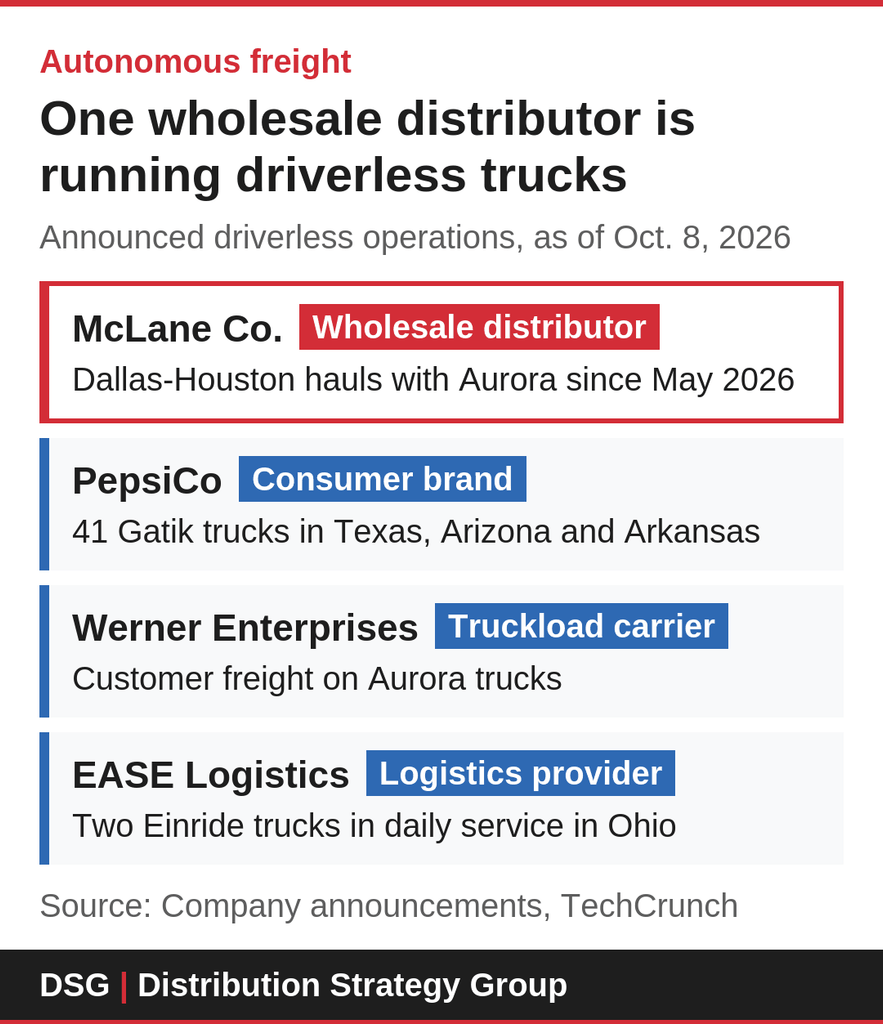
That distinction matters: EASE is a logistics provider, not a wholesale distributor. Its deployment puts driverless trucks into daily service, but it does not add another publicly announced wholesale distribution fleet. McLane, which supplies convenience stores, mass merchants and restaurant chains, remains the outlier.
The Ohio operation is part of the multiyear, $8.8 million Truck Automation Corridor Project involving the Ohio Department of Transportation, DriveOhio and the Indiana Department of Transportation. The project is studying automated freight on routes in the two states. EASE says this is its third autonomous-trucking deployment with DriveOhio.
For now, the Marysville service is a tightly defined shuttle: two trucks, scheduled trips and freight moving between the same company’s warehouses. Einride chief technology officer Henrik Green called the deployment a chance to gather “proof points” for expanding autonomous freight.
That is the test ahead. Daily service is more consequential than a demonstration, but two trucks on a fixed route do not establish whether driverless freight can deliver dependable savings across a complex distribution network.
McLane Is The Wholesale Test Case
McLane and Aurora Innovation began driverless commercial hauls on select Texas routes in May, moving freight between Dallas and Houston. Aurora’s system handles the long-haul middle mile; McLane drivers make local deliveries to customers.
The companies say the service followed a supervised pilot covering more than 280,000 autonomous miles and 1,400 loads, with a 100% on-time record. Those are company-reported figures, not an independent assessment of safety or profitability. (
The division of labor offers a useful model for distributors: automation handles the repetitive highway segment, while people manage routes involving multiple stops, customer access and face-to-face service.
It also shows the technology’s current reach. McLane has not publicly announced additional driverless lanes since the May launch, nor has it said it is replacing its delivery fleet. The announced arrangement gives autonomous trucks a specific job moving freight between facilities.
Aurora’s Targets Are Ambitious
Aurora is making some of the industry’s most aggressive public projections. At its Sept. 23 investor day, the company said it expects to end 2026 with 200 driverless trucks, exceed 1,000 by the end of 2027 and have more than 30,000 operating by 2030. Aurora said customers had already been allocated its planned 2026 fleet.
Those are company targets, not independent forecasts. And “allocated” does not mean all 200 trucks are already operating—or that the service is profitable.
Aurora says trucks serving McLane, Werner Enterprises and other customers are averaging more than 225,000 miles a year on an annualized basis, more than twice the utilization of a traditional truck. Higher utilization is central to the business case: A truck that operates more hours could move more freight with the same vehicle.
But Aurora’s figures do not show that distributors can achieve comparable mileage or savings on their own routes. Results will depend on route length, freight volume, operating hours and the time required for loading, unloading and maintenance.
The production system is also scaling up. Roush is upfitting International LT trucks with Aurora’s hardware, while Volvo is integrating Aurora’s system into its production process. Meeting Aurora’s targets will require more than customer interest: The company must build trucks, put them into service, keep them running and expand routes within the system’s operating limits.
There is no comparable public forecast for driverless trucks across wholesale distribution. Aurora’s projections describe one company’s expectations—not how many autonomous trucks distributors should expect in their networks.
The Strongest Case Is In The Middle Mile
The clearest near-term fit is a long, repetitive route between facilities, with high freight volume, a predictable schedule and manageable transfer points. That makes the middle mile a more natural starting point than routes with many customer stops. EASE’s warehouse shuttle and McLane’s Texas lane fit that pattern, though they use different vehicles and serve different operations.
The potential gains are straightforward: more vehicle hours, more consistent schedules and less reliance on recruiting drivers for specific long-haul lanes. If an autonomous truck can run more miles per day, an operator may be able to add capacity without assigning a conventional truck and driver to every additional load.
But more miles do not automatically mean lower costs. Operators still need trucks and trailers, maintenance, dispatch, loading and unloading, route planning, and people who can respond when something goes wrong. Autonomous hardware, system support, remote monitoring, insurance and facility transfers add costs of their own.
None of the newly announced operations has released enough public data to show total cost per load compared with a conventional truck on the same route. Until operators provide that comparison, the business case remains promising but unproven.
Nor does the model eliminate labor across the supply chain. McLane retains drivers for local deliveries. Einride and EASE use remote oversight, and their trucks move freight between facilities. Automation may change where people are needed and what they do, but these deployments do not show a distribution system operating without human workers.
Safety claims also require context. Pilot miles and on-time performance are useful measures, but they are not the same as independently verified safety results across different roads, weather and traffic conditions. Federal guidance recognizes that Level 4 systems operate within a defined operating domain; the designation does not mean a truck can drive itself anywhere, in every condition.
The Distribution Verdict
The Oct. 6 Ohio launch matters because driverless trucks have entered daily freight service on another route—not because wholesale distribution has suddenly embraced the technology. EASE’s two-truck shuttle adds a live test of warehouse-to-warehouse operations. McLane remains the only wholesale distributor publicly identified as using driverless trucks, with Aurora handling select Texas hauls while McLane drivers serve customers on the last mile.
For distributors, the decision is not whether to replace their fleets. It is whether they have specific, repeatable lanes where greater truck utilization could justify the technology and operating costs—and whether a trial can prove it.
The next milestones are whether EASE publishes operating data from Marysville, whether McLane announces additional routes and whether Aurora turns its fleet targets into trucks operating at scale. Driverless trucking is gaining ground in logistics. In wholesale distribution, adoption is still waiting for proof that the economics work.
Do not miss any content from Distribution Strategy Group. Join our list.
Share this article:
