


Why This Matters to Distributors: Robotics is helping distributors extend order cutoffs, speed counter service, store more inventory and improve inventory accuracy. The payoff depends on whether receiving, replenishment, packing, transportation, and maintenance can keep pace.
First Supply LLC is using warehouse robots to fulfill orders placed by 5 p.m. for next-morning delivery. Codale Electric Supply uses automated storage to process walk-in orders in minutes. And NAPA is expanding beyond a robotics pilot with plans for the installation of more than 100 robots, according to announcements from the distributors and their technology suppliers.
The projects reflect a broader push across distribution to use automation for overnight branch replenishment, counter pickup, warehouse consolidation, and inventory control. Deployments at Medline, Caterpillar dealer Warren CAT and Southern Glazer’s Wine & Spirits also show how the technology varies: Some systems bring bins to employees, others pick individual products, and drones scan inventory without handling it.
The competitive stakes extend beyond warehouse labor. Faster picking gives distributors more time to accept orders before trucks depart, and denser storage puts more inventory within reach of customers without a larger building. Whether those gains translate into better service depends on the rest of the operation, including receiving, replenishment, packing, and transportation.
At First Supply, the gain shows up in the order window. The Madison, Wisconsin-based wholesaler’s Exotec Skypod system has operated for just over a year and supports overnight replenishment across its branch network. Next-day orders can represent as much as 20% of the distribution center’s daily volume, Exotec said in an Oct. 6 announcement. First Supply serves heating, ventilation and air conditioning, plumbing, lighting, waterworks, and industrial supply markets through 54 locations that include distribution branches, waterworks operations and kitchen, bath and lighting showrooms.
Exotec said the system picks 10 times faster than First Supply’s manual process and holds more than 14,000 stock-keeping units. Its design allows storage capacity to grow fourfold within the existing racking footprint, with room for more hardware. That figure describes expansion capability, not a completed increase in stored inventory. The system also supported deliveries to hundreds of customers after flash flooding hit southeastern Wisconsin last summer, according to Exotec.
The later cutoff gives contractors more time to order material for the following day. Overnight replenishment also allows branches to fulfill orders for products they do not keep on their own shelves.
At Codale, a Sonepar company, automation supports the pickup counter. Sonepar opened Codale’s automated central distribution center near the Las Vegas Strip in October 2025. The company said the facility’s AutoStore system brings storage bins to employees and allows teams to process walk-in and will-call orders in minutes while also supporting regional replenishment. The project is part of Sonepar’s commitment of more than 2.5 billion euros to logistics automation and another 1 billion euros to its digital platform. Sonepar detailed the Las Vegas operation’s capabilities in February.
Codale stores about 9,700 stock-keeping units within a 5,500-square-foot grid served by 11 AutoStore robots, six picking ports and two inbound ports, according to Kardex, which integrated the system. Kardex said will-call processing is 20% faster and the automated storage application requires 80% less floor space. The project consolidated operations previously spread across three Las Vegas locations. Its software coordinates regional replenishment and local pickup orders, balances work among stations and determines carton sizes before picking begins. The system handles small electrical products such as receptacles, fittings, tools and safety equipment.
The operation must balance immediate counter orders with branch replenishment and scheduled shipments moving through the same facility. Faster picking can shorten a contractor’s wait, but only if other warehouse work continues to flow.
Warren CAT, one of the largest Caterpillar dealers in North America, faces the same tension in heavy equipment parts. Kardex said in September that it installed an AutoStore goods-to-person system with 20 AutoStore R5 robots in Warren CAT’s new 50,000-square-foot parts facility in Midland, Texas. The site combines a storefront, engine shop, warehouse and parts distribution operation, a mix that creates fulfillment requirements different from those of a traditional warehouse, according to Warren CAT. The system supports will-call orders and service department requests, and Kardex’s FulfillX software connects the robots to the warehouse management system used in Cat dealer operations. The dealer has not disclosed measured productivity results.
Superior Communications offers one of the more detailed sets of reported results. The mobile accessories distributor expanded its Tennessee installation from 25 Brightpick Autopicker robots in July 2025 to 50 in early 2026. A May case study from Brightpick said robots now complete 73% of picks autonomously in warehouse aisles. The remaining picks rely on employees: about 10% go through a station where products are brought to a picker, and 17% use a station where an employee picks fast-moving products from pallets and places them on robots.
Brightpick said the system handles up to 3,500 picks and 1,000 order lines an hour with two to three pickers per shift. That staffing figure excludes another three to four employees loading products into the system and four to five handling packout. The installation occupies about 25,000 square feet and supports Superior’s consolidation of two Tennessee distribution centers into one. Superior obtained the system through a robots-as-a-service arrangement, according to Brightpick.
Superior’s results illustrate the limits of picking automation as a labor measure. Employees still receive and replenish inventory and pack completed orders, work that must be included when evaluating total staffing and costs.
Medline’s experience shows what happens when a first automation project reaches its limit. The health care products distributor had used an AutoStore storage system with manual picking and packing for its health-plan business, and the setup worked until demand doubled, according to an Oct. 6 report in Modern Materials Handling. As the system ran closer to capacity, Medline had less room to absorb sharp quarterly order spikes. The company responded with a system it calls Pick Pack Pro, which combines Tompkins Solutions’ tSort sortation technology with automated packing and a Ranpak vision system that identifies cartons needing manual rework. The result is a single automated flow from batch picking through sortation, packing, labeling and shipping. Medline selected each supplier independently and managed the handoffs between systems with its own engineers.
The Medline project underscores a point that robot counts miss. Automating one step can move the bottleneck to the next, and distributors that add storage robots often find themselves investing next in sortation and packing.
NAPA, the automotive parts distributor owned by Genuine Parts Co., began a pilot with Brightpick in 2025 and signed an agreement for an additional site in early 2026. Brightpick’s Feb. 18 announcement said the first project under that agreement would include more than 100 robots, with the potential for installations at other locations. The systems are intended to support handling and replenishment across NAPA’s store network of 6,000 U.S. stores, which draw on more than 560,000 parts, accessories, and supplies, according to the announcement.
Justin Ducharme, NAPA’s executive vice president of distribution and logistics, said the expansion supports the company’s efforts to improve store replenishment and meet demand for fast, reliable parts delivery. The announcement did not disclose the additional site’s location, commissioning date, or measured productivity results. NAPA’s rollout underscores the distinction between a functioning pilot and a broader deployment: the pilot was operating, while the larger installation was announced as a future project.
Outside the United States, wholesalers are making similar moves. Japanese industrial wholesaler Trusco Nakayama began full-scale operation of an Exotec Skypod system at its new Planet Aichi distribution center in August. The installation includes 37 robots, 31,975 bins and four workstations, according to a joint announcement from Trusco, Exotec and IHI Logistics & Machinery. The robots bring factory consumables, tools, storage supplies, and safety equipment to employees, replacing walks through storage areas. Planet Aichi opened in May and is Trusco’s 29th and largest distribution center. The wholesaler holds about 630,000 items and plans to expand that assortment to more than 1 million by 2030. The announcement described productivity, labor and accuracy objectives but did not provide measured picking gains.
Food wholesaler Mitsubishi Shokuhin announced full-scale operation of another Exotec installation in July at its Soka Food Service Distribution Center in Japan, which serves small and midsize restaurants and other commercial food customers. Robots retrieve food ingredients, alcoholic beverages, and other materials in the ambient-temperature area, while a separate automated case storage system from IHI handles frozen products. Employees at existing facilities had used voice instructions while walking storage aisles to pick from about 13,000 products. The new systems are intended to reduce walking and manual handling, stabilize operating quality, and raise shipping capacity. The announcement did not disclose quantified results.
The Japanese projects show that one building can require different systems for different inventory. Ambient products, frozen cases, small tools, and bulky goods each present distinct handling requirements.
Some distributor robots do not pick at all. Southern Glazer’s Wine & Spirits has deployed more than 40 Corvus One autonomous drones across nine distribution centers over the past 18 months, with further expansion planned, the companies said March 24. The drones fly warehouse aisles to scan and validate reserve storage locations during active operations and sync results with Southern Glazer’s warehouse management system. Inventory checks at participating facilities have moved from quarterly counts to biweekly cycles, and improved inventory accuracy has contributed to a 100-basis-point gain in cases per hour, according to the announcement.
For a beverage distributor operating in 47 U.S. markets and Canada, where a single pallet can carry substantial value, inventory errors affect fill rates, service levels, and labor planning.
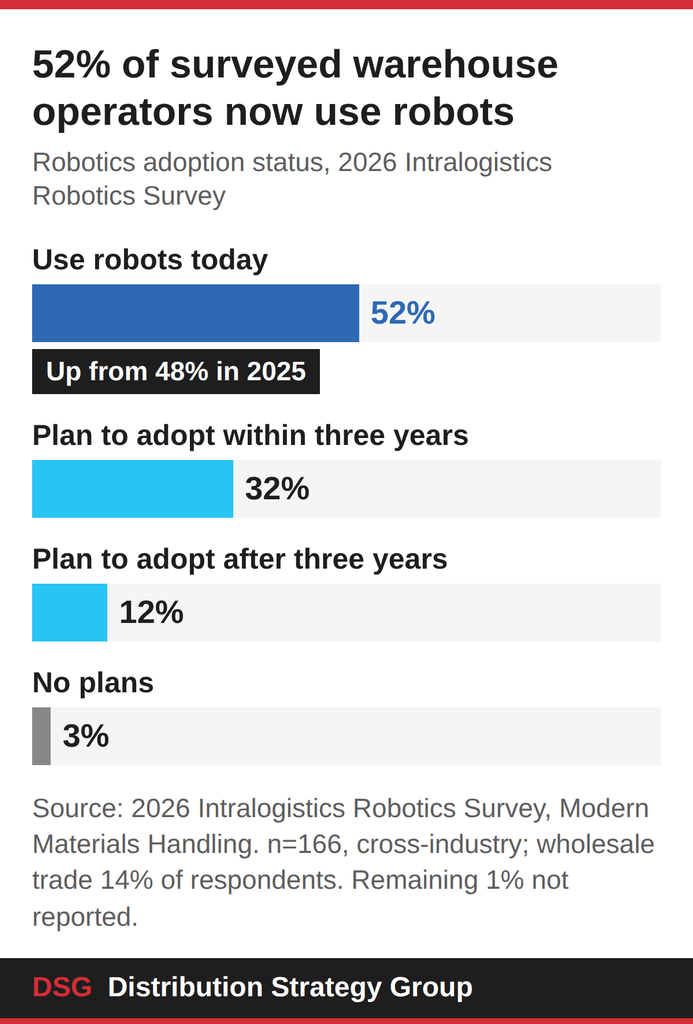
Industry surveys also suggest broader adoption, although they do not establish a distributor-specific adoption rate. The 2026 Intralogistics Robotics Survey found that 52% of respondents use at least one type of robot in their warehouses or distribution centers, up from 48% a year earlier. Another 32% plan to adopt robots within three years, and the share reporting no plans fell from 9% to 3%. The survey, produced by Peerless Research Group with MHI and The Robotics Group and published by Modern Materials Handling, covered 166 operations and supply chain professionals in March and April. Wholesale trade accounted for 14% of respondents, compared with 29% in manufacturing and 21% in transportation and warehousing.
Those findings describe a cross-industry sample, not a distributor adoption rate. They also do not show how extensively respondents use robots across their networks. A single installation can qualify a company as a user even when its other warehouses remain manual.
The distributor announcements provide more specific evidence, but their results also require careful comparison. Superior reports picks and order lines per hour. Codale reports faster will-call processing. Southern Glazer’s reports count frequency and cases per hour. First Supply emphasizes a delivery cutoff. Those measures address different operating problems and cannot be treated as interchangeable benchmarks.
Amazon’s fulfillment network adds pressure from outside the channel. Amazon said it has deployed more than 1 million robots across its operations network, supporting inventory movement and order fulfillment. Amazon Business reached $60 billion in annualized gross sales in the second quarter and serves more than 11 million organizations worldwide, the company said in July. That figure represents an annualized sales pace, not completed full-year sales.
Amazon Business made more than half a billion deliveries worldwide in 2025. The company has also rolled out dedicated business delivery trucks in 13 states that offer scheduled delivery windows, palletized bulk and parcel delivery and consolidated drop-offs. Its business product selection grew 30% from the previous year, including growth in repair tools and office furniture.
For distributors, the competitive implication is that business buyers now have a broader combination of selection and delivery options. The projects at First Supply, Codale and Warren CAT show established distributors strengthening their own service through later order acceptance, faster counter pickup and branch replenishment, capabilities tied to local inventory and trade relationships that a parcel network does not replicate.
Maintenance remains an operating constraint. A September survey commissioned by condition-monitoring supplier MultiSensor AI found that 91% of respondents had approved, implemented, or integrated automation while knowing their teams or facilities were not fully prepared to maintain it. Censuswide surveyed 152 reliability and maintenance practitioners and senior operations leaders in ecommerce distribution and logistics. Eighty percent reported six or more unplanned downtime events affecting fulfillment, sortation, or distribution during the previous year. Among vice president-level respondents, 95% estimated that a major downtime event could match or exceed a facility’s annual automation investment.
The findings cover automation broadly, not warehouse robots alone, and come from research commissioned by a vendor that sells monitoring technology. They nevertheless identify a cost that accompanies every deployment: keeping the equipment and connected systems running.
For distributors, an interruption can leave branches short of stock or prevent completed orders from shipping. A packing bottleneck can also erase time saved in picking, making reliability across the entire operation essential to meeting delivery commitments.
The installations show robots and drones moving into daily work across electrical, plumbing, heating, and cooling, health care, automotive, heavy equipment, beverage, industrial and food service distribution. Public disclosures are less consistent on total operating costs, payback periods, and performance during outages, leaving distributors with less evidence to judge whether similar projects would work across their own networks.
Do not miss any content from Distribution Strategy Group. Join our list.
Share this article:
