



Why This Matters to Distributors: Wholesale employment declined after two months of gains, with nondurable goods wholesalers accounting for most of the decrease. Manufacturing added jobs, however, providing a more encouraging signal for industrial suppliers. The mixed results underscore the importance of tracking customer demand by market rather than relying on the national hiring headline.
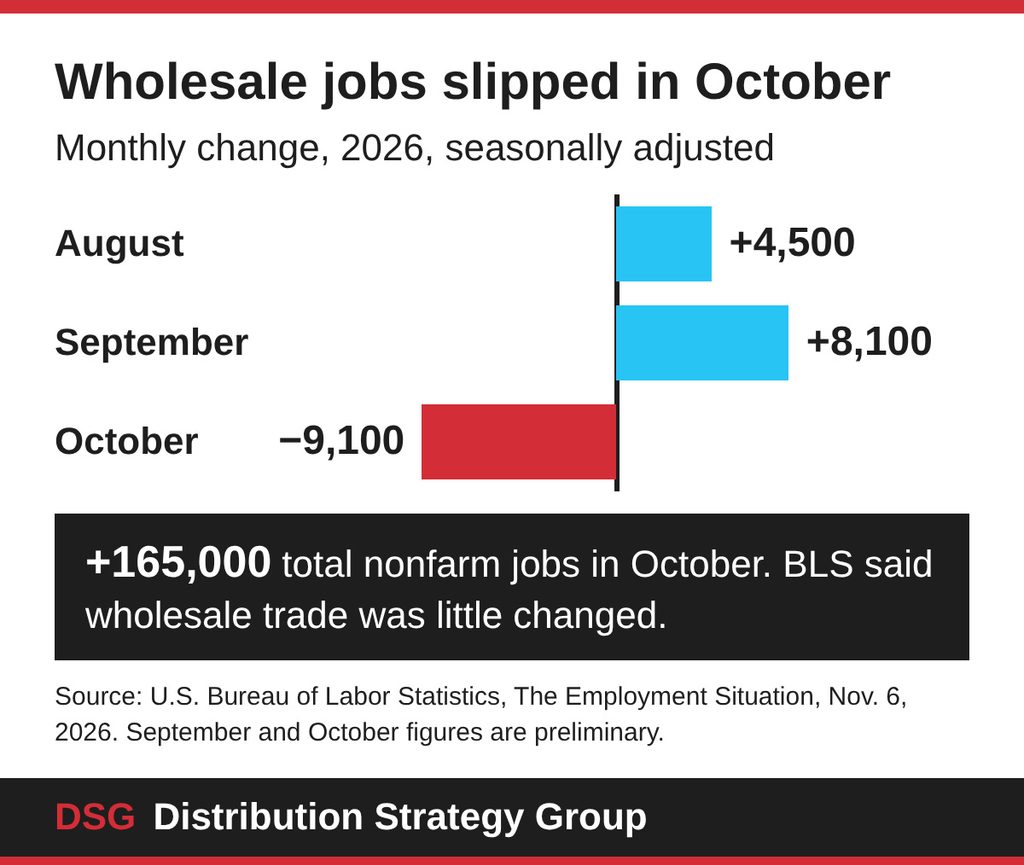
U.S. wholesale trade employment fell by 9,100 jobs in October, reversing most of the industry’s gains during the preceding two months as hiring expanded across the broader economy.
Wholesalers employed approximately 6.07 million people on a seasonally adjusted basis, according to the Bureau of Labor Statistics’ employment report released Nov. 6. Employment declined about 0.1% from September but remained at 14,200 jobs, or 0.2%, above October 2025, indicating little overall growth during the past year.
The October decrease followed gains of 8,100 jobs in September and 4,500 in August. Together, those figures left wholesale employment up a net 3,500 positions over the three months. September and October estimates are preliminary and subject to revision.
BLS included wholesale trade among industries where employment showed “little change” during October. The agency’s characterization puts the decline in perspective: The preliminary estimate alone does not establish a sustained contraction in wholesale employment.
Job losses were concentrated among nondurable goods merchant wholesalers, where employment decreased by 7,700 to approximately 2.20 million. Durable goods merchant wholesalers lost 3,100 jobs, leaving employment at about 3.42 million. Wholesale agents and brokers added 1,700 positions, partly offsetting those declines.
The year-over-year figures also showed differing conditions within distribution. Durable goods wholesalers employed 22,600 more people than in October 2025, an increase of 0.7%. Nondurable goods wholesalers employed 14,800 fewer people, a decrease of 0.7%, while agents and brokers added 6,400 jobs.
Wholesale earnings remained above year-earlier levels despite little monthly movement in hourly pay. Average hourly earnings were $39.99 in October, down a penny from September but up 2.1% from $39.17 a year earlier.
Average weekly earnings increased to $1,579.61, up 0.2% from September and 2.9% from October 2025. These averages cover employees across wholesale trade, rather than specific warehouse, sales, or delivery positions. Changes can reflect shifts in the mix of employees and hours worked as well as changes in pay.
For distributors, the earnings figures suggest that slower employment growth has not eliminated pressure on compensation budgets. They do not, however, show whether individual companies raised wages or whether occupations became easier to fill.
Employment in several markets served by distributors offered more favorable reading. Manufacturing added 19,000 jobs in October, as durable goods manufacturers added 25,000 positions and nondurable goods manufacturers lost 6,000. Transportation and warehousing added 24,800 jobs, while construction employment decreased by 3,000.
The manufacturing gains provide a potentially encouraging signal for distributors selling tools, safety products, maintenance supplies, and replacement parts. Additional factory employment can support demand for those products, although the jobs report does not measure purchasing activity or establish that distributors received more orders.
Construction’s modest employment decline provides less evidence of expanding demand for building-related supplies. For distributors serving contractors, local project activity, customer backlogs, and order patterns remain necessary to assess whether the national figures reflect conditions in their territories.
Across the economy, employers added 165,000 jobs in October, and the unemployment rate edged down to 4.1% from 4.2% in September. Professional and business services added 70,000 jobs, and BLS also reported employment increases in health care, transportation, and warehousing.
The wholesale decline does not establish why businesses reduced employment. A net payroll decrease can reflect layoffs, departures that went unfilled or hiring that failed to keep pace with turnover. The figures also do not establish whether automation, consolidation or changes in sales affected staffing.
For distribution executives, the report makes the relationship between staffing and business volume worth watching. Declining employment accompanied by stable orders and reliable fulfillment would suggest different operating conditions than payroll reductions occurring alongside weaker sales and fewer customer purchases. October’s results warrant closer attention to nondurable goods distribution, while manufacturing’s gains provide a reason to assess industrial demand separately.
Do not miss any content from Distribution Strategy Group. Join our list.
Share this article:
