

Why This Matters to Distributors: A new round of proposed and pending tariffs is forcing distributors to reassess pricing, sourcing, and inventory strategies. While several measures have not yet taken effect, the uncertainty is complicating supplier negotiations, customer pricing, and purchasing decisions across industrial, healthcare, electrical, HVAC and construction markets.
Wholesale distributors are once again reassessing pricing, sourcing and inventory strategies as the Trump administration advances new tariff proposals affecting pharmaceuticals, Canadian imports and other products while leaving key questions about future trade policy unresolved.
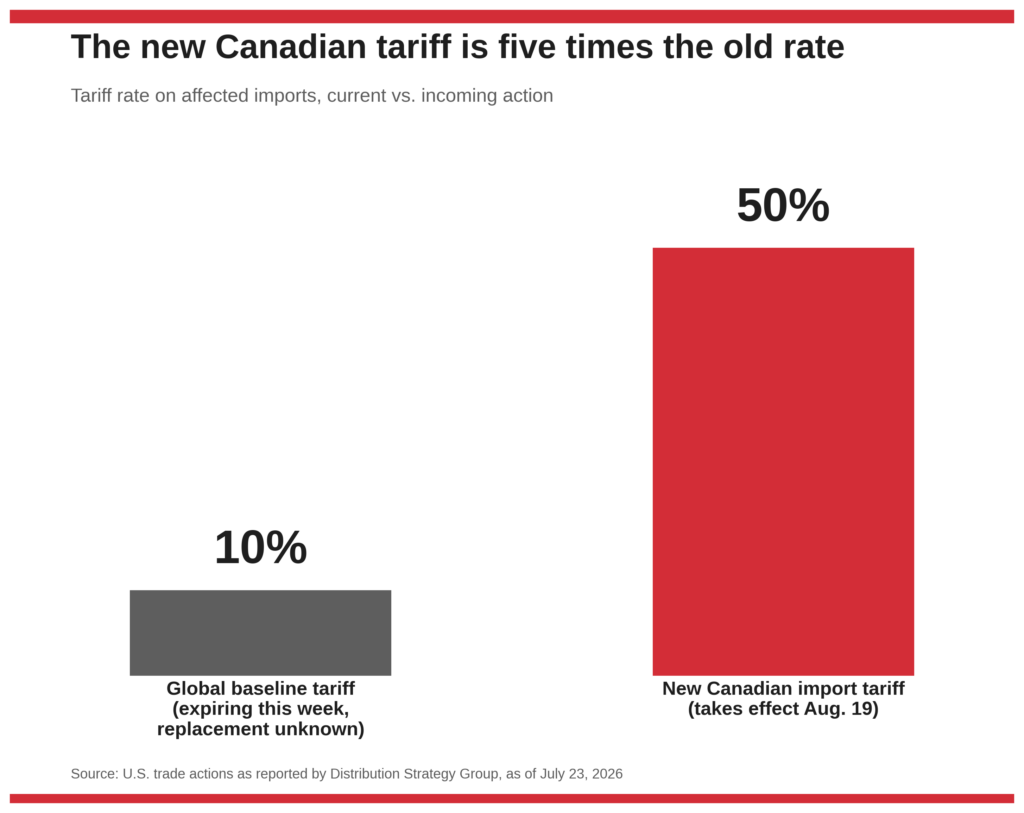
The latest developments include proposed tariffs of up to 200% on imported generic pharmaceuticals, new 50% tariffs on many Canadian imports and uncertainty over what will replace a temporary 10% global tariff scheduled to expire this week. Even where tariffs have not taken effect, distributors are making fourth quarter purchasing decisions without knowing what their future import costs will be.
For distributors, the uncertainty is becoming a business issue independent of the tariffs themselves. Companies are finalizing fourth-quarter inventory purchases, negotiating supplier contracts, and setting customer pricing without knowing where trade policy will settle. That makes it more difficult to determine how much inventory to buy, when to pass through higher costs and how much working capital to commit ahead of year-end.
The administration this week proposed tariffs of up to 200% on imported generic pharmaceuticals. Under the proposal, generic drugs would remain tariff-free until August 2028, followed by a 100% tariff for one year before increasing to 200%. Administration officials said the phased approach is intended to encourage manufacturers to move production to the United States.
For healthcare distributors, the proposal raises questions about product availability, sourcing, and future pricing.
Companies including Cardinal Health, McKesson, Cencora and Medline rely on global supply chains for many generic medications. While the delayed implementation provides time to renegotiate supply agreements and diversify sourcing, industry groups say rebuilding U.S. manufacturing capacity will take longer. That means distributors could remain dependent on imported products even after the tariffs begin taking effect.
The proposal also has implications for hospitals, health systems and group purchasing organizations, many of which operate under multiyear purchasing contracts. Distributors will need to revisit pricing provisions and cost-sharing arrangements well before the tariffs are implemented.
The administration has also announced 50% tariffs on many Canadian imports under Section 338 of the Tariff Act of 1930. The tariffs are scheduled to take effect Aug. 19, although many products that qualify under the U.S.-Mexico-Canada Agreement remain exempt.
The action affects distributors serving manufacturing, construction and infrastructure markets that rely on Canadian suppliers for steel products, fabricated metal components, chemicals, and building materials.
Before the tariffs take effect, distributors will need to determine which products qualify for USMCA exemptions and which do not. That review could require companies to audit certificates of origin, product classifications and supplier documentation across thousands of SKUs while preparing contingency plans if trade rules change again.
For many distributors, the most immediate impact will be on pricing.
Manufacturers often issue price-increase notices shortly after tariff announcements, leaving distributors to decide whether to absorb higher costs, negotiate with suppliers or pass increases on to customers.
Those decisions become more difficult for distributors serving customers under annual or multi-year contracts where pricing has already been established. Companies with dynamic pricing systems can often respond quickly to supplier cost increases. Those relying on quarterly price books or manual updates face a greater risk of margin erosion while waiting to adjust customer pricing.
Distributors with fixed-price contracts face an additional challenge. Companies without tariff pass-through provisions may have to absorb higher costs until agreements can be renegotiated, increasing pressure on margins.
Several distributors addressed tariffs during recent second-quarter earnings calls, suggesting the issue is already affecting pricing and customer purchasing decisions.
Fastenal executives said pricing actions have helped offset tariffs and other inflationary pressures, although the company continues to work through higher costs. Management also noted that ongoing trade uncertainty is influencing customer purchasing decisions.
MSC Industrial Direct said it implemented additional pricing in May to offset tariff-related cost increases in metalworking and other product categories and expects pricing gains to moderate later this year as comparisons normalize.
Genuine Parts Co. said it intends to pass through tariff-related supplier cost increases where possible and expects tariffs to account for half of its projected pricing increases this year.
Taken together, the comments suggest distributors are relying on pricing to protect margins while customers remain cautious about committing to future purchases.
Industrial distributors are likely to feel the broadest effects because they source products across multiple industries and countries.
Electrical distributors remain exposed to imported wire, switchgear, transformers, and electrical components. Plumbing and PVF distributors continue monitoring valves, fittings, pumps, and castings, while HVAC distributors face potential increases on compressors, motors, controls, and sheet metal products sourced through global supply chains.
Construction equipment distributors also could see higher costs for imported machinery, replacement parts, and fabricated steel components.
The impact will vary depending on each distributor’s supplier mix, inventory position, and ability to shift sourcing to domestic manufacturers or alternative countries.
The latest tariff proposals are also renewing attention on inventory management.
Many distributors have spent the past several years diversifying suppliers after pandemic-era shortages exposed to weaknesses in global supply chains. Those investments may now provide greater flexibility as companies evaluate alternative sourcing options.
Some distributors may choose to build inventory ahead of potential tariff deadlines, while others may avoid tying up working capital until trade policy becomes clearer. The decision will depend on product availability, supplier relationships, and the likelihood that additional tariffs will take effect.
The best positioned distributors heading into the fourth quarter are likely to be those with diversified supplier networks, strong inventory visibility and pricing systems that can respond quickly to changing costs. For many companies, inventory is becoming less a purchasing decision than a risk management strategy.
Another question facing distributors is what happens after the expiration of the temporary 10% global tariff imposed earlier this year.
The tariff is scheduled to expire this week, but the administration has not announced what, if anything, will replace it. That leaves distributors entering the second half of 2026 without a clear picture of future import costs.
After navigating pandemic disruptions, inflation and repeated shifts in trade policy, many distributors have become more disciplined about diversifying suppliers, improving pricing systems and strengthening inventory visibility. The latest tariff proposals suggest those capabilities are becoming long-term competitive rather than temporary responses to supply chain disruption.
Do not miss any content from Distribution Strategy Group. Join our list.
Share this article:
