



McKinsey recently published Where Value Is Won and Lost in Distribution, identifying five themes shaping the future of the U.S. distribution industry. Most are well reasoned. One is deeply flawed. Here is the firm’s fourth theme, quoted in full:
“With more suppliers bypassing distributors and going directly to customers, pressure on traditional models will intensify. Distributors can grow alongside the trend, rather than be displaced by it, if they learn from this shift and deliberately use their leverage to integrate into supplier ecosystems, expand digitally without expanding their physical footprint, and reinforce their unique strengths.”
“Reinforce their unique strengths” is fine advice. The rest boils down to this: manufacturers are coming for your role in the channel, and your best response is to stop investing in the assets that define that role while making yourself useful to the companies replacing you. That’s not a growth strategy. It’s advice on how to hold the door for the people carrying out your furniture.
Start With the Word “Consumer”
McKinsey titled this theme “Direct-to-consumer models are continuing to expand, and the lessons haven’t changed.” Read that again: direct to consumer. Distributors don’t sell to consumers. Distributors’ customers are contractors, factories, hospitals, schools, municipalities, and dealers—businesses that buy products to run their operations. Retailers sell to consumers. If a little consumer volume trickles through a distributor’s counter, it’s incidental. Maybe “consumer” is a typo. Maybe it’s a tell. Either way it’s not a small mistake, because D2C is a retail playbook, and using the term imports a decade of consumer-brand ideology—cut out the middleman, own the customer—into channels where the economics are entirely different.
And that playbook didn’t even work in retail. Nike, arguably the best-funded direct-to-consumer experiment in modern retail, sidelined many of its retail partners in pursuit of higher-margin direct sales. (Nike calls those retailers its “wholesale channel,” which tells you how loosely channel vocabulary gets used even by the companies living it.) Within a couple of years, slowing growth and shelf space surrendered to upstart competitors forced the company to rebuild relationships with the very retailers it had pushed aside. The tier is different, but the lesson isn’t: a manufacturer took over channel functions from its downstream intermediary, discovered it couldn’t perform them as well, and paid to reverse course.
The exhibit behind the theme gives the game away. McKinsey reports that “more than 50% of supplier sales are already made through direct-to-consumer channels.” Look at what counts as D2C: “via phone” (15%) and “in person” (19%). That’s field sales reps and phone orders—the way manufacturers have managed the big orders going to their largest accounts since before the launch of the interstate highway system. This business has always been sold direct, while distributors handle the fragmented long tail where orders are small and service intensity is high. That’s not disruption. It’s the ordinary architecture of B2B channels with a trendy label stuck on it. And because the exhibit is a snapshot with no trend line, it can’t demonstrate that anything is “continuing to expand” at all.
Where’s the Evidence?
McKinsey does present data: 86% of suppliers expect to expand D2C investments, 72% expect direct sales to grow more than 25 % in two years, and 65 % of distributors are “bracing” for at least 10% of sales to bypass them within the next 12 months.
Every one of those numbers is a survey response about intentions or anxieties—not a shipment. Suppliers have been telling consultants they intend to go direct every time margins get squeezed for as long as I’ve been in this industry. And do the arithmetic on the fear: if distributors actually lost 10% of revenue to direct fulfillment every year, the industry would be visibly dying within three. McKinsey’s own footnote says the opposite is happening: from 2020 to 2025, distributors outperformed many industrial peers—and in several cases the broader S&P 500—with total shareholder returns 2.5 times greater, by the firm’s own analysis. Industries in the middle of being disintermediated do not post historic profitability and market-beating returns.
Why Direct Keeps Failing
For simple products bought in simple transactions, three capabilities decide who wins: wide assortment, easy ordering, and fast delivery. A manufacturer selling direct can build easy ordering. That’s one out of three. A single manufacturer can never offer broad assortment—they’re one brand. The only way to fix that is to stock other manufacturers’ products, at which point congratulations: you’ve become a distributor. And manufacturers almost never beat distributors on delivery because they lack the route density and local inventory that distributors spent decades building.
The economics get worse from there. When multiple manufacturers in a region go direct, each one builds a duplicate cost structure—its own sales coverage, warehousing, credit operation, and logistics—to serve the same customers one distributor serves with a single shared infrastructure. And pooling demand across brands and customers does something no manufacturer can replicate alone: volume grows faster than volatility, which means lower safety stock per dollar sold, smoother replenishment and better service. Inventory pooling isn’t a nice-to-have. It’s the mathematical core of why distribution exists. One distributor in a two-step channel put it to me plainly: there’s a big difference between shipping to and managing credit for a handful of distributors versus doing it for ten thousand dealers nationwide.
What Customers Actually Say
Since McKinsey built its case on surveys, let’s compare notes. Their customer survey had 599 respondents. In direct contrast and using our Customer Experience RX platform, we’ve administered more than 31,000 customer surveys across 50 distributors, measuring how much customers value ten distributor capabilities—and how satisfied they are with each one.
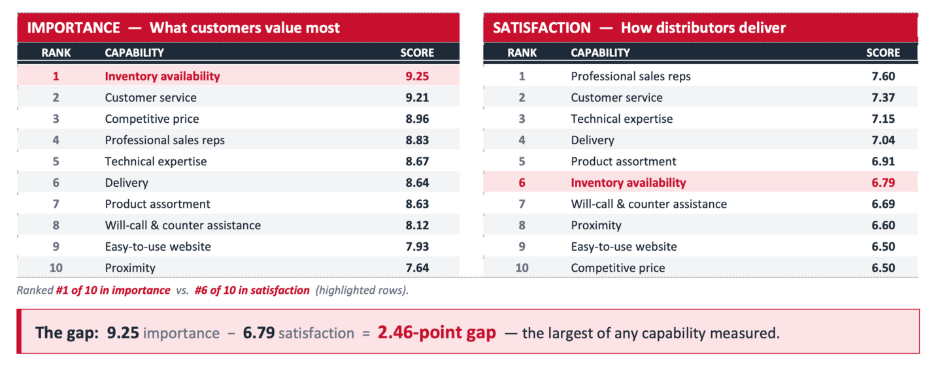
The number one capability customers weigh when choosing a supplier—ranked first of ten, with an importance score of 9.25 out of 10—is inventory availability. The most physical, most capital-intensive thing a distributor does. The precise asset McKinsey advises distributors not to expand.
Now the uncomfortable part: satisfaction with inventory availability scores just 6.79, sixth of ten. That 2.46-point gap between what customers want most and what they’re getting is the widest in our entire benchmark. Among construction customers, it stretches to 2.70. So the data cuts two ways. It confirms that availability is where distributor value lives—and it warns that distributors are underdelivering it. A gap like that is the open door competitors can walk through. The answer to it is not “expand digitally without expanding your physical footprint.” The answer is to get dramatically better at the thing your customers just told you matters most.
We see the same picture at ground level. We recently completed channel research in one distribution vertical for its trade association—executive interviews, site visits, and a survey of 202 channel participants, most of them the dealers who buy from distributors every day. They ranked parts and inventory availability as the most valuable thing distributors provide. Asked which capabilities would be most expensive for manufacturers to replicate internally at scale, they pointed to inventory investment and regional stocking. And when we asked what typically happens when manufacturers bypass distributors, “worse overall” was the runaway top answer—almost no one said the channel would work better without distributors. One respondent wrote: “In my 35 years in this industry, no manufacturer has been successful in this area.” We’re about to field similar research in a second vertical for another trade association. I’ll let you know if the story changes. I doubt it will.
The Real Predator
None of this means distributors are safe. Share is shifting—just not to manufacturers. Amazon Business went from $1 billion in 2015 to $60 billion today, by Amazon’s own announcement, and it wins exactly where the three capabilities are the whole game: simple products, simple transactions, no human touch required. But losing share to Amazon Business is not disintermediation. It’s losing to a better intermediary—one that out-executes on assortment, ordering and delivery at a scale no regional player can match. Go back to that satisfaction gap: Amazon Business grows in the space between what customers want and what distributors deliver. McKinsey looked at a real wound and named the wrong predator. The competitive threat to distributors is intermediary versus intermediary. Manufacturers going direct is a sideshow—with one important exception.
How Manufacturers Actually End Up Direct
Manufacturers don’t build direct channels because consultants tell them to. They end up direct because someone encourages them to build the capabilities. And too often, that someone is their distributor.
Here’s how it happens. A distributor, looking for superior returns on working capital (often PE-backed and obsessed with ROIC), tells a supplier…” I want you to ship the rest direct for me.” It feels like smart inventory management. But look at what the distributor just did: they asked the manufacturer to invest capital in pick, pack, ship, and small-order logistics—the exact capabilities the manufacturer hadn’t refined, and the distributor’s margin depended on. Once that investment exists, the manufacturer starts looking for ways to improve its return. And the shortest path to better utilization of small-order fulfillment capacity is selling on Amazon Business, where third-party sellers already account for more than half the volume.
Our vertical research caught the motive from the other side: when we asked manufacturers what tempts them to go direct, the top answer was margin pressure—not distributor failure. They see your margin. They don’t see your costs. The manufacturers I talk to who understand those costs tell me they’d rather participate on Amazon Business through their distributors, or with a 3PL, than build the capabilities themselves—because Amazon’s performance standards demand distribution muscle as strong as a great distributor’s. The barrier protecting distributors isn’t the platform. It’s the operational capability. Every direct-ship request chips away at that barrier using the distributor’s own volume as the training program.
McKinsey Refutes McKinsey
Here’s the strangest part of the article. The body of McKinsey’s own direct-to-consumer section says leading distributors are “doubling down on what makes them unique by expanding their assortment, building their technical expertise, expanding their logistics infrastructure, and deepening their customer relationships.” Expanding logistics infrastructure is expanding physical footprint. The section’s only case study is a distributor that stopped a supplier’s direct move cold by pointing to more than $50 million in accessory inventory held locally—inventory the supplier’s customers couldn’t keep projects on schedule without. And the article’s fifth theme, “trust is the new premium,” lists product availability first among the things customers expect distributors to deliver. All of that is correct. All of it refutes the theme-four prescription. The exhibit says don’t expand the footprint; the evidence underneath it says the footprint is the leverage.
Louis Stern and Adel El-Ansary laid down the governing principle in their classic Marketing Channels back in 1977: the value-added functions of a wholesale distributor—inventory holding, bulk-breaking, credit, market coverage, technical support and the rest—will be performed by someone in the channel. You cannot eliminate them. You can only reassign them. And whoever performs them gets paid for them.
That’s why “expand digitally without expanding your physical footprint” is a polite way of saying “perform fewer functions.” We already know what a distribution business that performs few functions and holds no inventory risk is worth, because it exists: it’s called a manufacturer’s rep. Reps earn a fraction of distributor margins and sell their firms for roughly one year’s commissions—because they own no inventory, no credit book and no logistics assets. Strip the inventory out of a distributor and you haven’t created an asset-light innovator. You’ve created a rep with an ecommerce site.
What to Do Instead
First, hold onto your functions—and perform them better. Inventory risk isn’t a burden to engineer away; it’s the price of admission and the source of the margin. The 2.46-point availability gap in our data is not an argument for carrying less inventory. It’s an argument for carrying smarter inventory—better forecasting, better analytics, better positioning—because customers have told us definitively that availability is why they choose distributors.
Second, watch the drift. Before you ask a supplier to direct-ship your tail, ask what they’ll do with that capability once they’ve built it. You already know the answer.
Third, fight the real fight. Amazon Business wins on simple, and it keeps using AI to reclassify complex as simple. Your defense is deepening complexity—services, integration, technical depth, being embedded in the customer’s operations—faster than technology commoditizes it.
Manufacturers rarely disintermediate distributors. Far more often, distributors do it to themselves—one shed function, one direct shipment at a time.
Share this article:
