



Why This Matters to Distributors: AI is moving deeper into distribution sales, but new research from Phocas Software shows many distributors still do not track basic measures such as win rates, forecast accuracy and customer retention. The findings also show that technology has yet to displace the traditional foundations of distribution sales: field representatives, product knowledge, and customer relationships.
Half of distributors are using artificial intelligence in sales, even as sizable percentages still do not measure some of the basic metrics needed to determine how effectively their sales organizations are performing, according to new research from Phocas Software.
Phocas, a business intelligence and financial planning and analysis software provider that serves wholesale distributors and other midmarket companies, surveyed more than 100 distribution sales professionals for its State of Sales in Distribution 2026 report. The research examined sales priorities, performance measurement, technology adoption, and the changing role of sales representatives.
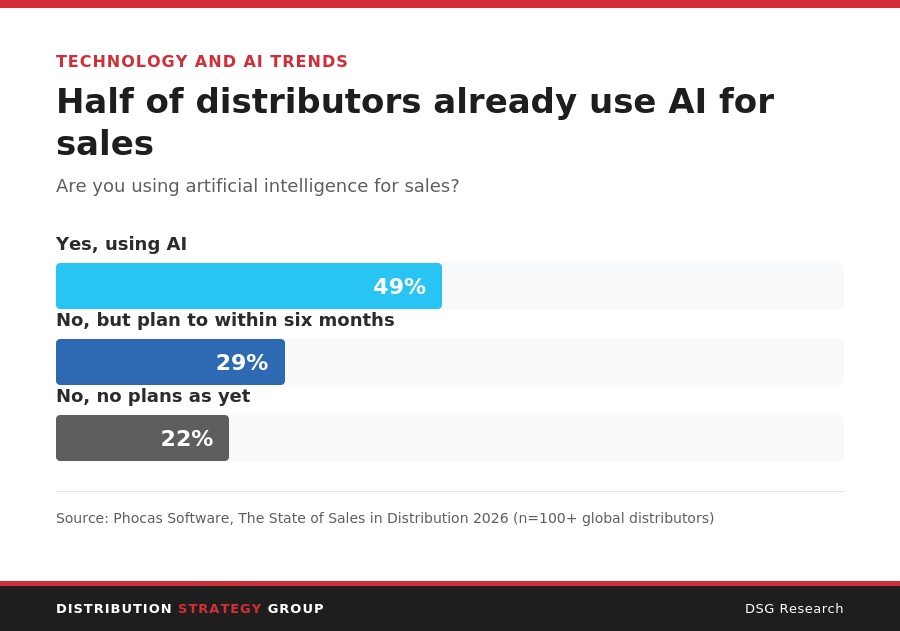
The report found that 49% of respondents are already using AI for sales, while another 29% plan to begin using it within six months. Twenty-two percent said they have no current plans to adopt AI.
But the report also identified substantial gaps in how distributors measure sales performance.
34% do not measure new-business win rates, while 32% do not measure win rates for existing accounts. Twenty-seven percent do not measure customer retention.
Forecasting presents another gap. 22% said they do not track forecast accuracy, while another 17% do not know how accurate their forecasts are. Among all respondents, 20% said their forecasts are off by more than 10%.
The results show that AI adoption is advancing even as some distributors continue to work on more fundamental sales-management issues, including measurement, customer relationship management adoption, and account prioritization.
Among distributors already using AI, 40% said greater collaboration across the business is the capability that would most improve their sales teams. Distributors that have not adopted AI were more focused on CRM adoption and determining which accounts sales representatives should prioritize.
Growing revenue from new customers was the top sales priority for 39% of respondents over the next 12 months, narrowly ahead of expanding revenue from existing accounts at 34%. Improving sales productivity, reducing customer churn, and improving margins ranked lower.
Distributors focused on acquiring customers also were more likely to measure the results. 87% of distributors prioritizing new-customer growth track their new-business win rate, compared with 46% of those focused on expanding existing accounts.
Overall, however, more than a third of respondents do not measure new business win rates. Among those that do, 27% said they close at least half of their new-business quotes.
Existing account close rates were higher. 38% of respondents said they close at least 80% of quotes for existing customers, although 32% do not measure that metric.
The survey also found signs of higher order values. Forty-six percent of respondents said average order values increased during the previous 12 months, while 37% reported no change and 10% reported a decline.
Despite increased investment in AI and other sales technology, distributors continue to rely heavily on field sales.
55% of respondents identified field or outside sales as their most effective sales channel. Twenty-seven percent said their sales channels perform consistently, while 9% selected inside or telephone sales and 5% selected e-commerce.
Product expertise also remains central to the sales role. 75% selected strong product and usage knowledge as one of the three attributes needed to be an effective sales professional. Long-term relationship management ranked second at 57%, followed by efficient sales activity management and follow-through at 41% and using data and insights to make sales decisions at 39%.
Customer priorities varied by distribution market. Overall, 35% of respondents said customers value service and business relationships most, compared with 30% who selected the best price.
Consumer goods were the only sector in which price ranked first outright, with 50% selecting it. Electrical and building materials and lumber respondents were more likely to identify faster quotes and orders as the leading customer priority, while heating, ventilation, air conditioning and refrigeration and plumbing, and industrial machinery respondents leaned more heavily toward service and relationships.
The survey found inconsistent use of customer relationship management systems. Only 34% of distributors with CRM systems said their sales teams log at least 75% of customer interactions. When respondents were asked which single capability would have the biggest impact on their sales organizations, 27% selected better CRM adoption, followed by greater collaboration across the business at 24% and better account prioritization at 20%.
The findings suggest that some distributors are adding AI before fully integrating earlier generations of sales technology into their operations.
Pricing and quoting systems and spreadsheets remain among the tools distributors use most frequently. Spreadsheets are used by 68% of respondents, but only 32% of those users rated their impact as high. General-purpose AI tools such as ChatGPT and Claude have reached the same adoption level as CRM among respondents, according to Phocas.
When asked where AI offers the biggest sales opportunity, respondents most frequently identify finding opportunities and prioritizing accounts. Broader data analysis and reporting ranked second, followed by automating CRM logging and administrative tasks.
The respondents also reflect the small sales organizations common across distribution. 76% work on sales teams with fewer than 20 representatives, while 26% have worked in distribution sales for at least 26 years. 52% of respondents work for family-owned businesses.
The report coincides with the release of Phocas Sales Performance Suite, a new sales product aimed at distribution companies.
The company said the software analyzes sales and customer information to identify which customers representatives should contact and what products they should consider selling. Sales representatives can then record and act on those recommendations, while managers can track sales activity and whether teams are progressing toward their targets.
The product extends Phocas’ existing business intelligence, planning and analytics capabilities into day-to-day sales execution, with an emphasis on account prioritization, product recommendations, and sales performance tracking.
Its release comes as Phocas’ own research identifies a broader issue for distributors adopting AI: New sales technology is becoming more common, but many companies still lack consistent measurement of win rates, forecast accuracy, customer retention and other metrics needed to determine whether sales performance is improving.
Do not miss any content from Distribution Strategy Group. Join our list.
Share this article:
