



Why This Matters to Distributors: Second-quarter results are drawing a sharper line across wholesale distribution. Data centers, infrastructure, industrial maintenance, and automation are generating stronger demand, while discretionary and consumer-driven markets remain uneven. At the same time, market-share gains, pricing discipline, productivity, and M&A are becoming increasingly important growth levers heading into the final months of 2026.
Second-quarter earnings from some of the largest U.S. distributors are providing a clearer picture of where wholesale distribution is headed through the rest of 2026: Demand is improving, but the gains are concentrated and increasingly dependent on where distributors compete.
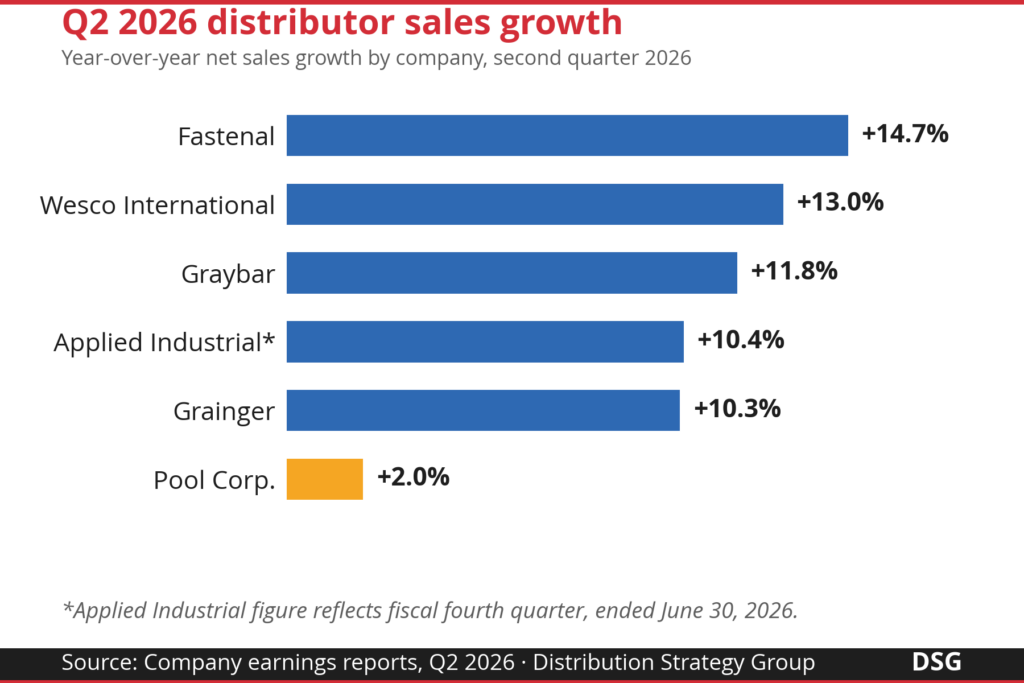
Results from W.W. Grainger, Fastenal, Wesco International, Graybar, Applied Industrial Technologies and Pool Corp. show stronger activity across industrial maintenance, data centers, electrical infrastructure, utilities, automation, and large national accounts. Distributors with greater exposure to discretionary construction and consumer spending continue to face softer conditions.
The divide is becoming difficult to ignore.
Rather than a broad economic rebound lifting the industry evenly, the second half is shaping up as a market where end-market exposure, customer mix, and the ability to take share could matter more than overall economic growth.
Wesco’s data center run extends to a fourth straight quarter
Wesco International offers one of the clearest examples.
The Pittsburgh-based electrical, communications and utility distributor reported record second-quarter net sales of $6.7 billion, up 13% from a year earlier, with organic sales also up 13%. Data center sales reached $1.5 billion, up approximately 45%, while total company backlog increased about 60% to a record level.
“We have now posted four consecutive quarters of double-digit sales growth fueled by data centers,” said John J. Engel, Wesco’s chairman, president, and CEO.
But Wesco’s growth extends beyond data centers.
“Beyond our outsized growth in data centers, demand remained strong across the rest of our diversified portfolio and end markets as customers continue to invest in major infrastructure projects,” Engel said.
Wesco also secured a multi-year grid services award from a hyperscale data center customer during the quarter, extending its Utility and Broadband Solutions business further into power infrastructure. Backlog in that segment increased about 80% year over year, while backlog in Communications and Security Solutions, which includes much of Wesco’s data center exposure, increased approximately 95%.
The numbers show how data center investment is spreading across distribution categories. The buildout requires electrical equipment, power distribution, cooling, networking, security and other infrastructure products and services.
For electrical and industrial distributors, data centers are becoming part of a broader infrastructure spending cycle that includes utilities, grid modernization, and industrial investment.
Industrial demand gains momentum
Industrial distributors are also reporting evidence that the prolonged period of sluggish manufacturing activity is easing.
Fastenal reported second-quarter net sales of $2.39 billion, up 14.7% from $2.08 billion a year earlier. Net income increased 15.9% to $382.8 million.
The Winona, Minnesota-based distributor attributed the increase primarily to market-share gains, pricing actions, and a modest improvement in industrial production.
Heavy manufacturing, Fastenal’s largest end market at 44.1% of sales, grew 18.1% on a daily basis. Nonresidential construction daily sales increased 17% for a second consecutive quarter, with strength concentrated in electrical, utility, infrastructure, and data center-related activity.
Applied Industrial Technologies sees a similar acceleration, although its fiscal calendar runs three months ahead of the standard calendar quarter.
For its fiscal fourth quarter ended June 30, the Cleveland-based distributor reported net sales of $1.353 billion, up 10.4% from $1.225 billion a year earlier. Net income increased 13.2% to $118.6 million from $107.8 million. Organic sales increased 9.7%.
Organic sales increased 12.9% in Applied’s Engineered Solutions segment and 7.9% in Service Center Based Distribution.
“We had a strong finish to fiscal 2026 with fourth quarter sales, EBITDA and EPS achieving record quarterly levels and exceeding our expectations,” CEO Neil Schrimsher said. “Organic sales growth of 10% was the strongest in more than three years with trends strengthening across both segments.”
More important for the months ahead, the improvement has continued.
Applied entered its fiscal 2027 first quarter with organic sales running approximately 7% above the prior year. The company expects fiscal 2027 sales growth of 4% to 6.5% and continues to see opportunities tied to automation, industrial system upgrades, technical support requirements, and infrastructure investment.
Taken together, Fastenal and Applied provide some of the clearest evidence yet that industrial demand is improving after an extended period of sluggish activity.
Market-share gains are becoming a bigger growth driver
The earnings reports also reveal another important trend: Some of the largest distributors are growing considerably faster than their underlying markets.
Fastenal’s 14.7% sales increase was driven partly by deeper penetration of large customers. The number of customer sites spending at least $50,000 per month increased 16.5% to 3,125. Revenue from those sites grew more than 26% and represented 57.9% of quarterly sales.
Digital sales, combining Fastenal Managed Inventory technology and eBusiness platforms, represented 61.6% of total sales.
The takeaway is significant: Fastenal does not need industrial production to grow at a double-digit rate to produce double-digit sales growth. It can take business from competitors and capture more spending from existing customers.
Wesco is pursuing a similar strategy through its One Wesco cross-selling initiative, combining electrical, communications, utility, and supply chain capabilities across large customer relationships.
That competitive dynamic is likely to intensify through year-end.
Large national and regional distributors increasingly have the product breadth, digital capabilities, inventory programs, technical expertise, and geographic coverage to consolidate customer spending that previously flowed through multiple suppliers.
For smaller distributors competing primarily on product availability and price, that raises the stakes.
Grainger raises its 2026 outlook
Grainger’s results reinforce the stronger demand picture.
Second-quarter net sales reached $5.02 billion, up 10.3% from $4.55 billion a year earlier. Net earnings increased 18.3% to $570 million. On a daily, organic, constant-currency basis, sales increased 13.7%.
Grainger’s High-Touch Solutions North America segment increased sales 11.9%, driven by higher volume and prices, including tariff-related increases.
CEO D.G. Macpherson said the company is seeing enough momentum to raise its full-year outlook.
“Looking ahead, we are increasing our outlook to reflect our strong first half performance and the continued momentum we are seeing across the demand environment,” Macpherson said.
Grainger now expects 2026 sales of $19.4 billion to $19.7 billion, representing growth of 8.4% to 10%. Its previous forecast called for sales of $19.2 billion to $19.6 billion and growth of 6.7% to 9.1%.
The momentum carried into July. Grainger said preliminary July sales increased more than 13% on a daily, organic, constant-currency basis. The company is also planning a September pricing action expected to add approximately 1% to annual revenue as it works to offset rising freight costs and tariff-driven product inflation.
Because Grainger serves customers across a broad range of industries, the higher outlook adds to evidence that improving demand is extending beyond a handful of specialized markets.
Electrical distribution remains one of the strongest markets
Graybar also reported record second-quarter results.
The St. Louis-based electrical, communications and industrial distributor generated net sales of $3.8 billion, up 11.8% from a year earlier. Net income increased 14.8% to $158.6 million from $138.2 million, marking the highest quarterly sales and earnings in the employee-owned company’s history.
For the first six months of 2026, net sales increased 12.1% to $7.1 billion, while net income increased 25.7% to $300.5 million.
“Achieving record second quarter results reflects the dedication of our employees and their commitment to delivering the best customer experience in the industry,” CEO Kathleen Mazzarella said. “These results also demonstrate the strength of our long-term strategy and the disciplined execution of key priorities across our business.”
Graybar is also expanding through acquisitions. The company added American Electric Supply during the quarter, strengthening its Southern California presence after acquiring Broken Arrow Electric Supply and its seven Oklahoma locations in March.
Taken together, Graybar and Wesco provide compelling evidence that electrical distribution remains one of the industry’s better-positioned sectors.
Electrical distributors sit at the intersection of several major investment cycles, including data centers, power generation and distribution, grid modernization, industrial automation, and infrastructure construction. Those markets appear positioned to remain important growth drivers through the end of 2026.
Tariffs put pricing back in focus
The second-quarter results also show pricing becoming a larger contributor to distributor sales growth.
Fastenal estimated pricing contributed 2.9 percentage points to second-quarter sales growth, compared with approximately 1.4 to 1.7 percentage points a year earlier.
Grainger also reported higher prices as tariff-related costs moved through the supply chain.
That makes headline sales growth increasingly important to dissect.
Part of the growth is coming from higher unit volume and market-share gains. Another part is coming from price increases.
And distributors are not necessarily retaining all those increases.
Fastenal’s gross margin declined 75 basis points to 44.6%. The company said an unfavorable net price-cost relationship accounted for about 40 basis points of the decline, with customer mix, rebates and higher transportation and fuel costs accounting for the remainder.
Pool Corp. reported a similar issue. Gross margin declined 30 basis points to 29.7%, primarily because of higher inbound freight costs and customer mix, partially offset by supply chain initiatives.
The challenge through year-end will be balancing higher selling prices against product, tariff, and transportation costs without weakening demand.
Productivity becomes the margin lever
Fastenal’s quarter also illustrates how distributors are responding to those pressures.
Despite the decline in gross margin, Fastenal maintained an operating margin of 21%. Selling, general and administrative expenses fell to 23.5% of sales from 24.4% a year earlier, an 80-basis-point improvement the company attributed to increased labor productivity and better leverage of fixed costs.
That dynamic could become increasingly important across wholesale distribution.
If product margins remain under pressure from tariffs, freight and large-account pricing, distributors will need to generate more revenue without allowing labor and operating costs to rise at the same pace.
That puts greater emphasis on warehouse automation, digital ordering, artificial intelligence, sales productivity, automated customer service, and inventory management.
For many distributors, protecting margins through the rest of 2026 could depend as much on operating productivity as on pricing.
Discretionary markets remain the weak spot
Pool Corp.’s results show why the second-quarter numbers should not be interpreted as evidence of a broad distribution boom.
The Covington, Louisiana-based swimming pool and outdoor-living products distributor reported second-quarter net sales of $1.8 billion, up 2% from a year earlier. Gross profit increased 1% to $540.8 million.
Management said maintenance demand remained steady and building-material sales improved, but discretionary spending remained muted. Europe was a bright spot, with sales increasing approximately 11%.
The distinction is important.
Customers continue to spend on maintaining existing assets. Industrial facilities are investing in productivity and automation. Large infrastructure projects are moving forward. Data center construction remains strong.
Spending that can be delayed remains less consistent.
Distributors heavily exposed to residential remodeling, discretionary construction and consumer-dependent markets could therefore face a much different finish to 2026 than Wesco, Graybar, Grainger, Fastenal and Applied.
M&A remains a growth strategy
Acquisitions also remain central to distributor growth.
Applied ended fiscal 2026 with what Schrimsher described as an active acquisition pipeline and expects M&A to remain part of its path toward $7 billion in annual sales.
Graybar completed multiple acquisitions during the first half of the year as part of its strategy to strengthen regional coverage.
Pool Corp. CEO John Watwood has also identified disciplined M&A as one of the company’s four strategic priorities, along with sales execution, pricing, and supply chain management.
The conditions continue to favor consolidation.
Many distribution markets remain fragmented, while the investments required to compete in technology, automation, inventory, digital capabilities, and technical talent continue to rise.
That increases the value of scale and gives larger distributors another avenue for growth even when underlying markets remain uneven.
What Q2 says about the rest of 2026
Taken together, second-quarter earnings point to a wholesale distribution market that is gaining momentum but becoming more divided.
Industrial demand is improving. Fastenal and Applied are reporting stronger manufacturing and maintenance activity after an extended period of sluggish industrial conditions.
Infrastructure remains a major growth engine. Wesco’s approximately 45% increase in data center sales and 60% increase in total backlog illustrate the scale of investment moving through electrical, utility and communications channels.
Pricing is contributing more to reported growth. Tariffs are pushing prices higher, making organic volume, customer activity and market-share gains increasingly important measures of underlying demand.
Margin pressure has not disappeared. Freight costs, tariffs, and large-account mix are weighing on product margins even as sales accelerate.
Market-share gains are separating the strongest distributors from the broader market. Fastenal’s large-account growth, Wesco’s cross-selling strategy, and double-digit growth across several major distributors show that competitive gains are contributing materially to results.
Technical capabilities are becoming more valuable. Applied’s strength in engineered solutions, automation and technically demanding applications underscores the growing value of distributors that provide expertise and services beyond product fulfillment.
And discretionary markets remain the weak spot. Pool Corp.’s results show that customers remain cautious about spending that can be postponed.
The message from Q2 is not that the entire distribution market is accelerating.
It is that the industry’s growth lanes are becoming much easier to identify.
Through the final months of 2026, demand appears strongest around infrastructure, data centers, industrial maintenance, automation, and investments tied directly to productivity and operating requirements. Customers remain more cautious about discretionary projects.
At the same time, the largest distributors are using technology, technical expertise, strategic accounts, and acquisitions to grow faster than their underlying markets.
That may be the most consequential signal coming out of the second-quarter earnings season.
Wholesale distribution is entering the final stretch of 2026 with stronger demand than it had at the beginning of the year. But the gains are not being distributed evenly — and the gap between companies positioned in the strongest end markets and those waiting for a broader economic recovery is likely to remain wide.
Do not miss any content from Distribution Strategy Group. Join our list.
Share this article:
