


Why This Matters to Distributors: Distributors are not broadly preparing for a downturn. More than 80% of respondents are maintaining or increasing inventory, while 96% expect fourth-quarter sales to increase or remain flat from a year earlier. But competitive pressure is intensifying. Online competitors are now the most frequently cited source of lost business, and 81% of respondents say competitors are primarily or mostly competing on price. That puts pressure on distributors to defend margins while improving the digital capabilities customers increasingly expect.
Wholesale distributors are heading into the fourth quarter with stable sales expectations and little evidence of a broad inventory pullback, even as ecommerce competitors capture more business and price competition intensifies.
Half of distributors surveyed by the American Supply Association expect fourth-quarter sales to increase from a year earlier, while 46% expect sales to remain flat. Just 4% anticipate a decline, according to the association’s latest Quarterly Market Survey.
The survey included 56 distributor respondents in the plumbing, heating, cooling, piping and industrial pipe, valves, and fittings markets. The questions were submitted by ASA member distributors and covered sales, margins, end markets, inventory strategy, and competitive pressures.
Recent sales results support the stable outlook. Half of respondents said overall sales volume increased during the previous two quarters. That included 29% reporting growth of at least 10% and 21% reporting increases of 3% to 9%. Another 32% said sales were flat, while 18% reported declines.
Growth, however, varies by end market. Commercial new construction was the most frequently cited growth segment, selected by 57% of respondents. Residential remodeling and repair followed at 48%, while 36% reported growth in residential new construction.
Maintenance, repair, and operations was identified as a growth market by 23% of respondents. Industrial and commercial remodeling were each cited by 21%, followed by data centers at 18%, health care at 16%, and education and infrastructure or public projects at 14% each.
Residential construction showed some of the sharpest differences among respondents.
Although 36% identified residential new construction as a growth market, 48% also named it as the segment experiencing the biggest slowdown. Commercial new construction was next at 20%, while 21% said they were not experiencing a significant slowdown.
The results point to uneven conditions for the company and market rather than a broad-based shift in demand. Inventory strategies also suggest most distributors are not anticipating a significant deterioration in demand.
Forty-three percent of respondents said they are increasing inventory to support growth, while 39% are maintaining current levels. Combined, 82% are either adding inventory or holding it steady.
Only 9% said they are reducing inventory to improve cash flow, while another 9% are cutting inventory because of weaker demand. The willingness to maintain inventory comes despite substantial pricing pressure.
Eighty-one percent of respondents described competitors as primarily or mostly competing on price. Another 12% said competitors were equally focused on price and service, while 7% said competitors mostly compete with service and value.
Asked where competitors outperform their companies, 52% cited lower prices, making it the most common response. Marketing and branding followed at 30%, while 23% pointed to a better digital experience.
Margins have remained stable despite those pressures. Forty-one percent said gross margins were about the same, and 27% reported slight improvement. Twenty-nine percent reported slight declines, while 4% said margins had declined significantly. No respondents reported significant margin improvement.
Distributors also are passing most supplier price increases through to customers. Forty-five percent said they are passing through all increases, while another 45% said they are passing through most.
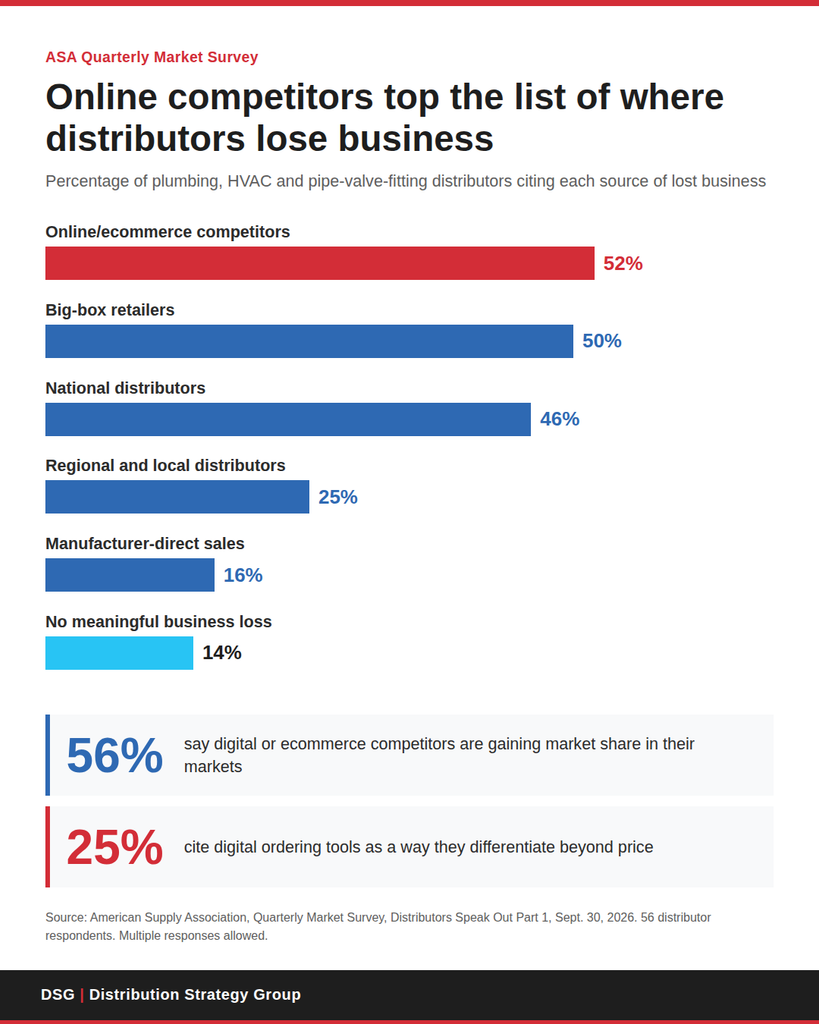
Ecommerce produced one of the survey’s clearest competitive signals. Fifty-two percent of respondents said they are losing business to online or ecommerce competitors, the highest percentage for any competitor category.
Big-box retailers followed at 50%, while 46% cited national distributors. Regional and local distributors were identified by 25% of respondents, and 16% cited manufacturers selling directly. Fourteen percent said they were not experiencing meaningful business losses.
More than half of respondents also believe digital competitors are gaining market share.
Fifty-six percent said digital or ecommerce competitors are gaining share in their markets. That included 7% who said the gains are significant and 49% who said digital competitors are gaining.
Twenty-nine percent said they were not seeing digital competitors gain share, while 15% were unsure.
The results also highlight a gap between the source of competitive pressure and how distributors differentiate themselves. Only 25% cited digital ordering tools as a competitive differentiator. Instead, distributors overwhelmingly pointed to more traditional strengths.
Local relationships led at 91%, followed by superior customer service at 89%. Technical expertise was cited by 68%, product availability by 61%, faster delivery by 52% and value-added services by 50%. Training and education were selected by 43%.
The survey suggests distributors are entering the final quarter of 2026 with demand holding up but competition is becoming more difficult. Most expect sales to grow or remain stable, and few are cutting inventory. At the same time, distributors report widespread price competition and growing pressure from ecommerce companies.
That combination puts more emphasis on the ability to maintain product availability and service while competing for customers who increasingly have digital alternatives.
ASA said it plans to release the second part of its Quarterly Market Survey later this fall.
Do not miss any content from Distribution Strategy Group. Join our list.
Share this article:
