



Why This Matters to Distributors: Wholesale sales are growing much faster than inventories, suggesting distributors are maintaining leaner stock levels while demand remains resilient heading into the second half of 2026.
U.S. wholesale sales remained sharply higher than a year earlier in June despite a month-over-month decline, while inventories continued to grow at a much slower pace, signaling healthy product movement across the distribution sector.
Merchant wholesaler sales totaled $794.1 billion in June, down 3.0% from May but up 14.1% from $696.0 billion in June 2025, according to the U.S. Census Bureau’s Monthly Wholesale Trade Report released Thursday. May sales were revised upward to a 3.5% monthly increase from April.
The report adds to evidence from second-quarter earnings that demand has remained resilient across much of the wholesale distribution industry, even as growth has become more uneven across end markets.
Inventories totaled $944.7 billion at the end of June, up 0.2% from May and 4.2% from $906.4 billion a year earlier. The Census Bureau said the monthly inventory increase was not statistically significant.
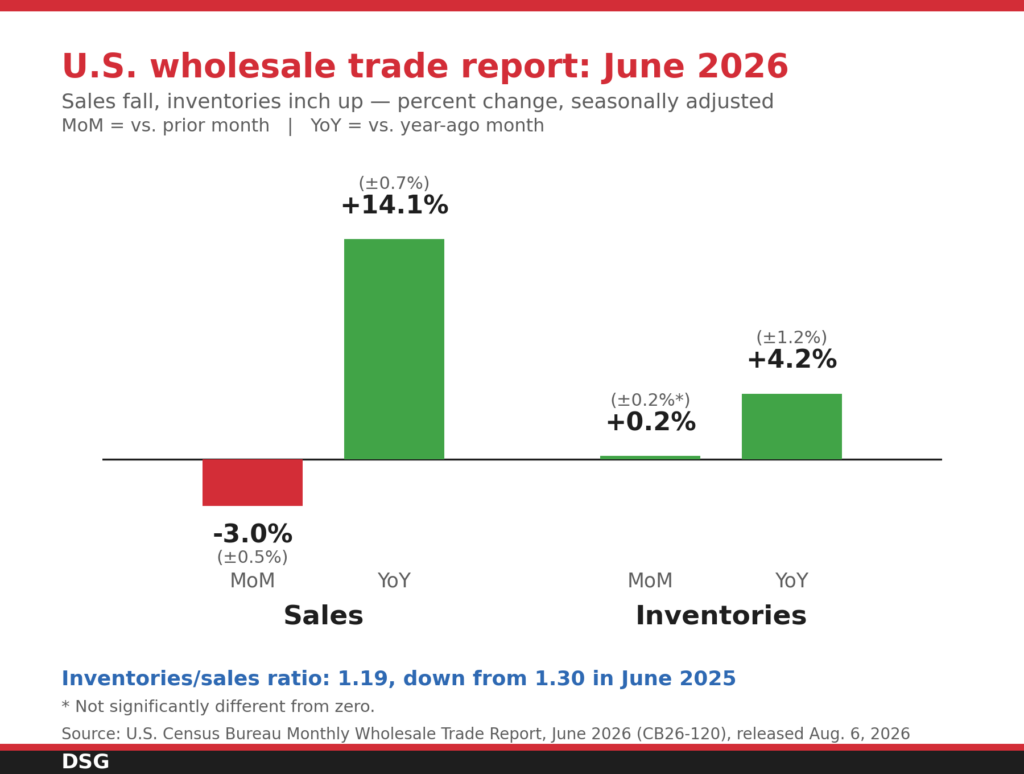
For distributors, the more significant trend is the widening gap between sales growth and inventory growth. While sales increased 14.1% from a year ago, inventories grew just 4.2%, indicating wholesalers are moving product considerably faster than they are adding inventory.
That trend pushed the inventories-to-sales ratio to 1.19 in June, down from 1.30 in June 2025. The ratio measures how many months it would take wholesalers to sell existing inventory at the current sales rate. A lower ratio generally indicates inventory is turning more quickly and less capital is tied up in warehouse stock.
The June data align with results reported this week by several publicly traded distributors, including W.W. Grainger, DXP Enterprises, DNOW and Henry Schein, which cited steady customer demand, market share gains and disciplined inventory management despite ongoing uncertainty in manufacturing and construction markets.
The Census report also suggests distributors entered the second half of 2026 with relatively lean inventories, providing flexibility should demand strengthen later in the year. At the same time, companies will need to balance inventory efficiency against the risk of supply disruptions or unexpected increases in customer orders.
The wholesale trade report measures sales and inventories of merchant wholesalers but is not adjusted for inflation. As a result, the year-over-year increase reflects both higher selling prices and changes in the volume of goods sold.
The next Monthly Wholesale Trade Report, covering July 2026 activity, is scheduled for release on Sept. 10.
Do not miss any content from Distribution Strategy Group. Join our list.
Share this article:
